



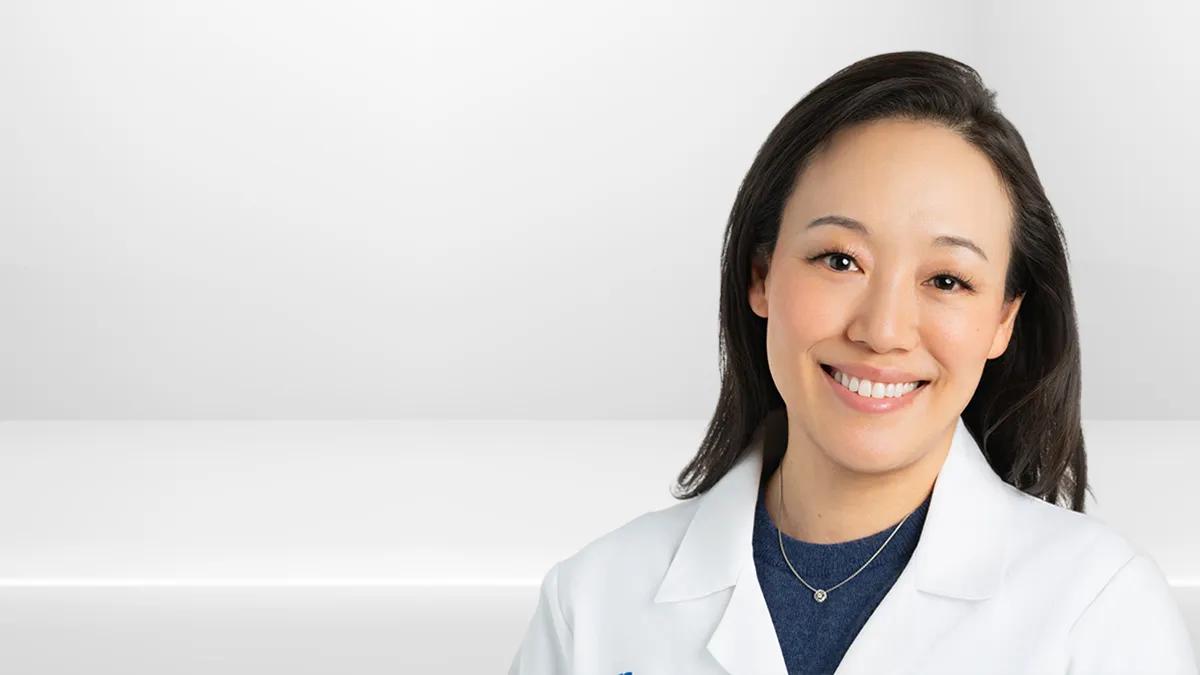
Redefining Resectability in Advanced Rectal Cancer
What happens when a cancer is deemed unresectable? In this episode, Dr. Haniee Chung discusses how multidisciplinary care is expanding treatment options for patients with advanced and recurrent rectal cancer. She highlights the role of tumor board review, neoadjuvant therapy, robotic surgery and specialized supportive services, and explains why referral to a dedicated multivisceral cancer program may uncover options previously thought impossible.
Advertisement
Cleveland Clinic is a non-profit academic medical center. Advertising on our site helps support our mission. We do not endorse non-Cleveland Clinic products or services. Policy
Recent Episodes
Are We Missing Patients? Expanding Germline Genetic Testing in Oncology
As recommendations for germline genetic testing continue to expand, many eligible patients remain untested. In this episode of Cancer Advanc…
Partnering with Classical Hematology: Optimizing Referrals, Diagnostics and Patient Care
Bethany Samuelson Bannow, MD, Director of Classical Hematology at Cleveland Clinic, joins the Cancer Advances podcast to discuss how stronge…
Personalizing Pediatric Cancer Care: The Promise of Precision Oncology
As molecular profiling advances, precision oncology is reshaping cancer care for children, adolescents and young adults. In this episode of…
Video content: This video is available to watch online.
View video online (https://cdnapisec.kaltura.com/p/2207941/sp/220794100/playManifest/entryId/1_mm0i6w37/flavorId/1_5f3sgelj/format/url/protocol/https/a.mp4)
Transcript
Dale Shepard, MD, PhD:
Cancer Advances, a Cleveland Clinic podcast for medical professionals exploring the latest innovative research and clinical advances in the field of oncology. Thank you for joining us for another episode of Cancer Advances. I'm your host, Dr. Dale Shepard, a medical oncologist and Co-Director of the Sarcoma Program at Cleveland Clinic. Today, I'm happy to be joined by Dr. Haniee Chung, Section Chief in the Department of Colorectal Surgery. She is here today to talk about the multivisceral cancer program, so welcome.
Advertisement
Cleveland Clinic is a non-profit academic medical center. Advertising on our site helps support our mission. We do not endorse non-Cleveland Clinic products or services. Policy
Haniee Chung, MD:
Thanks for having me.
Dale Shepard, MD, PhD:
Give us a little bit of an idea what you do here at Cleveland Clinic.
Haniee Chung, MD:
Yeah, I am on staff as a surgeon in the Colorectal Department, so I take care of surgical issues regarding colon, rectum, bowel issues, but specifically with a focus on cancer patients and with an even more specific focus on tackling complex cancer patients, including patients with recurrent rectal cancers.
Dale Shepard, MD, PhD:
All right, going to talk a little bit today about multivisceral cancer resection. Give us a little bit of an idea, a lot of different people might be listening in, what does that mean?
Haniee Chung, MD:
Simply put, it's whenever a cancer has either advanced or started off being very aggressive or treatment has caused enough damage such that removing just that affected organ isn't enough. Adjacent organs, so in the case of rectal cancer, adjacent organs in males, the prostate, in females, the vagina, uterus, sometimes even the bladder may be required to be removed for clean margins with a cancer operation.
Dale Shepard, MD, PhD:
And then I guess when you think about these, imaging's good, but how often when you see a patient, you're talking about surgery, how often do you have to sort of take out more organs than planned? And I'm sure you talk about that ahead of time, but-
Advertisement
Haniee Chung, MD:
Yeah, that's actually one of the challenges of this type of approach, because we do our best to image our patients. And especially for rectal cancer, preoperative MRI and endoscopy findings are very important and they are quite accurate in predicting where the margins will be. So usually we're able to plan ahead and involve other specialists who may be required for multivisceral resection. Sometimes though, we go in thinking that, "Oh, this is going to be clean margins, this is not going to be that bad," and it ends up being worse than we expected, and that requires sort of last minute calling in of favors from our specialists who are operating down the hall.
Dale Shepard, MD, PhD:
Sure. When we think about these sort of complex multivisceral resections, I mean, you're taking out more organs, you're taking out more things. How else do these vary from just standard resections of tumors and organs?
Haniee Chung, MD:
Yeah. When we're doing rectal cancer surgery for patients who do not necessarily need multiple organs resected, usually we're having conversations about sparing function, sparing the organ as much as we can. So trying to put patients back together, avoiding a permanent colostomy, that sort of thing. When we're talking about multivisceral resections, very often, not always, but often we're talking about potentially patients having permanent diversion of both bowel contents and possibly even urine contents, so we're talking about potentially two bags. So it ends up being a very involved conversation with the patients upfront about how quality of life and functional outcomes will be going into the surgery.
Dale Shepard, MD, PhD:
How have you sort of approached this here at the Cleveland Clinic in terms of maybe developing a core group of people to see these patients?
Haniee Chung, MD:
Yeah, and you hit the nail on the head, core group. And multivisceral resections is very much a team approach, so not only is there a lead from the colorectal side, dealing with the rectal cancer expertise, but we need team leads from urology, from gynecology, from sometimes, we even involve our orthopedic oncologists if we need to do bone resections, and very importantly, reconstruction with the plastic surgeons who help us with creating muscle flaps to close the defect once we've done the operation. So it's been exciting, challenging and really collaborative an atmosphere here, meeting all of the folks who are interested in doing this and developing a team mentality.
Dale Shepard, MD, PhD:
What's the role of tumor boards to make a decision on what's needed, who needs to be involved?
Haniee Chung, MD:
Critical. I think anybody with rectal cancer and some colon cancers really should be presented at tumor board, not only for coordinating the sub-specialists within surgery, but making sure that medical oncologists, radiation oncologists, pathologists and radiologists are all involved to, first of all, establish an accurate diagnosis and determine resectability, whether or not patients would benefit from pre or postoperative treatment, additional treatment, and that becomes pivotal in trying to personalize patients' treatments based on their cancer.
Advertisement
Dale Shepard, MD, PhD:
And I guess thinking about that personalization and involving things like medical oncologists, as we get newer and newer therapies, what's the role of giving systemic therapies to try to downstage and save organs and make these surgeries a little bit less complex?
Haniee Chung, MD:
Yeah, absolutely. And there's a lot of data out there that supports neoadjuvant treatment, and so we have been increasingly going towards total neoadjuvant treatment. Historically, we treated rectal cancers by giving radiation followed by surgery. And then based on the final pathology, the patients would get chemotherapy or not. But increasingly in the last 10 to 15 years, we've demonstrated in our literature that trying to give as much of the systemic treatment upfront as possible, especially in patients who have suspected lymph node spread or very bulky tumors that would benefit from radiation followed by some time to downstage and chemotherapy for down-staging directly, all of that has been very well studied. And so we are increasingly going more towards a total neoadjuvant approach and more and more centers across the country are adopting that model.
Dale Shepard, MD, PhD:
And the data looks pretty good for that. We've actually had a couple of podcast episodes where we've talked about that. So if people want to listen in, they can learn more about that specifically. How often do patients need radiation after surgery? You go in, you do a big surgery, you do these multivisceral resections, and then there's a margin issue or things like that.
Advertisement
Haniee Chung, MD:
It's hard to know ahead of time. Sometimes you know going in, that you're going to be leaving very close margins or know you have to leave margins because the tumor's touching vital structures like major blood vessels or nerves. But increasingly, what's happening is we're having to pursue these operations because number one, a lot of young patients are coming to us with these problems and we want to give them a fighting chance to have cure. And if not cure, then at least palliation. So many of these patients present with very debilitating symptoms of pain. They may be obstructed, either their GI system or their urinary system.
And so pursuing these operations for those reasons may lead to suboptimal resections where we know we're leaving cancer behind or we're concerned that we're leaving cancer behind. And so in those cases, it's interesting to be thinking about what's the role of radiation in that. We're fortunate here at the main campus to have access to intraoperative radiation. And so in those cases where we're able to tell real time or even ahead of time that we may benefit from some intraoperative radiation with targeting just kind of that spot where we suspect a positive margin, that's been really helpful to have. And then that's also an opportunity for us to leave clips and markers for the radiation oncologist to target postoperatively.
Advertisement
Dale Shepard, MD, PhD:
You mentioned young onset cancers, and I know we're doing a lot of work here on young onset cancers. Are there other particular social/psychological needs that we've been encountering with these surgeries in those patients?
Haniee Chung, MD:
Sure. I think early on in their diagnosis, young onset patients need a little more time to process and a lot more social support. We're very fortunate to have our Young Onset Colorectal Cancer Center where we have other supportive staff working with these patients to talk about reproductive health concerns, as well as psychiatric concerns early on. Those are automatically generated referrals that patients are referred to when they initially present to us.
Dale Shepard, MD, PhD:
And then just in general, these are very involved surgeries, lots of issues. You mentioned before about ostomies and things. So how are you currently or foreseeing working in more in terms of social work and psychology and rehab and things like that?
Haniee Chung, MD:
Yeah, that's actually very important for our patients. After a major operation like this, mobilizing after surgery is a huge issue. And so we've been working closely with our physical therapists in-house and once the patients are discharged. And so that's a very important service line that helps us. The stoma nurses are very involved from the very beginning where patients come in. They are assessed in terms of where is the optimal position for stomas, and so they're very helpful to us in that way.
And then even postoperatively, patients who have any issues dealing with their stoma complications, if there's issues pouching or even issues in coping, our stoma therapy team is very well-versed in being able to take care of these patients. We also are very fortunate to have a psychiatrist on staff in our department who is very well versed in dealing with patients who deal with chronic issues, but also new diagnosis of cancers, especially in young patients, so we're very fortunate to have that support as well.
Dale Shepard, MD, PhD:
Yeah, that's good. When you think about these are really big surgeries and you talked about early mobilization, just from a very practical standpoint, what does it look like from a patient standpoint in terms of length of stay and that time to get back to function?
Haniee Chung, MD:
Yeah, oftentimes we try to use a minimally invasive approach, even for these big operations. And so that's been helpful to reduce our length of stay. Primarily it has to do with patients' postoperative pain. So even patients who receive open surgery, we work with them on multimodal analgesia, so making sure we minimize narcotics and getting them up early with our physical therapists that are dedicated to these patients, to make sure that they're up and mobilizing.
So from a patient's perspective, yes, you're still coming in for a major operation, but we tend to stress early on that we're going to have you up and moving around day one. And the sooner you get up, the sooner we can get you recovered. And so patients have been very receptive to that and doing quite well. And so what used to be an operation that required patients to be in-house for weeks and maybe even months to recover from, most patients are out of the hospital within about a seven to 10-day window.
Dale Shepard, MD, PhD:
Impressive. Clearly, as a colorectal surgeon, you're mostly seeing colorectal patients and then asking these other groups to come in, these other surgeons to help out with these cases. How often does it work the other way that there are people who, general surgeons or our Gyn/Onc colleagues, and we build these multidisciplinary teams that you get involved in?
Haniee Chung, MD:
Yeah, so cancers affecting the gynecologic tract or the GU tract, those can be quite invasive. And more often, treatment for those cancers can cause issues with damage to the rectum. So in those cases, we get involved. And here, with the orthopedic oncology team being very robust in treating aggressive bony cancers, chondrosarcomas and requiring diversion to try to protect their joint replacements or doing major operations where a complication with injury to the rectum might be very, very morbid, we've been asked to be involved in those cases to divert patients proactively to prevent those complications.
Dale Shepard, MD, PhD:
Again, if we're thinking about people might be listening in, they may see a patient have really widely extensive disease, they're like, "There's no surgical options," who should be seen in your clinic? I mean, what does an ideal candidate look like?
Haniee Chung, MD:
I think honestly, nowadays we are very slow to declare somebody untreatable or unresectable. So if a patient has widely metastatic disease, that obviously falls under the purview of a medical oncologist who would treat the patient systemically. But in cases where patients have stable metastatic disease even, especially if their primary disease is causing a lot of quality of life issues, I think it's reasonable for them to be evaluated.
I think if there's any thought or any interest on the part of the patient to pursue aggressive therapy, and especially if they're young, I think it's very reasonable to send those patients to us more often than not, because especially with multiple specialists on the case, there may be novel ways of approaching the case where something that was deemed untreatable may at least, we may be able to palliate or potentially even treat.
Dale Shepard, MD, PhD:
And I guess just to solidify that, just from a patient selection standpoint, from an education of everyone, do you primarily see that there's maybe under-referral, over-referral, people being sent that you just can't do things with, people that you really wish you would've seen?
Haniee Chung, MD:
Yeah, we see the gamut. But just to give you a little bit of context from my personal experience, one of my very first rectal cancer patients that I took care of out of training was told that he needs palliative chemotherapy and there was nothing that could be done for his rectal cancer. And when we got him in and got him radiated, got some chemo, he actually had very good response. Now, he needed a major operation. He did need a pelvic exenteration, but ended up doing quite well, he survived.
And so for complex patients like that where, especially if the primary tumor looks very impressive on imaging or it's read as being surgically unresectable, then there is a tendency to give the patient the communication that, "Hey, there's not much we can do other than palliative options." But I think that it's those cases that we really want to be able to evaluate and see if there's anything else that we can offer patients.
Dale Shepard, MD, PhD:
Surgeons or innovators, what is coming down the road? You said a lot of these are done as much as possible, minimally invasive. Anything from a surgical side, from a technique standpoint that you'll think will make these cases easier on patients in recovery or outcome, or any technology issues coming along?
Haniee Chung, MD:
I use robotic approaches to some of these patients. So at least the abdominal portion of the operations, being inside the pelvis, it's very helpful to have a robotic approach to be able to visualize all the structures. So that's been an increasingly utilized way of doing these operations. Usually for big operations like this, people just assume, "Oh, I'm going to need a big operation, big open." And that may still be the case, but increasingly, and especially with our colleagues in the urology and the GYN spheres as well, being able to do a lot of these minimally invasively has been helpful to help minimize patients' postoperative pain and ability to mobilize afterwards.
Dale Shepard, MD, PhD:
Well, you're doing important work, sounds like you're making great progress. You got a good group of people to work with. Appreciate you being with us and sharing some insights with us.
Haniee Chung, MD:
Thank you so much for having me.
Dale Shepard, MD, PhD:
To make a direct online referral to our Cancer Institute, complete our online cancer patient referral form by visiting clevelandclinic.org/cancerpatientreferrals. You will receive confirmation once the appointment is scheduled.
This concludes this episode of Cancer Advances. For more podcast episodes, visit our website, clevelandclinic.org/canceradvancespodcast. Subscribe on Apple Podcasts, Spotify, or wherever you listen to podcasts.
Thank you for listening. Please join us again soon.
Recent Episodes
Are We Missing Patients? Expanding Germline Genetic Testing in Oncology
As recommendations for germline genetic testing continue to expand, many eligible patients remain untested. In this episode of Cancer Advanc…
Partnering with Classical Hematology: Optimizing Referrals, Diagnostics and Patient Care
Bethany Samuelson Bannow, MD, Director of Classical Hematology at Cleveland Clinic, joins the Cancer Advances podcast to discuss how stronge…
Personalizing Pediatric Cancer Care: The Promise of Precision Oncology
As molecular profiling advances, precision oncology is reshaping cancer care for children, adolescents and young adults. In this episode of…
Other Podcasts You May Love
Beyond Leadership
Hosts Jim Pae and Elizabeth Pugel escort you through a network of thought leaders, sharing world-cla…

Beyond the Pages: CCJM Podcast
Beyond the Pages: CCJM Podcast takes the listener more in-depth into Cleveland Clinic Journal of Med…

Butts & Guts
A Cleveland Clinic podcast exploring your digestive and surgical health from end to end. You’ll lear…
Cardiac Consult
A Cleveland Clinic podcast exploring heart, vascular and thoracic topics of interest to healthcare p…