Ataxia is when you have problems coordinating how your muscles work, leading to awkward, unwieldy or clumsy movements. A wide range of conditions or circumstances can cause it. Depending on why it happens, it might be possible to treat or reverse the effects of ataxia.
Advertisement
Cleveland Clinic is a non-profit academic medical center. Advertising on our site helps support our mission. We do not endorse non-Cleveland Clinic products or services. Policy
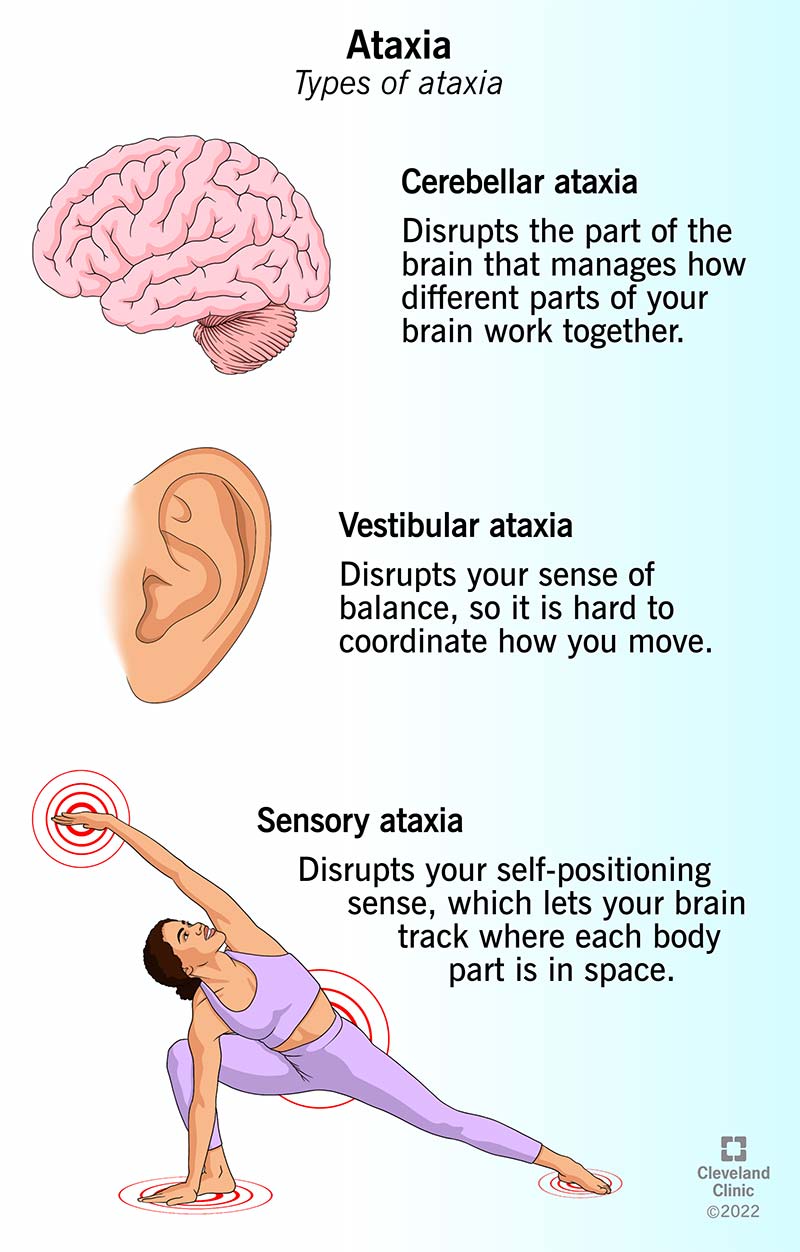
Image content: This image is available to view online.
View image online (https://my.clevelandclinic.org/-/scassets/images/org/health/articles/17748-ataxia)
“Ataxia” is an umbrella term for having uncoordinated movements. The word simply means “lack of coordination.” It’s a sign of a nervous system issue that can happen alongside other symptoms or as the main feature of a condition. Ataxia commonly involves difficulty walking and imbalance. But it can show up in other ways, possibly affecting other actions, depending on the underlying cause.
Advertisement
Cleveland Clinic is a non-profit academic medical center. Advertising on our site helps support our mission. We do not endorse non-Cleveland Clinic products or services. Policy
Ataxia has countless causes. Some are treatable or reversible, while others are permanent. It can develop at any age. Your healthcare provider can help you understand what ataxia means for you.
Ataxia can present in different ways depending on the type. It may involve:
Because ataxia can happen for so many reasons, healthcare providers classify it in different ways.
The three main types of it, based on the location of the issue, include:
Advertisement
Providers also classify ataxia based on how it develops:
In general, ataxia results from damage to your nervous system. In many cases, there’s an issue with your cerebellum or its connections. This is the part of your brain that’s responsible for coordinating your movements. In other cases, issues with your spinal cord or specific nerves (like your vestibulocochlear nerve) can cause ataxia.
Some examples of conditions or situations that can cause ataxia include:
The treatment for ataxia depends on why it happens. Some cases may go away with minor treatment, like those related to alcohol use, gluten, viruses and medications.
Other causes, like genetic or degenerative conditions, aren’t reversible. So, it’s a matter of managing ataxia. For example, physical therapy can help with muscle strength, balance and coordination. And speech therapy can improve how you talk and swallow.
Because each case is different, your healthcare provider is the best person to tell you which treatments are likely to help you.
Being unable to control your movements can disrupt your daily life. It can make everyday tasks difficult. This may lead to complications like depression and social isolation.
Physical complications of ataxia can include:
Not everyone develops these complications. Your risk depends on the underlying cause of ataxia and its severity.
Whether ataxia affects your lifespan depends on why it’s happening. Many of the causes of ataxia — especially the curable or temporary ones — won’t affect how long you live. But some causes, especially genetic forms of ataxia, can shorten your life expectancy.
Advertisement
Your healthcare provider will explain what effect, if any, ataxia may have on your lifespan.
Some causes of ataxia are preventable. But many of these happen unpredictably. Some ways you may be able to prevent acquired ataxia include:
Certain warning signs may mean ataxia is happening because of a more severe problem. You should talk to a healthcare provider if ataxia:
Get medical help right away if ataxia happens with any symptoms of a stroke.
Ataxia and apraxia sound alike and do have many similarities. But there are also key differences:
Advertisement
Ataxia can affect you in a lot of different ways. It can be temporary or permanent and range from mild to severe. If your healthcare provider brings up the term, ask them what it means for you. They can offer ways to treat or manage it and explain how it may affect your day-to-day life.
Advertisement



Sign up for our Health Essentials emails for expert guidance on nutrition, fitness, sleep, skin care and more.
Learn more about the Health Library and our editorial process.
Cleveland Clinic’s health articles are based on evidence-backed information and review by medical professionals to ensure accuracy, reliability and up-to-date clinical standards.
Cleveland Clinic’s health articles are based on evidence-backed information and review by medical professionals to ensure accuracy, reliability and up-to-date clinical standards.
If you have a neurological condition, you want expert advice. At Cleveland Clinic, we’ll work to create a treatment plan that’s right for you.