



Cor triatriatum is a rare congenital heart defect that affects an upper heart chamber — typically the left atrium. A membrane divides the chamber in two. This makes it hard for blood to flow from your child’s lungs out to their body. Symptoms like trouble breathing usually appear early in life. Surgery removes the membrane and restores blood flow.
Advertisement
Cleveland Clinic is a non-profit academic medical center. Advertising on our site helps support our mission. We do not endorse non-Cleveland Clinic products or services. Policy
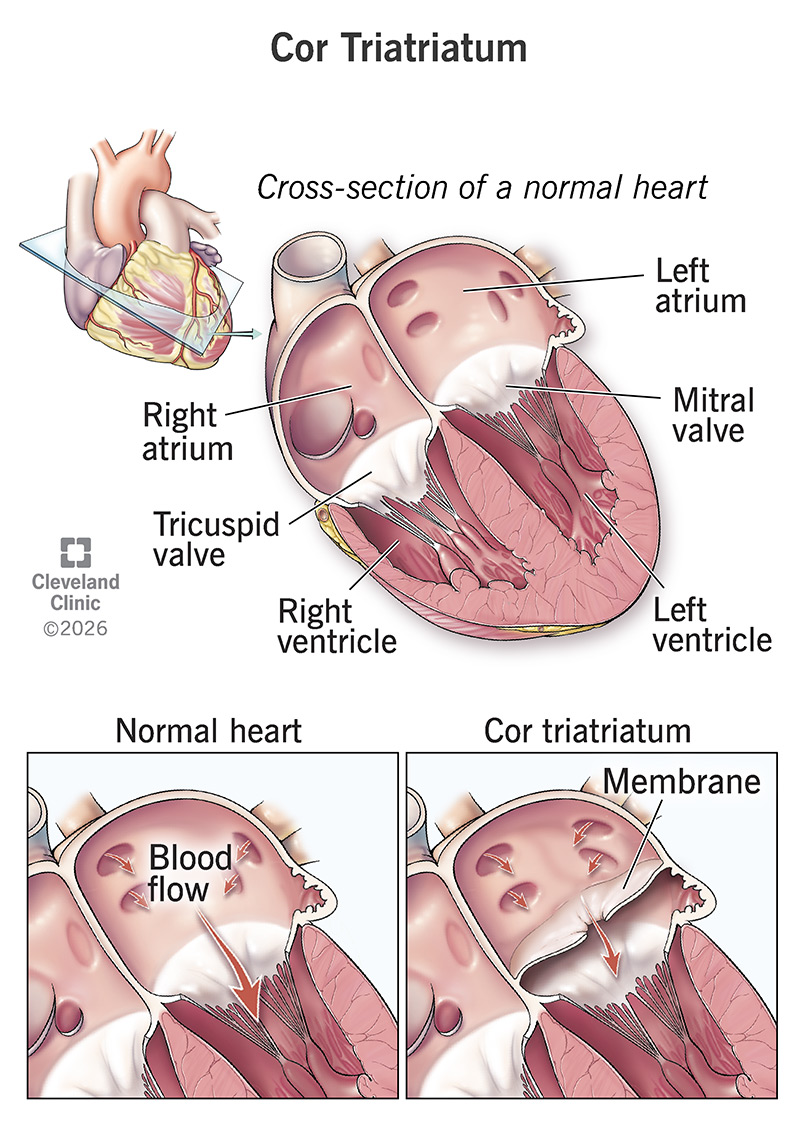
Image content: This image is available to view online.
View image online (https://my.clevelandclinic.org/-/scassets/images/org/health/articles/cor-triatriatum)
Cor triatriatum is a heart defect that’s present at birth (congenital), in which a membrane divides one of your child’s top heart chambers (atria) into two separate sections. This membrane makes it harder for blood to flow normally through your child’s heart. The membrane may have an opening that lets some blood through. But if there isn’t one, or if the opening is small, blood can back up in your child’s heart. This may lead to heart failure and other complications.
Advertisement
Cleveland Clinic is a non-profit academic medical center. Advertising on our site helps support our mission. We do not endorse non-Cleveland Clinic products or services. Policy
On an echo test, cor triatriatum makes it look like your child has three atria, rather than the expected two. That’s how the condition gets its name. Cor triatriatum comes from the Latin for “heart with three atria.”
There are two main types of this condition based on where the membrane is located. With cor triatriatum sinister, the membrane is in the left atrium. With cor triatriatum dexter, the membrane is in the right atrium.
This is a rare condition. Experts estimate that cor triatriatum accounts for 1 to 4 in every 1,000 cases of congenital heart disease.
Symptoms usually appear in infancy or early childhood. Your child may have:
Call a healthcare provider right away if you notice any of these symptoms.
Rarely, this condition causes no symptoms until adulthood. These may include:
Changes that occur during fetal development cause cor triatriatum. These changes result in a membrane forming in one of the top heart chambers.
Advertisement
Experts are still exploring exactly which changes cause cor triatriatum sinister. A leading theory is that the common pulmonary vein doesn’t merge with the left atrium as it should. Something goes wrong in the process. This causes the membrane to form.
With cor triatriatum dexter, fetal heart tissue that normally goes away on its own instead stays in place and forms the membrane.
Cor triatriatum has no known genetic causes. There’s also no evidence that it’s passed down within families (hereditary).
Some babies with cor triatriatum also have other heart defects. These include:
Cor triatriatum disrupts normal blood flow through your child’s heart. This can lead to serious complications, like:
Healthcare providers diagnose cor triatriatum with a physical exam and testing. Your child’s provider will:
Your child may need one or more of these tests:
Healthcare providers sometimes diagnose cor triatriatum in adults. This can happen if symptoms develop or signs appear on an imaging test done for another reason.
There are two main types of cor triatriatum:
Cor triatriatum sinister further breaks down into three groups. These are based on what the membrane looks like:
Advertisement
Groups 1 and 2 are more severe and cause symptoms early in life. These are the most common groups. Group 3 is milder and less common. It usually doesn’t cause symptoms until adulthood, if at all.
Surgery is the main treatment for cor triatriatum. Your child’s care team will describe the exact details. These can vary based on the anatomy of your child’s heart, including any other heart defects they have.
In general, a surgeon will remove the membrane that divides the left or right atrium. This allows blood to flow better through your child’s heart. They may also repair other heart issues at the same time.
Adults who are diagnosed but don’t have symptoms may not need surgery right away. Healthcare providers monitor the condition and decide the best time for surgery.
Seek medical attention right away if your child has trouble breathing or any other symptoms of cor triatriatum. Keep in mind that there are many possible causes for these issues. Your child doesn’t necessarily have a heart defect. But if they do, seeking care quickly can help them get the care they need.
If you suspect you may have cor triatriatum or another undiagnosed heart defect as an adult, reach out to a healthcare provider.
Advertisement
Your child’s outlook depends on many factors, including any other heart defects they have. Their care team can give you the best sense of what you might expect.
In general, many children and adults do well after surgery to treat cor triatriatum. Surgery can help blood flow normally through the heart and relieve symptoms. Anyone with this condition needs routine follow-up visits with a heart doctor (cardiologist) throughout their life.
It can feel scary or overwhelming to learn your child has a rare heart defect. This isn’t the news you wanted to hear. But it may help to know that cor triatriatum is treatable with surgery. Your child’s care team will be there to support you throughout the process. It may also help to connect with other parents and caregivers who have children with congenital heart disease. Sharing your experiences can offer both knowledge and comfort.
Advertisement



Sign up for our Health Essentials emails for expert guidance on nutrition, fitness, sleep, skin care and more.
Learn more about the Health Library and our editorial process.
Cleveland Clinic’s health articles are based on evidence-backed information and review by medical professionals to ensure accuracy, reliability and up-to-date clinical standards.
Cleveland Clinic’s health articles are based on evidence-backed information and review by medical professionals to ensure accuracy, reliability and up-to-date clinical standards.