



Postpartum depression is a type of depression that happens after having a baby. It affects up to 1 in 7 women. You may have emotional highs and lows and frequent crying, or feeling worthless. You may have trouble caring for your baby or yourself. Treatment often involves medication and counseling.
Advertisement
Cleveland Clinic is a non-profit academic medical center. Advertising on our site helps support our mission. We do not endorse non-Cleveland Clinic products or services. Policy
Postpartum depression (PPD) is a type of depression that typically happens after childbirth. If you feel extreme sadness or loneliness, have severe mood swings or anxiety, or lose interest in things you normally enjoy, you may have postpartum depression. You can develop it within the first few weeks of your child’s birth or gradually — even up to one year later. But it can also start during pregnancy. Most commonly, it occurs around six weeks postpartum.
Advertisement
Cleveland Clinic is a non-profit academic medical center. Advertising on our site helps support our mission. We do not endorse non-Cleveland Clinic products or services. Policy
Postpartum depression doesn’t just affect the mother. It can affect surrogates and adoptive parents, too. People experience hormonal, physical, emotional, financial and social changes after having a baby. These changes can make life feel difficult and you may begin to doubt yourself.
If you have postpartum depression, know that you’re not alone, it’s not your fault and that help is available. Some people never seek treatment out of fear or embarrassment. But your healthcare provider is always a safe space to share your symptoms and feelings. They can help you figure out if you need treatment and what treatment will work best for you.
There are three types of postpartum mood disorders — baby blues, postpartum depression and postpartum psychosis. The main difference between them is their severity (or intensity) and how long they last.
Most new moms experience postpartum “baby blues,” and this is considered a normal experience. The baby blues affect up to 3 in 4 people after delivery. If you’re experiencing the baby blues, you may cry for no apparent reason or feel anxious a few times a day. Baby blues typically begin within a few days of delivery, but the symptoms tend to subside within a week or two on their own. If symptoms continue beyond your second week postpartum, contact a healthcare provider.
Advertisement
Postpartum depression is more intense and more severe than the baby blues. It can start within one week of delivery and last several months. Symptoms of postpartum depression interfere with your day. Your days tend to feel mostly bad instead of mostly good. You may experience alternating highs and lows, frequent crying, irritability and fatigue. You may also feel that you can’t care for your baby or for yourself. Up to 1 in 7 will develop postpartum depression.
Postpartum psychosis is an extremely severe form of postpartum depression that requires emergency medical attention. This condition is rare, affecting 1 in 1,000 people after delivery. The symptoms generally come on quickly and intensely, lasting for many weeks or many months. Symptoms include severe agitation, confusion, feelings of hopelessness, delusions or hallucinations, rapid speech and mania.
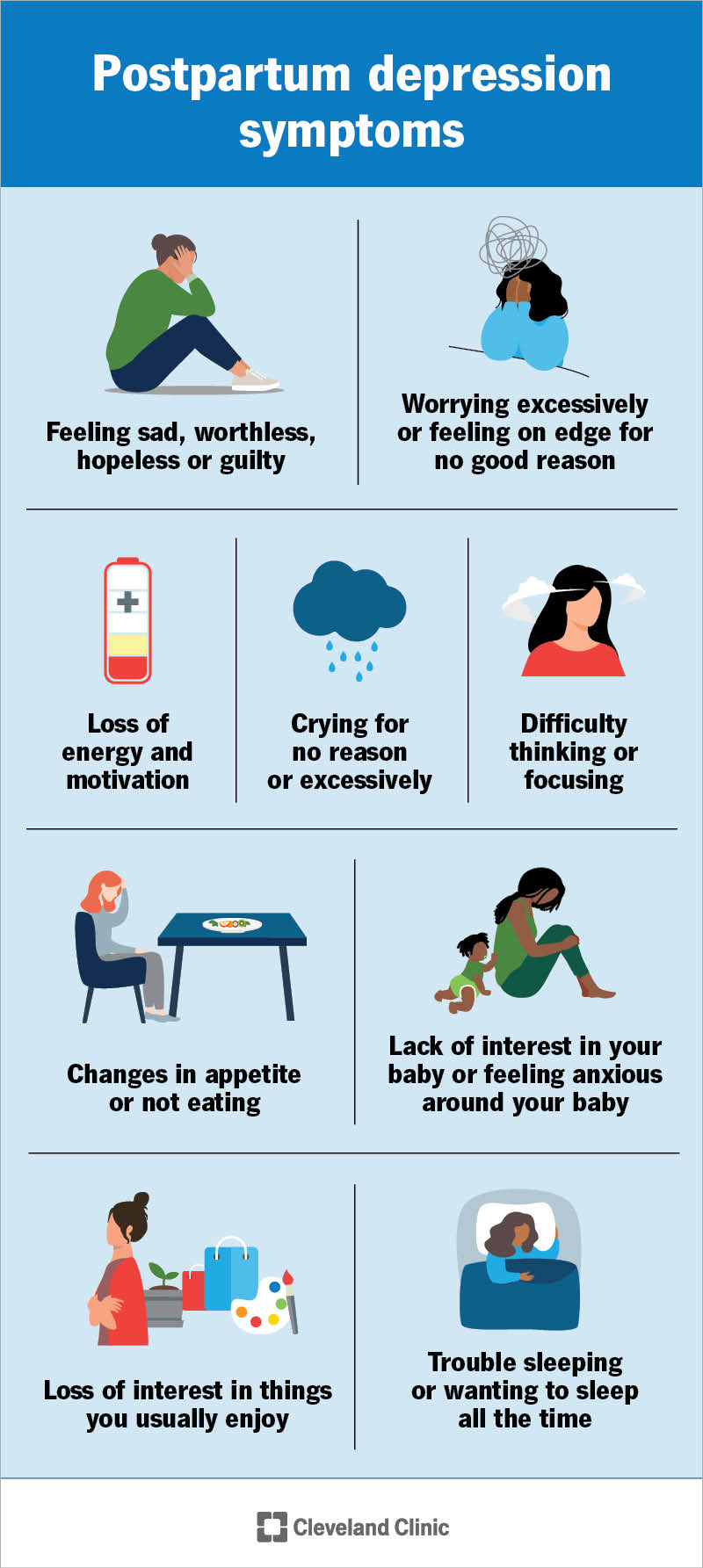
Image content: This image is available to view online.
View image online (https://my.clevelandclinic.org/-/scassets/images/org/health/articles/9312-postpartum-depression)
You may have postpartum depression if you have some of the following:
If you have any of the following symptoms, please notify your healthcare provider right away:
If at any time you feel overwhelmed or you need someone to talk to, call or text 988 to reach the Suicide and Crisis Lifeline (U.S.). Someone is available to help you 24/7.
Having symptoms of postpartum depression doesn’t mean you’re a terrible parent. Having a baby brings on so many changes and challenges to your life. It’s OK to feel overwhelmed or like it’s too much for you to handle sometimes. You aren’t the first person to feel this way, and you won’t be the last.
Contact your healthcare provider if you have symptoms of PPD. An obstetrician, primary care provider and mental health provider are all good options. Your baby’s pediatrician can also help you. They can talk to you about possible treatment options.
Healthcare providers don’t know the exact link between the rapid drop in hormones after delivery and depression, but they know there’s a connection. The levels of estrogen and progesterone increase tenfold during pregnancy but drop sharply after delivery. By three days postpartum, levels of these hormones are back to pre-pregnancy levels.
Advertisement
In addition to these chemical changes, the social and psychological changes of having a baby increase your risk. Examples of these changes include:
Certain factors increase your risk for postpartum depression. Some of these are:
Untreated postpartum depression is dangerous and affects you, your baby and those who love you. Some of the complications of postpartum depression are:
Advertisement
Yes, postpartum depression can affect your baby.
Research suggests that postpartum depression can affect your baby. Some potential problems are:
There’s no specific test that diagnoses postpartum depression. Your healthcare provider will evaluate you at your postpartum visit. This visit may include discussing your health history, how you’ve felt since delivery, a physical exam, pelvic exam and lab tests. Many providers schedule visits at two or three weeks postpartum to screen for depression. This ensures you get the help you need as soon as possible.
They may do a depression screening or ask you a series of questions to assess if you have postpartum depression. They’ll ask how you’re feeling. Be open and honest with your provider to ensure they get an accurate picture of your emotions and thoughts. They can determine if your feelings are typical or symptoms of postpartum depression.
Your healthcare provider may order a blood test because postpartum depression can cause symptoms similar to many thyroid conditions.
Remember, your healthcare provider is there to support you and make sure you’re healthy, so be honest with them. There’s no judgment, and you aren’t alone in your feelings.
Advertisement
It can be hard to detect mild cases of postpartum depression. Healthcare providers rely heavily on your responses to their questions.
Many healthcare providers use the Edinburgh Postnatal Depression Scale to screen for postpartum depression during pregnancy, as well as during the postpartum period. It consists of 10 questions related to symptoms of depression, such as feeling unhappy, anxious or guilty. You’re asked to check the response that comes closest to how you’ve felt the last seven days. A higher score indicates possible postpartum depression.
If your provider feels you have signs of postpartum depression, they’ll recommend an appropriate treatment.
Treatment for postpartum depression depends on the type and severity of your symptoms. Treatment options include anti-anxiety or antidepressant medicines, psychotherapy (talk therapy or cognitive behavioral therapy) and joining support groups. It’s also common for your provider to recommend both treatments at the same time.
Your healthcare provider may prescribe antidepressants to manage symptoms of postpartum depression. Antidepressants help balance the chemicals in your brain that affect your mood. You can take antidepressant medication during pregnancy, delivery and into the postpartum period.
If you’re breastfeeding, talk to your healthcare provider about the risks and benefits of taking an antidepressant. Medications can transfer to your baby through your breast milk. But the transfer level is generally low, and many antidepressant medications are safe. Your provider can help you decide which medicine is right for you based on your symptoms and whether you’re nursing.
Some common antidepressants for postpartum depression are:
Keep in mind that it takes at least two or four weeks for antidepressants to work completely. Talk to your healthcare provider before stopping the medication. Stopping your medication too soon can cause symptoms to return. You should stay on your antidepressant for at least six months to one year before tapering off. Most providers will recommend reducing your dose before stopping completely.
If your provider detects postpartum depression while you’re still in the hospital, they may recommend IV medication containing brexanolone.
It’s OK to feel overwhelmed. Parenting is full of ups and downs, and having a baby isn’t easy. If you have depression, you don’t have to accept your feelings as normal or try to get over them by yourself. Don’t be embarrassed to share your feelings with people close to you. Your healthcare provider can help find a treatment that works for you.
Here are some things you can do to help cope with postpartum depression:
Postpartum depression can last until one year after your child is born. But this doesn’t mean you should feel or be “cured” in one year. Talk to your healthcare provider about your symptoms and treatment. Be honest about how you feel. Think carefully about whether you feel better than you did at the beginning of your diagnosis. Then, they can recommend ongoing treatment for your symptoms.
Not usually. Most people need some type of treatment to feel better. Not everyone needs the same treatment, and not everyone feels relief at the same time or in the same way. But most healthcare providers agree that some intervention is necessary to help with symptoms of postpartum depression.
The reality of being a new parent can hit you hard. You may have expected life with a baby to be mostly rainbows and butterflies, but instead you feel disconnected, lonely and unhappy. You may ask yourself, “Am I doing this right?” or “Is it normal to feel like this?” You’re not alone in your feelings. Hundreds of thousands of people have been in your shoes. And with professional help, many of them have stepped out of those shoes, overcoming the challenges and symptoms postpartum depression can bring.
The first step is seeking help. You might feel shame, embarrassment or guilt for taking care of yourself when you’re trying to take care of your newborn. Postpartum depression isn’t something that magically goes away on its own. It’s a real condition, and most people will get better with treatment. There can be complications if you don’t get help. Remember, seeking help isn’t a sign of weakness.
Once you and your healthcare provider determine the best treatment, stick with your treatment plan. If your treatment involves medication, take it exactly as your provider prescribes. Don’t attempt to increase or decrease your dosage on your own. If your provider thinks you’ll benefit from counseling, try it for several sessions to see if it helps you feel better. You can also try attending virtual support groups.
Postpartum depression isn’t your fault. There are resources available to help relieve your symptoms and get you back to feeling like yourself.
Postpartum depression isn’t entirely preventable. It helps to know the warning signs of the condition and the factors that increase your risk. Here are some tips that can help prevent postpartum depression:
You should seek professional help when:
For immediate help, or if you have thoughts of hurting yourself or someone else:
People with postpartum depression need lots of support. Here are some ways you can help:
If you know someone with symptoms of PPD, offer to call their provider for them. They may feel shame or be afraid to ask for help, or they may not realize how severe postpartum depression can be. You could also go with them to their appointment as a support person.
Postpartum depression can happen to anyone. Having a new baby to care for — while also caring for yourself and other loved ones — can be overwhelming, to say the least. The biological, physical and social factors that cause postpartum depression are beyond your control. It’s not your fault, and you did nothing to cause it. It doesn’t make you a bad parent, and you’re not the first person to feel the way you feel.
Everyone has good days and bad days. But if you feel like you have more bad days than good days, it’s time to reach out to your healthcare provider for help. They can figure out the best way to manage your symptoms. Counseling, medication and joining a support group are good ways to help you cope with PPD and get you feeling better.



Sign up for our Health Essentials emails for expert guidance on nutrition, fitness, sleep, skin care and more.
Learn more about the Health Library and our editorial process.
Cleveland Clinic’s health articles are based on evidence-backed information and review by medical professionals to ensure accuracy, reliability and up-to-date clinical standards.
Cleveland Clinic’s health articles are based on evidence-backed information and review by medical professionals to ensure accuracy, reliability and up-to-date clinical standards.
Life can come with many changes and challenges. Cleveland Clinic’s women’s behavioral health team can help with a care plan that’s specific to you.
