



The placenta is a temporary organ that forms in your uterus during pregnancy. It attaches to your uterine wall and provides nutrients and oxygen to the fetus through the umbilical cord. Certain placental conditions can cause pregnancy complications.
Advertisement
Cleveland Clinic is a non-profit academic medical center. Advertising on our site helps support our mission. We do not endorse non-Cleveland Clinic products or services. Policy
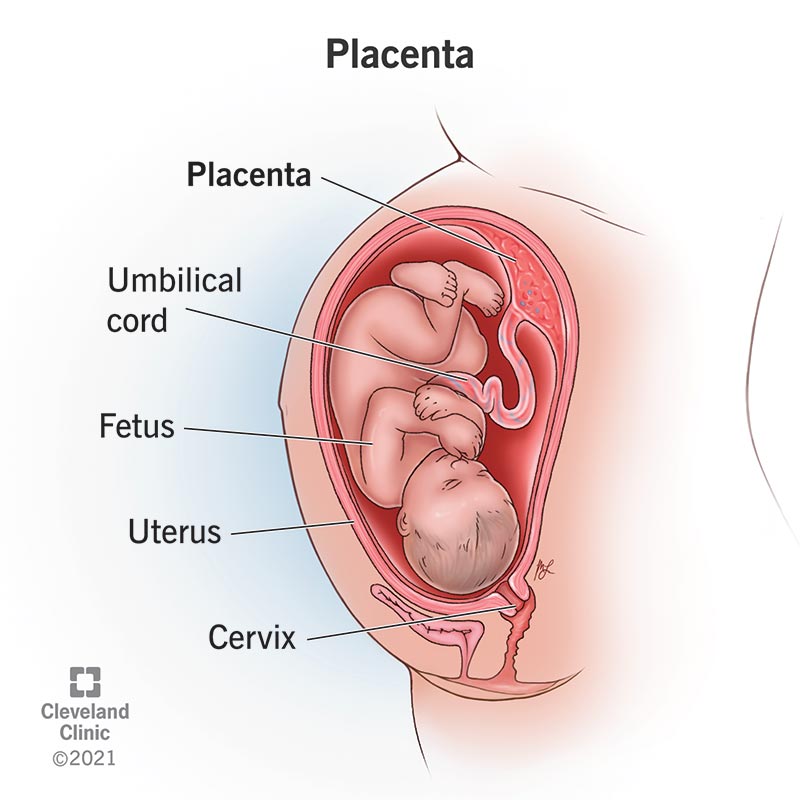
Image content: This image is available to view online.
View image online (https://my.clevelandclinic.org/-/scassets/images/org/health/articles/22337-placenta)
The placenta is a temporary organ that connects the fetus to your uterus during pregnancy. The umbilical cord connects the fetus to the placenta. Together, they make it possible for your body’s nutrients to support the growth of the fetus.
Advertisement
Cleveland Clinic is a non-profit academic medical center. Advertising on our site helps support our mission. We do not endorse non-Cleveland Clinic products or services. Policy
There’s nothing much you can do to affect the growth and health of the placenta. But learning about it can help you better understand pregnancy and how fascinating this organ is.
The placenta is vital to fetal development. It acts as the fetus’s lungs, kidneys and liver until birth.
The placenta’s main functions include:
Your blood passes through the placenta and provides oxygen, glucose (sugar) and nutrients to the fetus through the umbilical cord. The placenta can also filter out harmful waste and carbon dioxide from the fetus’s blood.
As you get closer to delivery, the placenta passes antibodies from your immune system to the fetus to jumpstart immunity. This immunity sticks with your baby for several months after birth.
The placenta allows the exchange of all these things between your bloodstream and that of the fetus without ever mixing them.
The placenta also acts as an endocrine organ. It makes several hormones to support the pregnancy. The hormones affect both you and the fetus.
Advertisement
Some of these hormones include:
Both progesterone and hPL stimulate your appetite. This is why most people are extra hungry during pregnancy.
The placenta begins to form after a fertilized egg implants in your uterine lining (endometrium). It has the same genetic makeup as the fetus.
It continues to grow throughout your pregnancy to support the fetus. The placenta starts as a few cells and grows to be several inches long.
The placenta takes over hormone production by the end of the first trimester (12 weeks of pregnancy). Up until this time, the corpus luteum handles most of the hormone production. Many people’s first-trimester symptoms of nausea and fatigue go away once the placenta takes over in the second trimester.
You deliver the placenta shortly after your baby is born (usually within 30 minutes). This is called the afterbirth or the third stage of labor.
If you’ve had a vaginal delivery, your uterus will continue to contract to get rid of the placenta. Your healthcare provider may push on your belly or ask you for one final push. If you had a C-section, your provider removes the placenta through the same incision your baby came through.
In rare cases, parts of the placenta stay in your uterus after delivery. This can cause excessive bleeding (hemorrhage) and/or infection.
Your provider will look at the placenta to check that it detached completely from your uterus. They’ll look for any signs of missing pieces or breakage.
After this, your provider will throw away the placenta after birth unless you choose otherwise.
You may choose to bank placental tissue through a stem cell bank. Placental tissue banking is when tissue and blood from the placenta are collected and stored after delivery. The placental tissues are rich in stem cells that can help treat certain conditions.
Advertisement
Sometimes, your provider might ask a pathologist to examine the placenta if:
You can think of the placenta as having three main parts:
The placenta contains mostly blood vessels contained within structures called villi. The placental cavity contains 30 to 40 of these villi.
You can think of the villi as trees. The trunk of the tree connects to the fetal surface of the placenta. Each “tree” has several branches that form a small lobe. The center of each lobe is over the opening of a spiral artery from the uterus side of the placenta.
Your blood then “bathes” the villi. This is how the fetus gets oxygen and nutrients. This is also how your body filters out waste from the fetus.
The placenta looks like a big disc of bumpy tissue rich in blood vessels. It has a gel-like consistency or is like a very wet sponge.
After delivery of the placenta, the side attached to your uterus appears bumpy and is a deep red color. The side that was facing your baby looks shiny and grayish.
Advertisement
On average, a mature placenta is almost 9 inches (22 centimeters) long. It’s about an inch thick at the center (2.5 centimeters). It typically weighs a little over 1 pound (500 grams).
All these measurements can vary. Placentas can be bigger or smaller.
The placenta can form anywhere on the inner lining of your uterus. It develops wherever the fertilized egg implants into your uterine wall. Some positions of the placenta are:
You may also have a low-lying placenta. This means it’s low in your uterus and covers part or all of your cervix.
The placenta appears to move only because your uterus expands as the pregnancy continues. Your healthcare provider will look at the location of your placenta during your 20-week anatomy ultrasound. They’ll check if its position (like a low-lying placenta) may cause complications.
Most placentas “move” to the top or side of the uterus by 32 weeks of pregnancy. It’s common to have a placenta that transitions upwards and away from your cervix as the fetus gets bigger.
Advertisement
An issue with your placenta can cause issues for you and your baby. Some placenta complications include:
The placenta can also form in different ways. Some include:
Each of these conditions has different risk factors and symptoms. This is why it’s important to go to all your prenatal appointments. Tell your provider if you feel like something’s wrong.
The placenta may also contribute to other pregnancy-related conditions, including:
Bleeding from your vagina is the most common sign that there’s a problem with the placenta. But this kind of bleeding has other causes, too.
Other possible symptoms and signs include:
Talk to your pregnancy care provider as soon as possible if you have any unusual pregnancy symptoms.
The placenta is a hardworking organ during pregnancy. Because of its many functions and importance, your pregnancy care provider will want to check on it during your ultrasounds. Don’t hesitate to ask any questions you have about the placenta or your pregnancy. Your provider is there to make sure you’re informed and feel empowered.



Sign up for our Health Essentials emails for expert guidance on nutrition, fitness, sleep, skin care and more.
Learn more about the Health Library and our editorial process.
Cleveland Clinic’s health articles are based on evidence-backed information and review by medical professionals to ensure accuracy, reliability and up-to-date clinical standards.
Cleveland Clinic’s health articles are based on evidence-backed information and review by medical professionals to ensure accuracy, reliability and up-to-date clinical standards.
Cleveland Clinic childbirth experts coach you through every step — from labor to delivery to what to expect when you and your newborn head home.
