



Cyclic vomiting syndrome is when you experience cycles of severe nausea, vomiting and exhaustion that can last from a few hours up to a few days. Although the symptoms won’t occur daily, the syndrome can last a lifetime. Avoiding triggers and taking anti-seizure and anti-nausea medications can help.
Advertisement
Cleveland Clinic is a non-profit academic medical center. Advertising on our site helps support our mission. We do not endorse non-Cleveland Clinic products or services. Policy
Cyclic vomiting syndrome (CVS) involves repeated, unexplained episodes of severe nausea and vomiting. Episodes can last from a few hours to several days. They can be so severe that you need to stay in bed. You may need to go to the emergency room (ER) or hospital to get IV fluids to prevent dehydration. Following an episode, you’re free of symptoms and return to normal health.
Advertisement
Cleveland Clinic is a non-profit academic medical center. Advertising on our site helps support our mission. We do not endorse non-Cleveland Clinic products or services. Policy
CVS may last for months, years or decades. However, symptoms don’t occur every day. Episodes generally occur several times a year but can happen up to once or twice a month.
The symptoms, time of day, frequency, severity and length of each episode are usually the same for any one person. But these factors can vary from person to person.
CVS is more common in children than adults. Approximately 3 of every 100,000 children have CVS. In most cases in children, episodes start between the ages of 3 and 7. However, the disorder can begin at any age.
Cyclic vomiting syndrome (CVS) involves sudden, repeated episodes of severe nausea and vomiting. Episodes often unfold like this:
Advertisement
Other signs and symptoms of CVS include:
There isn’t a single known cause of CVS. Instead, several factors may play a role, including:
Certain conditions, events and emotional states can trigger a vomiting episode, including:
CVS can lead to:
Diagnosing CVS involves ruling out other conditions that cause similar symptoms. Your healthcare provider will ask questions about your medical history, family medical history, and your pattern of vomiting and nausea.
You’ll need a physical exam and (likely) several tests.
There isn’t a single test to diagnose CVS. Instead, your provider may order several tests to exclude other conditions that cause vomiting. Tests include:
Advertisement
A CVS diagnosis involves ruling out common conditions that cause vomiting, including infections, acid reflux (GERD) and stomach ulcers. Your provider may also need to exclude:
Advertisement
Treatment for cyclic vomiting syndrome depends on whether you’re experiencing an episode or trying to prevent one from happening.
Medications stop an episode, reduce its intensity or prevent it from happening. Your prescription depends on your age, how severe your episodes are and how you’ve responded to other forms of treatment.
Medications include:
Advertisement
You may also benefit from taking supplements, including coenzyme Q10, riboflavin and L-carnitine at doses recommended by your provider. Never start a supplement without getting your provider’s OK first.
Many children with CVS eventually outgrow it but develop severe migraines as adults. Persistent and severe vomiting can disrupt daily life for children and adults alike. Children may have to miss school, and adults may have to miss work. Depending on how severe the vomiting is, you may need to be hospitalized to prevent dehydration.
Working with your provider to find the right treatments and identify your triggers is essential. Everyone’s experience is different. It’s important to find what works for you.
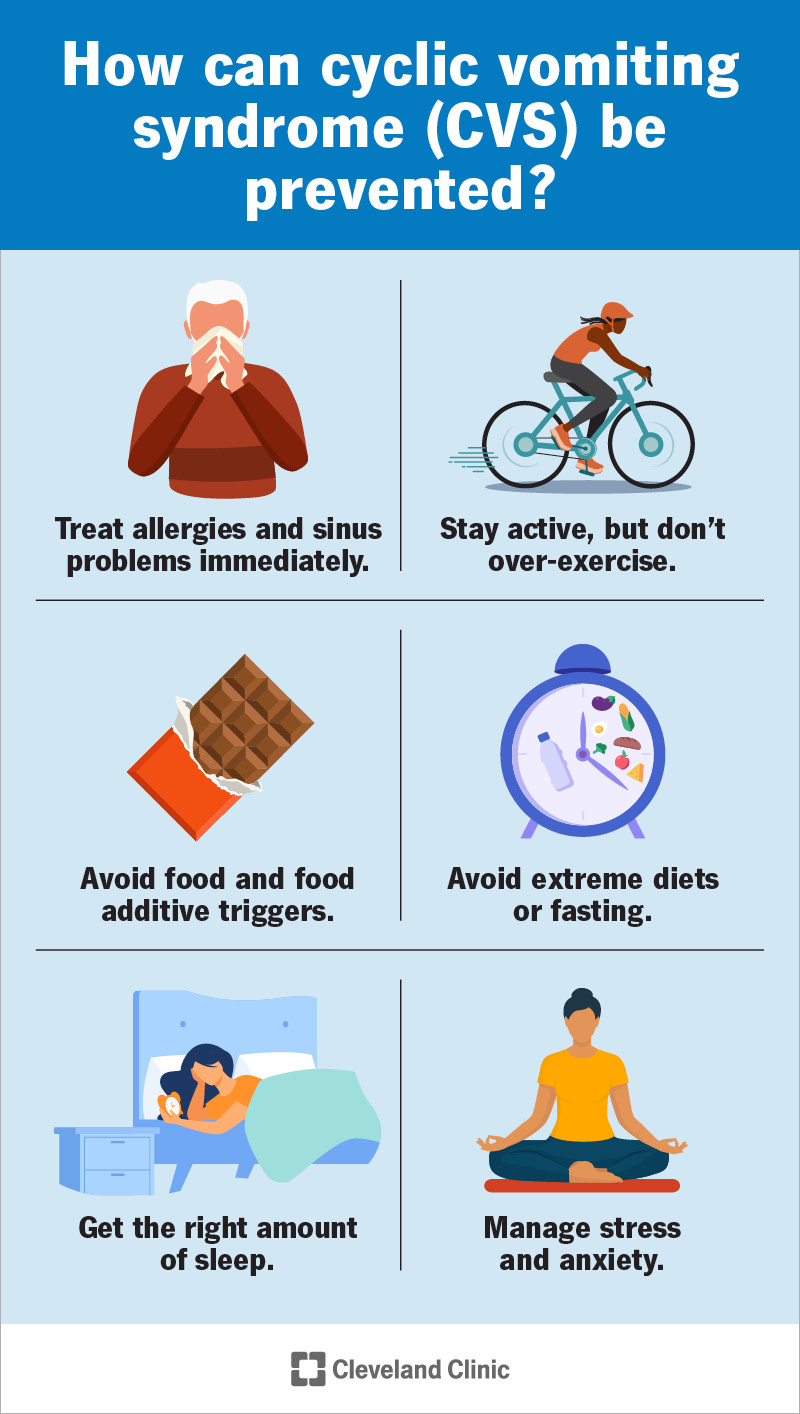
Image content: This image is available to view online.
View image online (https://my.clevelandclinic.org/-/scassets/Images/org/health/articles/14894-cyclic-vomiting-syndrome)
You can reduce your risk of an episode by avoiding triggers and taking medications as prescribed by your healthcare provider. Other tips include:
Ask your provider:
CVS may feel as if your gut (and vomiting reflex) has turned against you. It’s a frustrating diagnosis, especially since no single medicine or lifestyle change guarantees you won’t have an episode. Be patient with yourself and your provider as you find treatments that work. It may take some time to identify your triggers, but eventually, most people with CVS get good at learning and avoiding them. In the meantime, some medicines can ease your symptoms when an episode does start.



Sign up for our Health Essentials emails for expert guidance on nutrition, fitness, sleep, skin care and more.
Learn more about the Health Library and our editorial process.
Cleveland Clinic’s health articles are based on evidence-backed information and review by medical professionals to ensure accuracy, reliability and up-to-date clinical standards.
Cleveland Clinic’s health articles are based on evidence-backed information and review by medical professionals to ensure accuracy, reliability and up-to-date clinical standards.
If you have issues with your digestive system, you need a team of experts you can trust. Our gastroenterology specialists at Cleveland Clinic can help.
