



Obsessive-compulsive disorder (OCD) involves ongoing intrusive thoughts and urges to repeat certain behaviors to relieve anxiety. It can make everyday tasks hard. But with therapy, medication or both, many people find relief and regain control over their lives.
Advertisement
Cleveland Clinic is a non-profit academic medical center. Advertising on our site helps support our mission. We do not endorse non-Cleveland Clinic products or services. Policy
Obsessive-compulsive disorder (OCD) is a mental health condition that causes a pattern of unwanted thoughts and fears (obsessions). These lead to repetitive behaviors (compulsions) that can interfere with your daily life and responsibilities.
Advertisement
Cleveland Clinic is a non-profit academic medical center. Advertising on our site helps support our mission. We do not endorse non-Cleveland Clinic products or services. Policy
If you have this condition, you may focus on different worries or behaviors. You might fear germs or contamination, need things to feel symmetrical or “just right,” have unwanted intrusive thoughts or feel the urge to collect or save items.
It affects about 2 out of every 100 people in the U.S.
While many people “obsess” over things now and then, OCD isn’t short term. These thoughts and behaviors are strong and overwhelming. A healthcare provider can help you manage this condition.
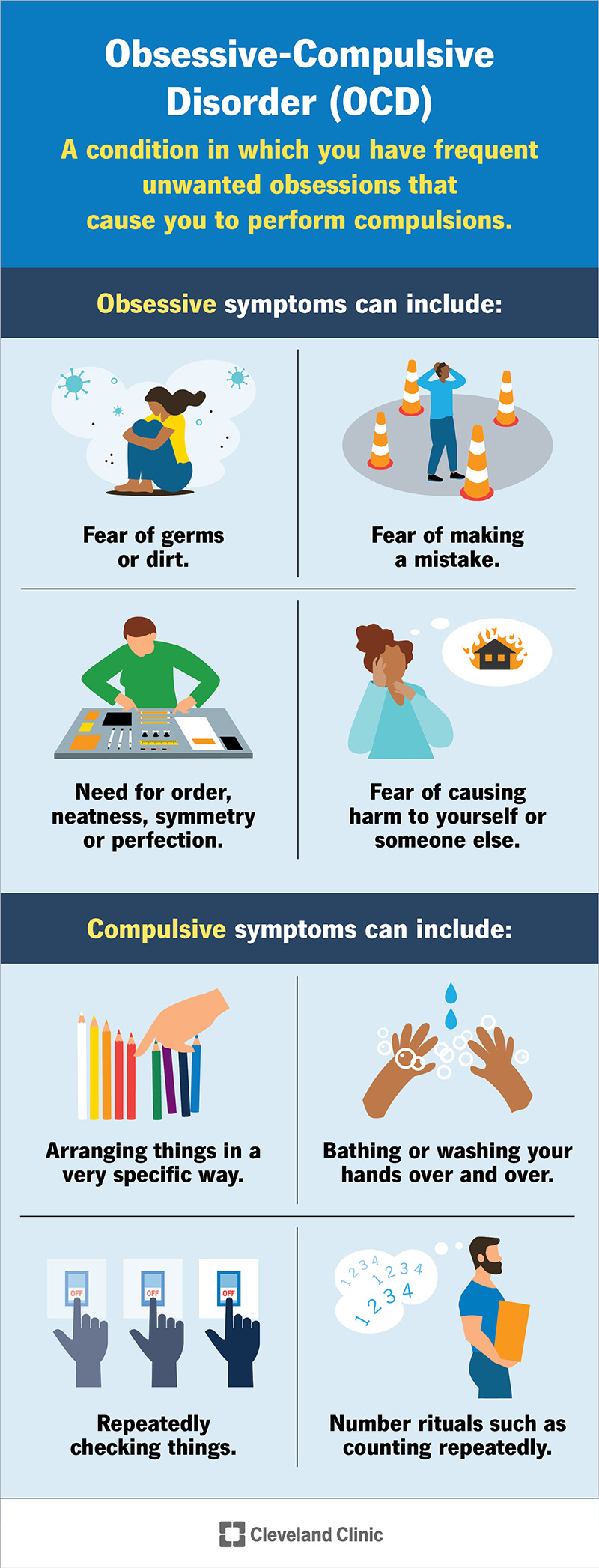
Image content: This image is available to view online.
View image online (https://my.clevelandclinic.org/-/scassets/images/org/health/articles/9490-ocd-obsessive-compulsive-disorder)
The two main symptoms of OCD are:
It’s possible to have an obsession without a compulsion and a compulsion without an obsession.
Common obsessions include:
Advertisement
Common compulsions include:
These symptoms often:
OCD symptoms can come and go, improve for a while or get worse over time. If you or your child has symptoms that interfere with daily life, talk to a healthcare provider.
The exact cause of obsessive-compulsive disorder isn’t known. But several factors may play a role, including:
Studies show that OCD can run in families. If you have a parent or sibling who has OCD, you’re more likely to develop it yourself. The risk is higher if your relative developed OCD as a child or teen. But this isn’t the case for everyone, since many people don’t have a history of OCD in their biological family.
Anyone can develop this condition, but your risk may be higher if you:
Obsessive-compulsive disorder can take a heavy toll on your daily life. Compulsions use up time and energy, leaving you physically and mentally exhausted. They can strain relationships, since others may not understand what you’re going through.
Advertisement
Possible complications include:
If you’re ever in a difficult spot and you’re not sure what to do, know that help is available 24/7. You can call or text the Suicide and Crisis Lifeline at 988. If you’re in immediate danger, contact 911 or your local emergency services number.
A healthcare provider will diagnose this condition by asking about your symptoms, your medical history and your mental health. A diagnosis is usually made by a psychiatrist or psychologist, but your primary care provider can start the evaluation and refer you.
Sometimes, the symptoms themselves (like needing extra time to get ready or feeling anxious about leaving home) can make it hard to get to appointments. If that’s the case, ask your provider if a virtual visit is an option.
Many healthcare providers find that there’s a delay in seeking help. It averages about seven to eight years before someone reaches out to a psychiatrist or a doctor about OCD symptoms. Naturally, the longer you wait, the harder it may be to manage. It’s important to talk to a healthcare provider if you notice symptoms so they can make an accurate diagnosis.
Advertisement
There’s no single test for OCD. Providers diagnose it using the criteria in the Diagnostic and Statistical Manual of Mental Disorders, 5th Edition (DSM-5).
The criteria include:
Providers may also use structured questionnaires to measure how severe symptoms are and track changes over time, like the Yale-Brown Obsessive Compulsive Scale (Y-BOCS) or CY-BOCS for children.
The most common treatments for obsessive-compulsive disorder are:
Advertisement
Your provider might also add these treatments to your plan:
Medications may reduce OCD symptoms. The most common ones are selective serotonin reuptake inhibitors (SSRIs). These affect serotonin, a brain chemical that helps control mood and anxiety.
The U.S. Food and Drug Administration (FDA) approved these SSRIs for OCD:
Another option is clomipramine, a tricyclic antidepressant. It can work well, but it often causes more side effects, so providers usually try SSRIs first.
It may take eight to 12 weeks to feel the full benefits, though some people notice improvement earlier. Once symptoms get better, most people stay on medication for 12 to 24 months or longer, since stopping too soon can bring symptoms back. Your provider will monitor you closely and adjust your dose if needed.
If you or your child has an OCD diagnosis, you’ll likely need regular visits with your healthcare provider or a mental health professional to check that treatment is working. Let them know if you have new or worsening symptoms.
If you take medication for OCD and notice side effects, let your provider know right away.
The outlook for OCD is different for each person. Early treatment can sometimes make habits easier to change, but even if you weren’t diagnosed early, there’s still hope.
There isn’t one treatment that works for everyone. Your provider will help you find the plan that fits you best. Many people see their symptoms improve with therapy, medication or both. Treatment takes effort, and progress often depends on sticking with it.
OCD can cause serious complications if it isn’t managed, but you don’t have to face it alone. Your care team is there to support you.
Living with OCD can feel like your mind is stuck on repeat. The record keeps spinning with unwanted thoughts that won’t go away and routines that feel impossible to skip. But you’re not “overreacting” or “worrying too much.” OCD is a real, treatable mental health condition. And getting the right care can make a meaningful difference.
It may take time to find the treatment plan that works best for you — and that’s OK. Whether it’s therapy, medication or a mix of both, your provider will help you figure out what fits your needs. Progress might be slow at times, but small steps forward are still progress. And with support, you can start to reclaim the time and energy that OCD has been holding onto.



Sign up for our Health Essentials emails for expert guidance on nutrition, fitness, sleep, skin care and more.
Learn more about the Health Library and our editorial process.
Cleveland Clinic’s health articles are based on evidence-backed information and review by medical professionals to ensure accuracy, reliability and up-to-date clinical standards.
Cleveland Clinic’s health articles are based on evidence-backed information and review by medical professionals to ensure accuracy, reliability and up-to-date clinical standards.
Your mental well-being is just as important as your physical well-being. Cleveland Clinic’s mental health experts can help you live life to the fullest.
