



Your cholesterol levels show how much cholesterol is circulating in your blood. Your HDL (“good” cholesterol) is the one number you want to be high (ideally 60 to 80). Your LDL (“bad” cholesterol) should be below 100. Your total should be below 200. Talk with your provider about what your results mean for you and how to manage your cholesterol.
Advertisement
Cleveland Clinic is a non-profit academic medical center. Advertising on our site helps support our mission. We do not endorse non-Cleveland Clinic products or services. Policy
Your cholesterol levels are important because they help you know your risk for heart disease. Cholesterol is a type of lipid (fat) that helps your body perform many important functions. But too much cholesterol in your blood is harmful. It can enter your artery wall, weaken it and lead to atherosclerotic plaque (hardened deposits) forming.
Advertisement
Cleveland Clinic is a non-profit academic medical center. Advertising on our site helps support our mission. We do not endorse non-Cleveland Clinic products or services. Policy
This process of plaque buildup is called atherosclerosis. It can lead to serious problems like:
You can live for many years with high cholesterol and not even know it. That’s why it’s essential to get your cholesterol numbers checked on a regular basis. If your cholesterol numbers are too high (hyperlipidemia), that’s a red flag for you and your healthcare provider, and it may place you at risk of a heart attack or stroke.
Many people have high cholesterol, which is a major risk factor for heart disease. But you’re not stuck with the cholesterol numbers you have. It’s possible to change them by tweaking some habits and maybe taking some medicines. The first step is learning what your numbers are. Then, you can work with your healthcare provider to reach healthier numbers if needed.
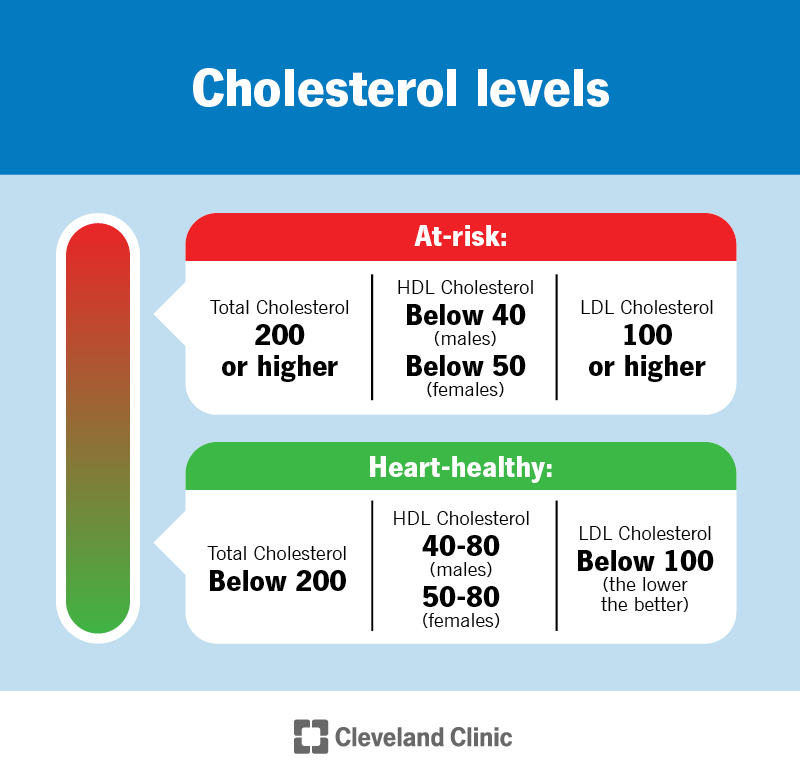
Image content: This image is available to view online.
View image online (https://my.clevelandclinic.org/-/scassets/images/org/health/articles/11920-cholesterol-chart)
Cholesterol numbers in the heart-healthy range can help lower your risk of heart disease.
The main levels your healthcare provider checks are:
Advertisement
Your provider checks your cholesterol levels with a blood test they call a lipid panel or profile. They also measure your triglycerides (another type of fat) at the same time. A provider will draw blood from a vein in your arm and send it to a lab for analysis.
Be sure to follow your provider’s instructions on how to prepare for the test. You’ll likely need to fast for 12 hours beforehand. This means avoiding all foods and drinks except water.
When your results come in, your provider will let you know. You may also be able to access your results through your electronic medical record. The results will show your cholesterol levels as milligrams of cholesterol per deciliter of blood. This is abbreviated as mg/dL.
Normal cholesterol levels vary based on your age, ethnicity and sex. Here are numbers that healthcare providers consider normal for most adults. Generally speaking, though, low levels of total cholesterol and LDL cholesterol are considered better:
Here are a few things to know about these levels:
High cholesterol generally means your total cholesterol is 200 mg/dL or higher, or higher than normal. But providers also use terms like “borderline high” to break down your results. If your numbers are close to normal, they may be easier to manage.
Here are the high cholesterol numbers to know:
Total cholesterol:
LDL cholesterol:
VLDL cholesterol:
For LDL, VLDL and total cholesterol, lower is better — typically as low as you can go. Researchers haven’t set a lower limit for these. But your HDL is unique. It needs to be higher, rather than lower. It shouldn’t fall below 40 (in males) or 50 (in females).
Your provider will tell you how often you need your cholesterol checked. It depends on your:
Advertisement
Children should get their first test between 9 and 11. Then, they should receive a test every five years. Your child’s provider may recommend starting at a younger age based on family history.
Here are general guidelines for adults based on sex and age:
| Age | How often to get your cholesterol checked |
|---|---|
| 20 to 44 | Every five years |
| 45 to 65 | Every one to two years |
| 65+ | Every year |
| Age | |
| 20 to 44 | |
| How often to get your cholesterol checked | |
| Every five years | |
| 45 to 65 | |
| How often to get your cholesterol checked | |
| Every one to two years | |
| 65+ | |
| How often to get your cholesterol checked | |
| Every year |
| Age | How often to get your cholesterol checked |
|---|---|
| 20 to 54 | Every five years |
| 55 to 65 | Every one to two years |
| 65+ | Every year |
| Age | |
| 20 to 54 | |
| How often to get your cholesterol checked | |
| Every five years | |
| 55 to 65 | |
| How often to get your cholesterol checked | |
| Every one to two years | |
| 65+ | |
| How often to get your cholesterol checked | |
| Every year |
Knowing your cholesterol numbers can help you learn your risk for heart disease. But keep in mind that your cholesterol numbers are just part of the story. Your healthcare provider will also look at other aspects of your health to learn more about your risks.
So, if your numbers fall outside the normal range, don’t panic. Talk with your provider about what your cholesterol levels mean in the context of your overall health. And work with your provider to get your numbers back to a healthier place.
Advertisement



Sign up for our Health Essentials emails for expert guidance on nutrition, fitness, sleep, skin care and more.
Learn more about the Health Library and our editorial process.
Cleveland Clinic’s health articles are based on evidence-backed information and review by medical professionals to ensure accuracy, reliability and up-to-date clinical standards.
Cleveland Clinic’s health articles are based on evidence-backed information and review by medical professionals to ensure accuracy, reliability and up-to-date clinical standards.
When your heart needs some help, the cardiology experts at Cleveland Clinic are here for you. We diagnose and treat the full spectrum of cardiovascular diseases.
