Chat Live With a Health Educatorhealth maintenance videosonline health chatChat Live With a Health Educator

Small Cell Lung Cancer


Print this ContentEmail this Content

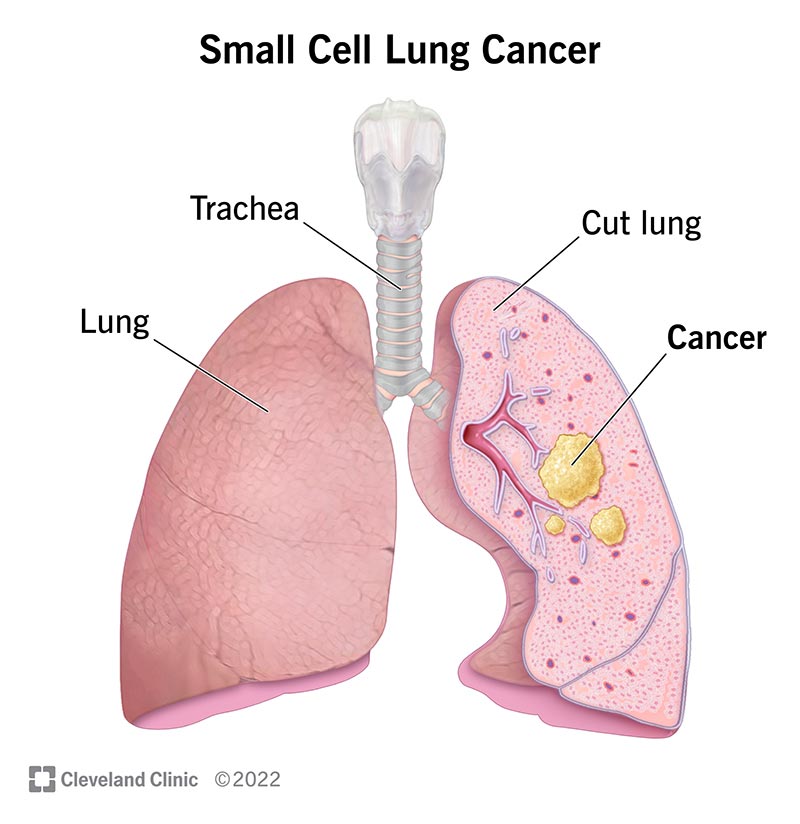
Small cell lung cancer is a disease in which malignant (cancer) cells form in the tissues of the lung.

The lungs are a pair of cone-shaped breathing organs that are found within the chest. The lungs bring oxygen into the body when breathing in and take out carbon dioxide when breathing out. Each lung has sections called lobes. The left lung has two lobes. The right lung, which is slightly larger, has three. A thin membrane called the pleura surrounds the lungs. Two tubes called bronchi lead from the trachea (windpipe) to the right and left lungs. The bronchi are sometimes also involved in lung cancer. Small tubes called bronchioles and tiny air sacs called alveoli make up the inside of the lungs.

There are two types of lung cancer, small cell lung cancer and non-small cell lung cancer.

There are three types of small cell lung cancer

These three types include many different types of cells. The cancer cells of each type grow and spread in different ways. The types of small cell lung cancer are named for the kinds of cells found in the cancer and how the cells look when viewed under a microscope:

  • Small cell carcinoma (oat cell cancer).
  • Mixed small cell/large cell carcinoma.
  • Combined small cell carcinoma.
Smoking tobacco is the major risk factor for developing small cell lung cancer.

Cigarette smoking is the most common cause of lung cancer. Risk factors for small cell lung cancer include:

  • Smoking cigarettes, cigars, or pipes now or in the past.
  • Being exposed to second hand smoke.
  • Being exposed to asbestos or radon.
Possible signs of small cell lung cancer include coughing, chest pain, and shortness of breath.

These and other symptoms may be caused by small cell lung cancer or by other conditions. A doctor should be consulted if any of the following problems occur:

  • A cough that doesn’t go away.
  • Shortness of breath.
  • Chest pain that doesn’t go away.
  • Wheezing.
  • Coughing up blood.
  • Hoarseness.
  • Swelling of the face and neck.
  • Loss of appetite.
  • Unexplained weight loss.
  • Unusual tiredness.
Tests and procedures that examine the lungs are used to detect (find) and diagnose small cell lung cancer.

The following tests and procedures may be used:

Chest x-ray: An x-ray of the organs and bones inside the chest. An x-ray is a type of energy beam that can go through the body and onto film, making a picture of areas inside the body.

Physical exam and history: An exam of the body to check general signs of health, including checking for signs of disease, such as lumps or anything else that seems unusual. A history of the patient’s health habits and past illnesses and treatments will also be taken.

Sputum cytology: A microscope is used to check for cancer cells in the sputum (mucus coughed up from the lungs).

Laboratory tests: Medical procedures that test samples of tissue, blood, urine, or other substances in the body. These tests help to diagnose disease, plan and check treatment, or monitor the disease over time.

Bronchoscopy: A procedure to look inside the trachea and large airways in the lung for abnormal areas. A bronchoscope (a thin, lighted tube) is inserted through the nose or mouth into the trachea and lungs. Tissue samples may be taken for biopsy.

Fine needle aspiration biopsy: The removal of part of a lump, suspicious tissue, or fluid, using a thin needle. A pathologist views the tissue or fluid under a microscope to look for cancer cells. This procedure is also called a needle biopsy.

Lung biopsy: The patient lies on a table that slides through the computed tomography (CT) machine which takes x-ray pictures of the inside of the body. The x-ray pictures help the doctor see where the abnormal tissue is in the lung. A biopsy needle is inserted through the chest wall and into the area of abnormal lung tissue. A small piece of tissue is removed through the needle and checked under the microscope for signs of cancer.)

Thoracentesis: Removal of fluid from the pleural cavity (the space between the lungs and chest wall) through a needle inserted between the ribs.

Certain factors affect prognosis (chance of recovery) and treatment options.

The prognosis (chance of recovery) and treatment options depend on the following:

  • The stage of the cancer (whether it is in the chest cavity only or has spread to other places in the body).
  • The patient’s gender and general health.
  • The blood level of lactate dehydrogenase (LDH), a substance found in the blood that may indicate cancer when the level is higher than normal.
For most patients with small cell lung cancer, current treatments do not cure the cancer.

If lung cancer is found, participation in one of the many clinical trials being done to improve treatment should be considered. Clinical trials are taking place in most parts of the country for patients with all stages of small cell lung cancer.

After small cell lung cancer has been diagnosed, tests are done to find out if cancer cells have spread within the chest or to other parts of the body.

The process used to find out if cancer has spread within the chest or to other parts of the body is called staging. The information gathered from the staging process determines the stage of the disease. It is important to know the stage in order to plan treatment. The following tests and procedures may be used in the staging process:

Bone marrow biopsy: The removal of a small piece of bone and bone marrow by inserting a needle into the hipbone or breastbone. A pathologist views both the bone and the bone marrow samples under a microscope to look for signs of cancer.

CT scan (CAT scan) of brain, chest, and abdomen: A procedure that makes a series of detailed pictures of areas inside the body, taken from different angles. The pictures are made by a computer linked to an x-ray machine. A dye may be injected into a vein or swallowed to help the organs or tissues show up more clearly. This procedure is also called computed tomography, computerized tomography, or computerized axial tomography.

MRI (magnetic resonance imaging): A procedure that uses a magnet, radio waves, and a computer to make a series of detailed pictures of areas inside the body. This procedure is also called nuclear magnetic resonance imaging (NMRI).

Certain factors affect prognosis (chance of recovery) and treatment options.

The prognosis (chance of recovery) and treatment options depend on the following:

  • The stage of the cancer (whether it is in the chest cavity only or has spread to other places in the body).
  • The patient’s gender and general health.
  • The blood level of lactate dehydrogenase (LDH), a substance found in the blood that may indicate cancer when the level is higher than normal.

For most patients with small cell lung cancer, current treatments do not cure the cancer.

If lung cancer is found, participation in one of the many clinical trials being done to improve treatment should be considered. Clinical trials are taking place in most parts of the country for patients with all stages of small cell lung cancer.

After small cell lung cancer has been diagnosed, tests are done to find out if cancer cells have spread within the chest or to other parts of the body.

The process used to find out if cancer has spread within the chest or to other parts of the body is called staging. The information gathered from the staging process determines the stage of the disease. It is important to know the stage in order to plan treatment. The following tests and procedures may be used in the staging process:

Bone marrow biopsy: The removal of a small piece of bone and bone marrow by inserting a needle into the hipbone or breastbone. A pathologist views both the bone and the bone marrow samples under a microscope to look for signs of cancer.

CT scan (CAT scan) of brain, chest, and abdomen: A procedure that makes a series of detailed pictures of areas inside the body, taken from different angles. The pictures are made by a computer linked to an x-ray machine. A dye may be injected into a vein or swallowed to help the organs or tissues show up more clearly. This procedure is also called computed tomography, computerized tomography, or computerized axial tomography.

MRI (magnetic resonance imaging): A procedure that uses a magnet, radio waves, and a computer to make a series of detailed pictures of areas inside the body. This procedure is also called nuclear magnetic resonance imaging (NMRI).

PET scan (positron emission tomography scan): A procedure to find malignant tumor cells in the body. A small amount of radionuclide glucose (sugar) is injected into a vein. The PET scanner rotates around the body and makes a picture of where glucose is being used in the body. Malignant tumor cells show up brighter in the picture because they are more active and take up more glucose than normal cells do.)

The following stages are used for small cell lung cancer

Limited-stage small cell lung cancer: In limited-stage, cancer is found in one lung, the tissues between the lungs, and nearby lymph nodes only.

Extensive-stage small cell lung cancer: In extensive-stage, cancer has spread outside of the lung in which it began or to other parts of the body.

Recurrent small cell lung cancer: Recurrent small cell lung cancer is cancer that has recurred (come back) after it has been treated. The cancer may come back in the chest, central nervous system, or in other parts of the body.

Treatment option overview

There are different types of treatment for patients with small cell lung cancer.

Different types of treatment are available for patients with small cell lung cancer. Some treatments are standard (the currently used treatment), and some are being tested in clinical trials. Before starting treatment, patients may want to think about taking part in a clinical trial. A treatment clinical trial is a research study meant to help improve current treatments or obtain information on new treatments for patients with cancer. When clinical trials show that a new treatment is better than the standard treatment, the new treatment may become the standard treatment.

Three types of standard treatment are used:

Surgery: Surgery may be used if the cancer is found in one lung and in nearby lymph nodes only. Because this type of lung cancer is usually found in both lungs, surgery alone is not often used. Occasionally, surgery may be used to help determine the patient’s exact type of lung cancer. During surgery, the doctor will also remove lymph nodes to see if they contain cancer. Laser therapy (the use of an intensely powerful beam of light to kill cancer cells) may be used.

Even if the doctor removes all the cancer that can be seen at the time of the operation, some patients may be given chemotherapy or radiation therapy after surgery to kill any cancer cells that are left. Treatment given after the surgery, to increase the chances of a cure, is called adjuvant therapy.

Chemotherapy: Chemotherapy is a cancer treatment that uses drugs to stop the growth of cancer cells, either by killing the cells or by stopping the cells from dividing. When chemotherapy is taken by mouth or injected into a vein or muscle, the drugs enter the bloodstream and can reach cancer cells throughout the body (systemic chemotherapy). When chemotherapy is placed directly into the spinal column, an organ, or a body cavity such as the abdomen, the drugs mainly affect cancer cells in those areas (regional chemotherapy). The way the chemotherapy is given depends on the type and stage of the cancer being treated.

Radiation therapy: Radiation therapy is a cancer treatment that uses high-energy x-rays or other types of radiation to kill cancer cells. There are two types of radiation therapy. External radiation therapy uses a machine outside the body to send radiation toward the cancer. Internal radiation therapy uses a radioactive substance sealed in needles, seeds, wires, or catheters that are placed directly into or near the cancer. Prophylactic cranial irradiation (radiation therapy to the brain to reduce the risk that cancer will spread to the brain) may also be given. The way the radiation therapy is given depends on the type and stage of the cancer being treated.

Treatment options by stage

Limited-stage small cell lung cancer: Treatment of limited-stage small cell lung cancer may include the following:

  • Combination chemotherapy and radiation therapy to the chest, with or without radiation therapy to the brain.
  • Combination chemotherapy with or without radiation therapy to the brain in patients with complete response.
  • Combination chemotherapy with or without radiation therapy to the chest.
  • Surgery followed by chemotherapy or chemotherapy plus radiation therapy to the chest, with or without radiation therapy to the brain.
  • Clinical trials of new chemotherapy, surgery, and radiation treatments.

Extensive-stage small cell lung cancer: Treatment of extensive-stage small cell lung cancer may include the following:

  • Chemotherapy
  • Combination chemotherapy
  • Combination chemotherapy with or without radiation therapy to the brain for patients with complete response.
  • Radiation therapy to the brain, spine, bone, or other parts of the body where the cancer has spread, as palliative therapy to relieve symptoms and improve quality of life.
  • Clinical trials of new chemotherapy treatments.
Treatment options for recurrent small cell lung cancer

Treatment of recurrent small cell lung cancer may include the following:

  • Radiation therapy as palliative therapy to relieve symptoms and improve quality of life.
  • Chemotherapy as palliative therapy to relieve symptoms and improve quality of life.
  • Laser therapy, surgical placement of devices to keep the airways open, and/or internal radiation therapy, as palliative therapy to relieve symptoms and improve quality of life.
  • Clinical trials of chemotherapy.

For more information from the NCI, please write to this address:

NCI Public Inquiries Office
Suite 3036A
6116 Executive Boulevard, MSC8322
Bethesda, MD 20892-8322

U.S. residents may call the National Cancer Institute's (NCI's) Cancer Information Service toll-free at 1.800.4.CANCER (1.800.422.6237) Monday through Friday from 9:00 a.m. to 4:30 p.m. Deaf and hard-of-hearing callers with TTY equipment may call 1.800.332.8615. Information about ongoing clinical trials is available from the NCI Web site www.cancer.gov/clinicaltrials.

Source: National Institutes of Health; National Cancer Institute

Can't find the health information you’re looking for?

Ask a Health Educator, Live!

Know someone who could use this information?...send them this link.

This information is provided by the Cleveland Clinic and is not intended to replace the medical advice of your doctor or health care provider. Please consult your health care provider for advice about a specific medical condition. This document was last reviewed on: 8/2/2007…#6202