



Autism is a difference in how your child’s brain works that causes them to socialize and behave in unique ways. Early signs of autism include limited eye contact and body language and repetitive motions or speech. Behavioral therapies and other support can help autistic kids (and adults) make the most of their strengths and manage any challenges.
Advertisement
Cleveland Clinic is a non-profit academic medical center. Advertising on our site helps support our mission. We do not endorse non-Cleveland Clinic products or services. Policy
Video content: This video is available to watch online.
View video online (https://cdnapisec.kaltura.com/p/2207941/sp/220794100/playManifest/entryId/1_ftmtx7ec/flavorId/1_5f3sgelj/format/url/protocol/https/a.mp4)
Carrie Cuffman, MD, explains common characteristics of autism.
Autism (autism spectrum disorder, or ASD) is a difference in how your child’s brain works that shapes their behaviors, interests, social interactions and ways of communicating. ASD falls under the umbrella of neurodevelopmental disorders. These are conditions affecting brain function that become noticeable early in life — often before or soon after starting school. About 1 in 31 kids in the U.S. has ASD.
Advertisement
Cleveland Clinic is a non-profit academic medical center. Advertising on our site helps support our mission. We do not endorse non-Cleveland Clinic products or services. Policy
In the past, healthcare providers used several different names to describe neurodevelopmental disorders with features of autism:
Providers don’t use these names anymore. Instead, they recognize that autism is a spectrum, and that autistic people are neurodivergent. This means they have a wide range of personality traits, strengths and challenges, and they need varying levels of support. So, providers use ASD as the official diagnosis and describe features and needs unique to each person.
Words aren’t perfect. And sometimes, “medspeak” that healthcare providers use — like “disorder,” “symptoms” or “diagnosis” — doesn’t match the lived experience of autistic people or their families. It’s important to know that autism isn’t a disease that can be “cured,” and it’s not a mental health condition.
Throughout this article, we’ll use medical terms as needed to describe available support for your family. But we recognize that autism is an identity, not just a diagnosis. We use the term “autistic” to reflect the identity-first language preferences of the autistic community.
Advertisement
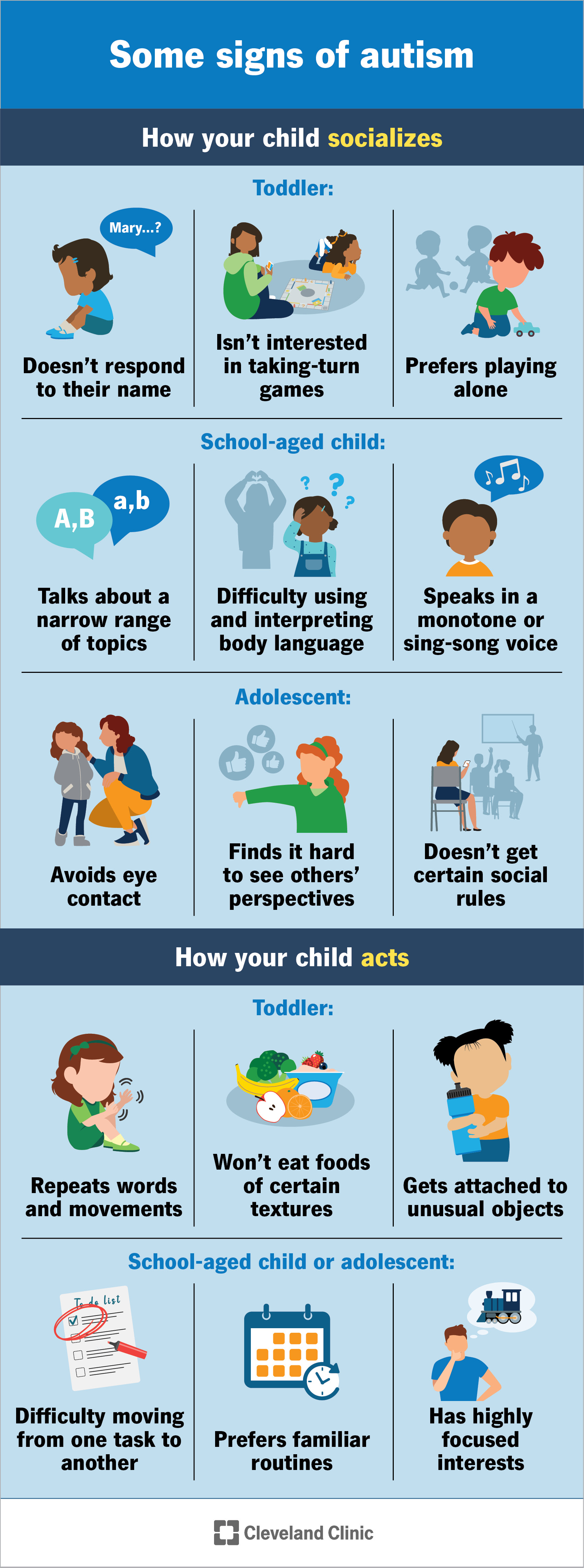
Image content: This image is available to view online.
View image online (https://my.clevelandclinic.org/-/scassets/images/org/health/articles/autism-spectrum-disorder.jpg)
Signs of autism fall into two groups: difficulties with socializing and restrictive and repetitive behaviors, interests or activities.
Autism characteristics fall into two main groups:
Below are examples of autism characteristics you might recognize in your child at different ages.
You may notice your toddler:
You may notice your older child:
You may notice your adolescent:
You may notice your toddler:
You may notice your older child or adolescent:
Many kids do these things at one point or another. But with autism, these behaviors are more than a phase. And they may pose challenges for your child when at school or socializing with peers.
Experts haven’t found a single cause of autism. It’s likely a combination of genetics and certain things related to pregnancy, labor and delivery, including:
Advertisement
The genetic causes of autism are complicated. There’s not a single, specific gene variation that’s unique to autism. Instead, many gene variations are linked to autism. This means your child might have variations in one or more genes that affect how their brain works. These changes might be inherited (passed down within your biological family) or appear for the first time in your child.
Diagnosing autism involves several steps. Often, the process begins at a child’s routine well-check. The American Academy of Pediatrics recommends autism screenings at the 18-month and 24-month visits. A screening means your pediatrician will ask some questions about your child, including how they act, communicate and express emotions.
If your pediatrician notices possible signs of autism, they’ll refer you to a provider who specializes in diagnosing autism.
Providers use the criteria listed in the DSM-5-TR. This diagnostic manual breaks down symptoms into the two main groups discussed earlier: how your child socializes and how they act.
Your child must have difficulties in all three of the following social areas:
Advertisement
AND your child must do at least two of the following:
No, not in the way you might think of a medical test. There aren’t any lab tests or markers in blood or pee for autism. Providers may do genetic testing to check for gene variations associated with autism. But genetic testing doesn’t diagnose autism. Instead, it may help narrow down the cause of your child’s brain differences.
When seeking a diagnosis, it helps to see a developmental pediatrician, who’s trained to recognize autism. They can do a standardized assessment, like the Autism Diagnostic Observation Schedule (ADOS). The ADOS is a set of questions that helps providers identify autism characteristics when observing or interacting with your child. The ADOS and similar tools are designed for providers to use in a clinical setting.
There are many different therapies available to support children with autism. Options like behavioral therapy, speech-language therapy and social skills training help your child manage any challenges they face and build on their strengths. The earlier such support begins — ideally, before age 3 — the more it can benefit your child in the long run.
Advertisement
Some autistic kids have other conditions that need support or treatment. There’s a wide range of conditions that may co-occur with autism, including attention-deficit/hyperactivity disorder (ADHD), anxiety disorders, digestive issues, intellectual disabilities and obsessive-compulsive disorder (OCD).
Providers manage or treat these conditions with things like cognitive behavioral therapy, medications and referrals for educational support.
Childhood disintegrative disorder was one of the names previously used to describe a specific disorder with features of autism.
In the past, a provider would diagnose a child with this disorder if they developed as expected for a period of time before they lost learned skills. This would usually occur after age 3.
Today, providers no longer give a diagnosis of childhood disintegrative disorder. Instead, a child with these features will receive a diagnosis of autism spectrum disorder.



Sign up for our Health Essentials emails for expert guidance on nutrition, fitness, sleep, skin care and more.
Learn more about the Health Library and our editorial process.
Cleveland Clinic’s health articles are based on evidence-backed information and review by medical professionals to ensure accuracy, reliability and up-to-date clinical standards.
Cleveland Clinic’s health articles are based on evidence-backed information and review by medical professionals to ensure accuracy, reliability and up-to-date clinical standards.
There’s hope and caring for kids with autism spectrum disorder. At Cleveland Clinic, we design compassionate, personalized treatments for them.
