



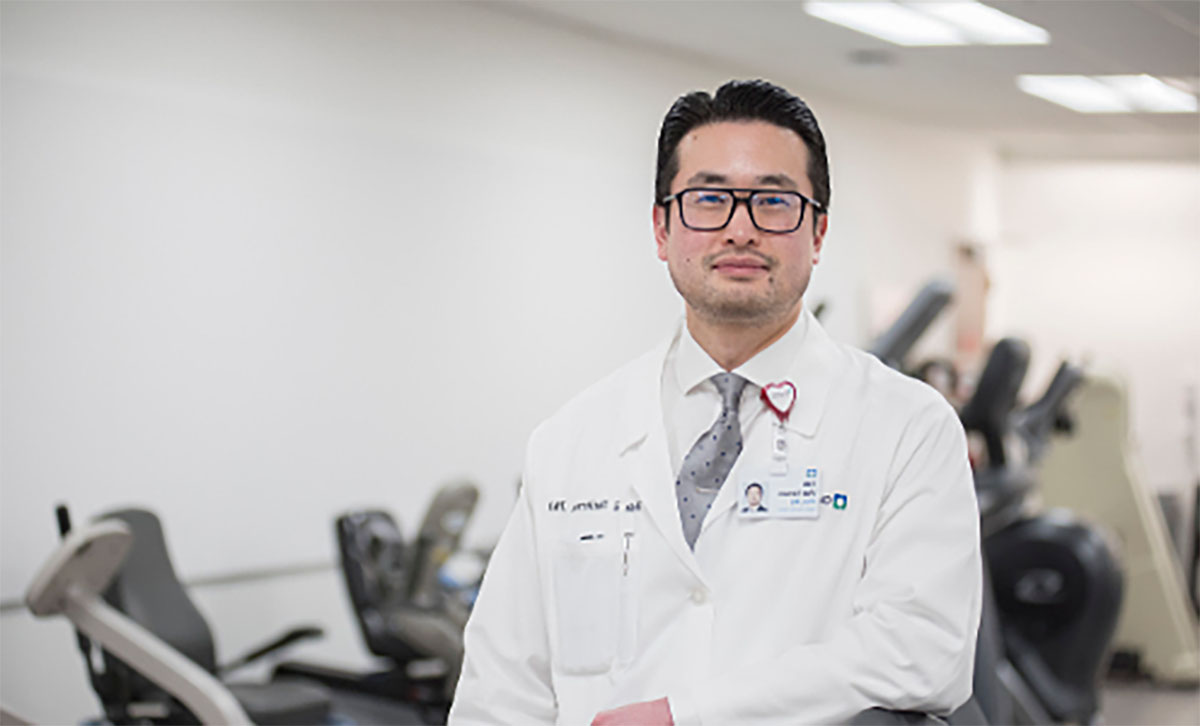
Understanding Cardiac Rehab
Cardiac rehabilitation is a program that combines exercise, diet and education to help people with heart conditions. Erik Van Iterson, PhD, MS, MA, explains how cardiac rehab can improve a patient's quality of life.
Advertisement
Cleveland Clinic is a non-profit academic medical center. Advertising on our site helps support our mission. We do not endorse non-Cleveland Clinic products or services. Policy
Recent Episodes
Encore: AFib After an Ablation
This is an encore episode of "AFib After an Ablation: What to Know", originally published in June 2025. Experiencing persistent or recurrin…
Understanding High-Risk Aortic Valve Endocarditis
Milind Desai, MD, and Per Wierup, MD, discuss high-risk aortic valve endocarditis, a serious infection that can affect heart valves and lead…
Robotic Heart Valve Surgery
Marc Gillinov, MD, and Per Wierup, MD, discuss how robotic heart valve surgery allows surgeons to repair or replace heart valves through sma…
Video content: This video is available to watch online.
View video online (https://cdnapisec.kaltura.com/p/2207941/sp/220794100/playManifest/entryId/1_17fmn1nx/flavorId/1_5f3sgelj/format/url/protocol/https/a.mp4)
Transcript
Announcer:
Welcome to Love Your Heart, brought to you by Cleveland Clinic's Sydell and Arnold Miller Family Heart, Vascular and Thoracic Institute. These podcasts will help you learn more about your heart, thoracic and vascular systems, ways to stay healthy and information about diseases and treatment options. Enjoy.
Advertisement
Cleveland Clinic is a non-profit academic medical center. Advertising on our site helps support our mission. We do not endorse non-Cleveland Clinic products or services. Policy
Erik Van Iterson, PhD, MS, MA:
Good morning, everyone. Thank you very much for tuning in for this podcast, focusing on this topic of cardiac rehab, why it is critical. My name is Dr. Van Iterson. I am the Director of Cardiac Rehab at the Cleveland Clinic in Cleveland, Ohio.
Today, we'll begin with giving a general overview of the modern cardiac rehab program and its key components, who are the patients who are eligible for the service.
So, I'll begin with perhaps what we might all think about when the term cardiac rehab first arises. Many of us may not realize that yes, exercise training is involved in cardiac rehab, but this only represents the origin story of cardiac rehab back when it first started in 1970. In the modern-day version of cardiac rehab, yes, exercise training still exists as a fundamental component of the service, but that exercise training can only be optimized when we look at cardiac rehab from a multidisciplinary perspective. Cardiac rehab always includes discussions and education with patients about exercise training, but also the importance of blood pressure management, lipid control, blood sugar control for diabetes prevention, tobacco cessation, if there's a concern there, and psychosocial and mental health awareness and education and strategies to manage that, and finally, important education on topics relating to diet, nutrition and body weight management.
Advertisement
Cardiac rehab is indeed a multidisciplinary systematic approach to applying secondary prevention therapies of known benefit. Cardiac rehab is a Class 1 recommendation. Cardiac rehab is always individualized to the patient regardless of what they're coming in for. We strongly encourage individuals who are eligible for cardiac rehab to get started as soon as possible.
For some of these patients, it can be in as little as one week, but typically most can start within 21 days following their hospital discharge. We don't want to delay cardiac rehab initiation because we also know that every day that goes by beyond an ideal window of starting this program, there unfortunately becomes a lesser likelihood that a patient will begin the process. So, getting started early is better and it is optimal for extracting the best benefits from not just the three sessions per week for 12 consecutive weeks or 36 sessions of cardiac rehab, but the lifelong practice of cardiac rehab after you get done with hospital-based care.
When patients come into cardiac rehab, we take all that information and create what we call an individualized treatment plan. That means patients have a clear set of interventions defined to address each of the risk factors relating to the core components of cardiac rehab. We set very specific goals for patients to work towards throughout the program, but also set them up for success beyond cardiac rehab. We want patients to not just, of course, participate, but we want them to be adherent to the education, the recommendations and ask questions.
When patients initiate cardiac rehab, they participate in the sessions, they adhere to all the program recommendations, and then they complete cardiac rehab with a discharge consultation to discuss what they should do beyond cardiac rehab.
Our largest patient population would be those coming into cardiac rehab with acute coronary syndrome who have experienced myocardial infarction with or without revascularization need.
The data are very potent in showing the benefits of cardiac rehab at the short-term follow-up, medium-term follow-up, and long-term follow-up when viewing important key clinical outcomes. Those important outcomes and the reduction in risk associated with a cardiac rehab course persist in the long term as long as individuals continue to adhere to and participate in those principles of secondary prevention.
We can see some strong benefits gained through reductions in risk of hospitalization readmission, as well as improvements in quality of life. Importantly, these are outcomes that patients experience not just in the short term or less than a year after finishing cardiac rehab, but these are benefits that patients tend to experience more than a year after the cardiac rehab experience began.
Advertisement
Even though changes in fitness or cardiovascular fitness aren't a prerequisite to extracting the benefits of cardiac rehab, we do know that, in general, there is a very strong association between fitness and risk of cardiovascular disease and other cardiovascular outcomes.
Participating in cardiac rehab over the course of 36 sessions or 12 weeks, what the data shows is that regardless of what starting fitness level you have, everyone can benefit from cardiac rehab and everyone can improve their fitness over the course of that program.
The data showed that those coming in with the least fitness ended up demonstrating the largest improvements in their fitness by the time they finish rehab. But overall, that change in fitness across the entire patient cohort translated to reduction in all-cause mortality risk in the long term just from a increase in fitness.
Thank you very much. I appreciate your interest in this topic.
Announcer:
Thank you for listening. We hope you enjoyed the podcast. We welcome your comments and feedback. Please contact us at heart@ccf.org. Like what you heard? Subscribe wherever you get your podcasts, or listen at clevelandclinic.org/loveyourheartpodcast.
Advertisement
Recent Episodes
Encore: AFib After an Ablation
This is an encore episode of "AFib After an Ablation: What to Know", originally published in June 2025. Experiencing persistent or recurrin…
Understanding High-Risk Aortic Valve Endocarditis
Milind Desai, MD, and Per Wierup, MD, discuss high-risk aortic valve endocarditis, a serious infection that can affect heart valves and lead…
Robotic Heart Valve Surgery
Marc Gillinov, MD, and Per Wierup, MD, discuss how robotic heart valve surgery allows surgeons to repair or replace heart valves through sma…
Never miss a moment - subscribe now.
Listen to the Health Essentials Podcast on your favorite streaming platform.
Other Podcasts You May Love
Beyond Leadership
Hosts Jim Pae and Elizabeth Pugel escort you through a network of thought leaders, sharing world-cla…

Beyond the Pages: CCJM Podcast
Beyond the Pages: CCJM Podcast takes the listener more in-depth into Cleveland Clinic Journal of Med…
Butts & Guts
A Cleveland Clinic podcast exploring your digestive and surgical health from end to end. You’ll lear…

Cancer Advances
A Cleveland Clinic podcast for medical professionals exploring the latest innovative research and cl…