



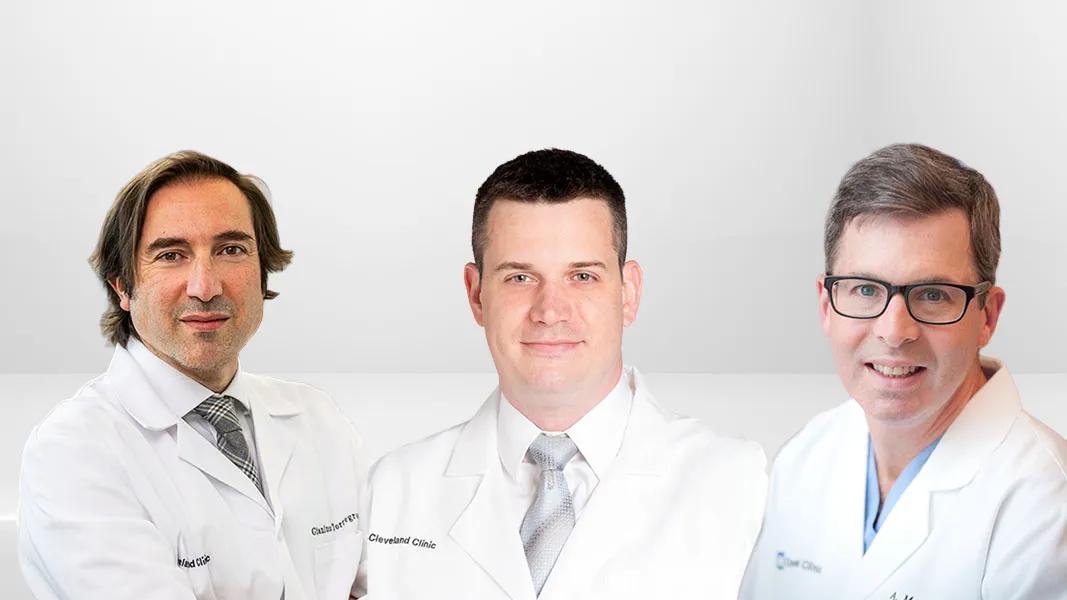
Twenty Years of Advancing Robotic Cardiac Surgery
Marc Gillinov, MD, Marijan Koprivanac, MD, and Gianluca Torregrossa, MD, reflect on 20 years of robotic cardiac surgery at Cleveland Clinic. Robotic innovations have expanded treatment options across the spectrum of heart conditions, including mitral valve disease, aortic valve disease, aortic conditions and coronary artery disease.
Schedule an appointment at Cleveland Clinic by calling 844.868.4339.
Advertisement
Cleveland Clinic is a non-profit academic medical center. Advertising on our site helps support our mission. We do not endorse non-Cleveland Clinic products or services. Policy
Recent Episodes
Traveling Safely With Heart Disease
Ashish Sarraju, MD, and Abhayjit Singh, MD, discuss how people with heart conditions can prepare for travel and when it may be necessary to…
Ask the Heart Doctor | Minimally Invasive Valve Surgery
In this Ask the Heart Doctor episode, Cleveland Clinic experts answer common questions about minimally invasive heart valve surgery. They di…
Ask the Heart Doctor | Genomics: Precision Medicine for Your Heart
In this Ask the Heart Doctor discussion, Cleveland Clinic experts explain cardiovascular genomics and how genetic testing can help identify…
Video content: This video is available to watch online.
View video online (https://cdnapisec.kaltura.com/p/2207941/sp/220794100/playManifest/entryId/1_nqriw9p3/flavorId/1_5f3sgelj/format/url/protocol/https/a.mp4)
Transcript
Announcer:
Welcome to Love Your Heart, brought to you by Cleveland Clinic's Sydell and Arnold Miller Family Heart, Vascular & Thoracic Institute. This podcast will explore disease prevention, testing, medical and surgical treatments, new innovations and more. Enjoy.
Advertisement
Cleveland Clinic is a non-profit academic medical center. Advertising on our site helps support our mission. We do not endorse non-Cleveland Clinic products or services. Policy
Dr. Marc Gillinov:
I'm Dr. Marc Gillinov, Chair of the Department of Cardiac Surgery at Cleveland Clinic, and I'm here with Dr. Marijan Koprivanac. We have something in common. We are two of the Cleveland Clinic's robotic cardiac surgeons. This is the 20th year, our 20th anniversary of doing robotic cardiac surgery at Cleveland Clinic. We were one of the first programs in the country, back in 2006, to adopt it. And at this point, we have the world's largest experience, with about 3,000 operations completed robotically, which means through very small incisions. We started 20 years ago with the mitral valve, and we still do the majority of our isolated mitral valve operations with the robot through tiny incisions. Those are mitral valve repairs for prolapse, mitral valve replacements, when someone has a rheumatic heart valve. We can even do re-operations on the mitral valve with the robot. But what's new? What's new is that we now, in the last few years, have a completely comprehensive robotic cardiac surgery program. Meaning we can do coronary artery bypass grafting through little incisions with the robot. We can do aortic valve surgery with the robot. And Dr. Koprivanac has pioneered new ways to do aortic valve surgery and aortic surgery. These are Cleveland Clinic innovations. Dr. Koprivanac, tell us what you've developed.
Advertisement
Dr. Marijan Koprivanac:
As you mentioned, Marc, we started widening the indications for the robotic approach, which means small incisions, better recovery for the patients, less trauma. We started pushing that edge into the aortic space. The aortic space first started with the aortic valve, and we started to try to see how we can do this to be as least invasive as possible, specifically for aortic valve. We developed this procedure called a transcervical aortic valve replacement with robotic assistance. It really minimizes any kind of incisions on the chest whatsoever, any bigger incision.
Dr. Marc Gillinov:
Where is the incision?
Dr. Marijan Koprivanac:
The incision is right there at the lower part of the neck, same as you have a thyroidectomy. Correct. Which makes minimal manipulation between the ribs, no spreading, no anything between the ribs whatsoever. So, it really improves the mechanics of the chest wall. No pain whatsoever, almost, kind of a dull pain, of course, inside. You still have to do surgery, but nothing compared to even the traditional robotic approaches. These patients are one of the rare patients that more consistently do not need any narcotic pain medications whatsoever because they don't have that much pain. Ibuprofen and Tylenol are pretty much good enough for pain control. They have no chest restrictions. They can go on back to their activities basically the next week already. We just recently had a physician who went back to work seeing patients two weeks after the surgery, which is quite remarkable after open-heart surgery. Because it's still open-heart surgery, just a very minimally invasive one. This really was a big move in general, just how we use the robot, and also a big move in the aortic space. We are still perfecting those procedures to get better and better. Then we also moved for more extensive approaches after that, to not just replace the aortic valve, but to replace the ascending aorta and try to get into more complex aortic space, that goes through the mini thoracotomy approach. We started, and we performed one of the world’s first ascending aorta and combined aortic valve replacements. Patients are doing remarkably well. It's big, in the last year, two years for the aortic robotic surgery space. Huge moves. I expect many other good new things in the future.
Dr. Marc Gillinov:
We are uniquely positioned to advance the field, to give patients better care with very small incisions, in part because we are the only program in the country, I believe, that has two dedicated robots, the most advanced platform. Two dedicated robots for cardiac surgery, meaning we are working together in adjacent operating rooms every day. But more important than that, we've got eight surgeons here who are experts with robotic surgery. Meaning we work together and help each other. Every patient who gets robotic surgery here gets the expertise of two of us or more. It's a remarkable team. It's one of the things that makes us unique, not just that we've done more than any place in the world and that our results are superlative, but that we have a team that covers the mitral valve, the aortic valve, the aorta, cardiac tumors. Through recruitment, we've added coronary artery bypass grafting, or CABG surgery. We've recruited a surgeon now named Gianluca Torregrossa, who you will hear from, and he's one of the few people in the world who can do more than one bypass through incisions this big without using the heart lung machine. Now, this has become a daily occurrence.
Dr. Gianluca Torregrossa:
My name is Gianluca Torregrossa, and I recently joined the Cleveland Clinic as the Director of the Robotic Coronary Program. What brought me here is the long legacy that Cleveland Clinic has had through the last 20 years with robotic cardiac surgery. It's thanks to Cleveland Clinic and the pioneer work of those who have been here for more than 20 years, advocating for a less invasive procedure. Particularly, the mitral valve has been one of the most successful robotic programs or the best established robotic program at Cleveland Clinic. Originally, it was trying to respond to a very important clinical question. We were seeing patients with mitral valve disease that needed surgery early on in their career, early on in their life, but yet these patients were completely asymptomatic, no symptoms at all. It is difficult to convince someone in their 40s or 50s in the peak of their activities when they have kids to bring to school, a swim team to attend because their kids are competing somewhere, a honey-do list and groceries to do, and a lot of jobs in their own careers. It’s difficult to convince someone to go into an operating room and receive a very invasive procedure from the front of the chest via a sternotomy approach. Robotics tried to answer this question. Finally, 20 years after, we have also learned that this approach allows us to have a better exposure of the valve. We can see better the mitral valve. We can repair better the mitral valve. I will say that as a nerd and someone with a huge passion for coronary artery disease, coronary artery disease and robotic CABG stand exactly where robotic mitral stood 10 years ago. In a time in which we are recognizing that nowadays there are more and more opportunities for non-invasive imaging and opportunities to detect coronary artery disease early on in the life of patients or even in advanced age of patients, but in patients that are completely asymptomatic. When you are 75, when you are 80, or at the same time, even when you are in your 40s and you have coronary artery disease, you're looking for a solution that might not imply the opening of the chest. Do we really need to open the chest to perform your bypass? The answer in a lot of specific anatomy is no. No, we don't need it. We are among the very few centers in the world who can perform off-pump totally endoscopic robotic bypass, single and multi-vessels. I have just finished a few hours ago a double vessel bilateral internal thoracic artery bypass grafting, totally endoscopic robotic. It’s a procedure that allows us to do two or three bypasses on the left coronary system of a young patient, just 50, in his early 50s. The patients will go home the next day, with no limitations, and the opportunity to go back to driving basically the exact next day, since you are back at home. The opportunity to go back to your regular life within few weeks of recovery: this is the complete change and the shifting of paradigm. We can address a lot of patients with very complex anatomy thanks to this opportunity, thanks to this technology. We can address a lot of different anatomies thanks to this strategy and thanks to these techniques. Together with my colleagues, experts in robotic aortic valve, robotic mitral valve, we can also offer combined procedures. Patients that have a combined valvular disease and coronary artery disease, and we can combine the efforts of our skills. Working together in the pure spirit of the Cleveland Clinic, putting together our efforts, our know-how, our knowledge, and advancing the level of care. Even complex disease patients with coronary and valvular heart disease still have the opportunity to receive a robotic procedure.
Advertisement
Dr. Marc Gillinov:
We are all very, very excited about what we can do with the robot and what we do with the robot every single day. The biggest impact on patient care is, the person I'm going to operate on today, actually two people I'll do operations on today, robotic mitral valve repairs, they'll be driving next week. Today is Wednesday, and they'll be driving on their own on Monday. That is really a frame shift in heart surgery. Wouldn't you agree?
Dr. Marijan Koprivanac:
Oh, absolutely, absolutely. What we learned from some research, regular surgery, the classical complete sternotomy, we always have these little stories here and there where patients, “oh, I had patients who went back to pretty good in three, four weeks and he felt like he was good”, but those are very, very few. Actually, the majority of patients need a lot of time to recover from those traditional incisions. Based on some of our quality research, and papers actually also from other centers, patients start to feel a normal hundred percent one year after surgery. With these procedures, we markedly reduce that. We have patients coming back to work much sooner and feeling more normal much, much, much faster than that. This is really the goal while still keeping the same safety, efficacy, efficiency of the surgery. That is what is so exciting and remarkable here.
Advertisement
Dr. Marc Gillinov:
As with everything we do at Cleveland Clinic, we track our outcomes meticulously. What we know is that robotic surgery is as safe, if not safer, than traditional heart surgery done with a big incision, and that recovery is quicker, infections are vanishingly rare, blood transfusions are less common, and people return to their lives more quickly. Meaning when people ask us, "Is robotic surgery as good?" Our answer is, "As good? It's better in the right person." We screen everyone very carefully to make sure that we give you the right operation. But more often than not, it's going to be robotic surgery. In the next few months, in terms of advances, we will be bringing in robotic systems from other countries. There is a system in India that is doing very well. I tried it last week in Europe, in Barcelona. It looks like it's got some very nice innovations. Toward the idea of always being on the cutting edge, we will be, almost certainly, the first place in North America to employ this system. It just broadens our ability to treat people. We also are able to advise the manufacturers on instruments we need to advance the field. I know with the aortic valve, you are using, for the most part, things I use for the mitral valve, but it's a different valve, so you're helping them to advance.
Advertisement
Dr. Marijan Koprivanac:
Correct, correct. We are adjusting a lot of other instruments also for that specifically, so there's a lot of good stuff happening.
Dr. Marc Gillinov:
At Cleveland Clinic, we've been doing robotic surgery since the beginning. The first surgical robots became available in the late '90s, and we jumped on that. The problem was that at that time, now 30 years ago, the robot wasn't quite right for heart surgery. It was just too difficult. Nevertheless, we worked with innovators, such that by 2006, the robot was suitable. In fact, it was good. Our current CEO, Dr. Tom Mihaljevic, was our first robotic mitral surgeon. We decided we would always work together. This is a feature of Cleveland Clinic. As a team, we are always stronger than as individuals. So, Dr. Mihaljevic and I decided to work together. He did our first robotic mitral valve surgery with me following about six months behind. We had the opportunity to learn together and we became better together. Over the years, the technology improved such that the visualization was better. The instruments became better over time. The instruments for the robot are what we call wristed, meaning the ends of the instruments can bend, but they can bend even more than your hands. So, if this hand were a robotic instrument, my fingers could bend all the way back to my arm. We have more degrees of freedom with the robot than we do with our own hands and fingers. We can see better. The robot actually has two cameras, one for each eye, and that means we get depth perception. Meaning it's like we're walking around inside someone's heart. Throughout the mid-2000s, we were one of the few programs that kept doing robotic surgery. The technology continued to improve such that now the surgical robots are about 98% computing power and 2% actual tools. What does that mean? It means that the data that we will be able to get from the robot will enable us to work with artificial intelligence, or AI, to plan operations, to assess operations, to determine the most efficient and best ways to do operations. And if you said, "What's next?" It's not a robot that's going to just do your operation. That is a good ways off. But it's a robot that will work with the surgeon. The robot will tell me, “this sort of operation is most efficiently completed, most safely achieved based on our database with the following steps”. It won't tell me what to do. But it will tell me the choices and outline what we can do to make the operation, which is already incredibly safe and effective, even better. Meaning, just as in so many parts of life, we're going to see AI play a big part. It's not going to be self-driving cars. We're not going to have self-driving robots where they come in and do your operation. But we will have surgeons who work, actually, with the robots. Now, we use the robot. I foresee we're working together. What do you think, Dr. Koprivanac?
Dr. Marijan Koprivanac:
I agree, yeah, absolutely agree. We already started to have automatic analysis of these cases, times and everything that we have, so this is where the future goes.
Dr. Marc Gillinov:
We will only get better. Compared to where we were five years ago, when we were just doing mitral valve surgery, we are advancing at an evolutionary rate. Now, we can do most operations, even re-operations, with the surgical robot and return people to their lives far more quickly, with the same safety and the same effectiveness as we would through a regular incision. There's nothing wrong with regular incisions, but our feeling is quite simple: if we can do the same operation, same safety, same effectiveness, and give you incisions this big, get you back to your life, then that is a superior option for most patients. There are three things that make Cleveland Clinic, that make us, unique compared to many other fine programs in the country. The first is experience. We have done 3,000 robotic operations. Nobody has done this much. Experience breeds excellence, it breeds competence, and we have that experience. The second thing that makes us unique is our outcomes. Our outcomes are superlative. The risk of robotic mitral valve surgery, for example, is less than one in a thousand. These are the sorts of risks one talks about for gallbladder surgery. Meaning robotic surgery is absolutely safe here, which gets back to the experience part. The third unique feature is that we are the only team in the country that spans all aspects of robotic surgery. By that, I mean we do everything. We do coronary artery bypass grafting. We do aortic valve surgery. We do aortic aneurysm surgery. We take out cardiac tumors with the robot. We fix the tricuspid valve. We can address your atrial fibrillation. We're the only program that is comprehensive. So, the three things: tremendous experience; outcomes, safety and effectiveness; and the breadth of procedures, virtually all of heart surgery. Because we now have two fully dedicated robots for cardiac surgery, and I believe soon to be three, we have capacity. If you need robotic heart surgery or if you have a patient who needs robotic heart surgery, you'll see how to reach us, we are easy to reach. We've got the ability and we'll get you right in and get you fixed up.
Announcer:
Thank you for listening to Love Your Heart. We hope you enjoyed the podcast. For more information or to schedule an appointment at Cleveland Clinic, please call 844.868.4339. That's 844.868.4339. We welcome your comments and feedback. Please contact us at heart@ccf.org. Like what you heard? Subscribe wherever you get your podcasts or listen at clevelandclinic.org/loveyourheartpodcast.
Recent Episodes
Traveling Safely With Heart Disease
Ashish Sarraju, MD, and Abhayjit Singh, MD, discuss how people with heart conditions can prepare for travel and when it may be necessary to…
Ask the Heart Doctor | Minimally Invasive Valve Surgery
In this Ask the Heart Doctor episode, Cleveland Clinic experts answer common questions about minimally invasive heart valve surgery. They di…
Ask the Heart Doctor | Genomics: Precision Medicine for Your Heart
In this Ask the Heart Doctor discussion, Cleveland Clinic experts explain cardiovascular genomics and how genetic testing can help identify…
Other Podcasts You May Love
Beyond Leadership
Hosts Jim Pae and Elizabeth Pugel escort you through a network of thought leaders, sharing world-cla…
Beyond the Pages: CCJM Podcast
Beyond the Pages: CCJM Podcast takes the listener more in-depth into Cleveland Clinic Journal of Med…
Butts & Guts
A Cleveland Clinic podcast exploring your digestive and surgical health from end to end. You’ll lear…

Cancer Advances
A Cleveland Clinic podcast for medical professionals exploring the latest innovative research and cl…