



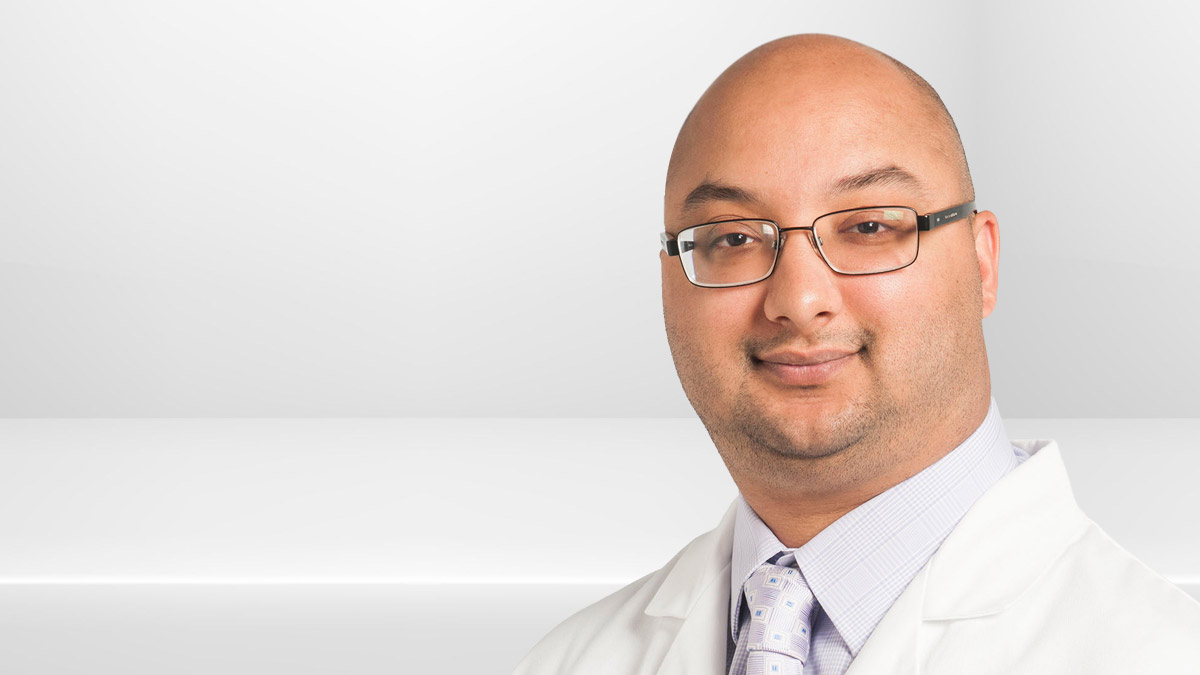
Reducing Radiation-Related Toxicities with CPAP Machines
Radiation Oncologist and Co-Director of the Comprehensive Breast Cancer Program at Cleveland Clinic, Chirag Shah, MD, joins the Cancer Advances podcast to discuss his study on the innovative use of CPAP (Continuous Positive Airway Pressure) machines in combination with radiation therapy. Listen as Dr. Shah explains how using CPAP machines in radiation therapy has been shown to reduce radiation-related toxicities in breast and lung cancer patients.
Advertisement
Cleveland Clinic is a non-profit academic medical center. Advertising on our site helps support our mission. We do not endorse non-Cleveland Clinic products or services. Policy
Recent Episodes
Redefining Resectability in Advanced Rectal Cancer
What happens when a cancer is deemed unresectable? In this episode, Dr. Haniee Chung discusses how multidisciplinary care is expanding treat…
Preserving Vision, Expanding Options in Uveal Melanoma
As new therapies move through clinical trials, the management of uveal melanoma is entering a period of significant change. In this episode…
Integrating Goals-of-Care Discussions in Oncology Practice
How can oncologists initiate meaningful goals-of-care discussions earlier in the disease course? In this episode, Dr. Natalie Jacobowski out…
Video content: This video is available to watch online.
View video online (https://cdnapisec.kaltura.com/p/2207941/sp/220794100/playManifest/entryId/1_h5id547z/flavorId/1_5f3sgelj/format/url/protocol/https/a.mp4)
Transcript
Dale Shepard, MD, PhD:
Cancer Advances, a Cleveland Clinic podcast for medical professionals exploring the latest innovative research and clinical advances in the field of oncology. Thank you for joining us for another episode of Cancer Advances. I'm your host, Dr. Dale Shepherd, a medical oncologist here at Cleveland Clinic directing the Taussig Early Cancer Therapeutics Program and co-directing the Cleveland Clinic Sarcoma Program.
Advertisement
Cleveland Clinic is a non-profit academic medical center. Advertising on our site helps support our mission. We do not endorse non-Cleveland Clinic products or services. Policy
Today, I'm very happy to be joined by Dr. Chirag Shah, Director of Breast Radiation Oncology here at Cleveland Clinic. He's been a frequent guest on this podcast to discuss issues related to radiation therapy for treatment of breast cancer, and those episodes are still available for you to listen to. He's here today to talk to us about reducing radiation related toxicities with CPAP machines. Welcome, Chirag.
Chirag Shah, MD : Thank you. Pleasure to be here.
Dale Shepard, MD, PhD:
Remind us of a little bit about what you do here at Cleveland Clinic.
Chirag Shah, MD:
Sure. I'm a radiation oncologist, and I specialize in breast cancer and in particular using techniques to reduce dose to the heart and lungs as these are areas, we can see side effects of breast radiation. Along with Dr. Halle Moore, I serve as the co-director of the Comprehensive Breast Program.
Dale Shepard, MD, PhD:
Excellent. We're going to talk a little bit about something that I got to tell you, I hadn't really thought much about, and that's using CPAP or continuous positive airway pressure machines in combination with radiation. Maybe just to start, give us a little bit of an idea what a CPAP machine is and how does it work and why we are thinking about using that.
Chirag Shah, MD:
When people think about a CPAP machine, which stands for continuous positive airway pressure machine, they think of people who have sleep apnea. And that's actually what the device was designed for, and it takes air, and it pushes that air and creates positive pressure. It goes through the sleeper's nose, their mouth, into the back of their throat, and it helps keep all those tissues open and therefore reduce the risk of sleep apnea.
Advertisement
But one of the other things that we've seen is that when you use this type of positive pressure, it can fill the lungs and it expands the lungs and push the lungs out. One of the things that does is it pushes the breast and the chest wall away from the lungs and the heart, and it also over inflates the lungs. So that if you're trying to give radiation, you're actually giving radiation to less of the lungs. That's really the concept behind using CPAP for breast radiation.
Dale Shepard, MD, PhD:
That's excellent. When we think about this, what are the most common toxicities that we're trying to avoid? Traditionally, we've done radiation without CPAP. What are the biggest things we're trying to avoid here?
Chirag Shah, MD:
The biggest things we're trying to avoid are really heart and lung side effects. When you think about heart side effects from breast radiation, that can include an increased risk of coronary heart disease and heart attacks, an increased risk of valvular abnormalities. On the lung side, it can include things like pneumonitis, which is an inflammation of the lung, and lung fibrosis.
One of the reasons we started using CPAP is we've used other technologies, but a lot of those technologies require the patient to be able to hold their breath for 15, 20 plus seconds. A lot of patients who may have other health problems aren't really able to hold their breath. We didn't have a good way to use these types of techniques until we started using CPAP, which doesn't require a patient to hold their breath.
Dale Shepard, MD, PhD:
When we think about particular groups of patients this might be good for, you mentioned something about limitations in holding breath, are there particular patients based on age, based on body habitus, who might benefit most from this?
Chirag Shah, MD:
When we think about it, we actually think about it for all patients who may need breast radiation, where we want to protect the heart and lungs, particularly the left side, but even on the right side where we're treating the lymph nodes, for example. We're also studying this in a cohort of patients who have lung cancer.
Often patient's lung cancer may have reduced lung volumes, ability to hold their breath, and this may be something where a CPAP device allows them to reduce the dose of their heart lungs if they can't hold their breath. It's not so much about body habits and age, but more pulmonary function and pulmonary conditioning.
Dale Shepard, MD, PhD:
Interesting. Now, you mentioned something about a study. Tell us a little bit about the research you're doing in this area.
Chirag Shah, MD:
We're doing a clinical study of using CPAP for both patients with breast cancer, as well as cancers of the lung. What we're looking at is we're comparing the heart and lung doses with CPAP as compared to, first of all, just free breathing or normal breathing scans, and then also compared to this breath hold scans, because the idea is that this can be as good or better than the breath hold scans. This is a much easier and patient oriented way of doing heart and lung sparing radiation.
Advertisement
Dale Shepard, MD, PhD:
When we think about a clinical trial, how large is a trial, how far along are you in the research?
Chirag Shah, MD:
The clinical trial is going to have 50 breast cancer patients and 50 lung cancer patients. We've been accruing for the past year, so we're continuing to accrue and it's going well. So far, our outcomes have been good. The preliminary results have shown what we've expected, which is that we're getting better heart and lung sparing as compared to free breathing, but obviously more data is needed to compare to the breath hold technique.
Dale Shepard, MD, PhD:
You mentioned before about the left side being more important. Are you limiting patients with left or right breast cancer?
Chirag Shah, MD:
Yeah. On this study, we're primarily having patients with left-sided breast cancers be evaluated just given that the heart tends to sit on the left side of the chest.
Dale Shepard, MD, PhD:
Makes sense. Too early to understand some of the toxicities that we might see. When would we typically find, you mentioned things like pneumonitis or issues with valvular disease, when do those typically occur and how are we going to be following for those kinds of side effects?
Chirag Shah, MD:
It's a great question. The side effects can happen starting weeks after radiation all the way to months to years later. Pneumonitis is typically seen within a few weeks to a few months of radiation being over. We typically follow this clinically to make sure that patients are not having any symptoms like fevers, cough, shortness of breath. Longer term side effects like valvular abnormalities, coronary artery disease typically is long-term.
Advertisement
This requires long-term follow-up of patients to see that they don't have any events. One of the things we do know is that the dose of these structures correlates with the risk of these side effects, which is how we're coming up with short-term data, basically correlating the dose of these structures and how that correlate to their risk of side effects.
Dale Shepard, MD, PhD:
And then what, if anything, could we talk about efficacy? Anytime you think about changing a technique, do you have areas that are getting more or less radiation?
Chirag Shah, MD:
Yeah, it's a great question. First of all, we have data that says this isn't going to change cancer control outcomes because we're still giving the same dose to the parts of the breast or lung we need to. That's first of all most important that this isn't a study where we think there's any change there. In terms of the side effects and the dosing, we get two sets of data.
The first set of data is really just a comparison of the dosing from the radiation on these organs, and we get that right away and we're able to see how it's reduced compared to free breathing and how it compares to breath hold. The second portion of data is going to take months and years to follow where we look at events downstream and see if there's any difference. We're going to follow those tracks at parallel times.
Advertisement
Dale Shepard, MD, PhD:
Very, very practical question that would be thinking about patient experience. I certainly see patients in clinics who need to be using CPAP for their sleep apnea and they say, "This is ridiculously uncomfortable. I'm not doing it." What's patient experience been like so far in terms of not only going through a radiation procedure, but then also overlaying CPAP? Have you had much input on that?
Chirag Shah, MD:
Yeah, the patients actually really like it. I have patients actually come and request either ones who've already had sleep and apnea and are comfortable with using a CPAP or those patients say, Dr. Chirag, compared to having the breath hold technique with the nose plugs on my nose and things like that, this is much better, much more oriented to me." Actually, we were worried about that actually. But actually, when people see the comparison of the breath hold technique, they actually favor the CPAP.
Dale Shepard, MD, PhD:
Was there any need to familiarize patients who may not have used CPAP in the past to these CPAP machines? What did that look like?
Chirag Shah, MD:
We were very lucky. We worked with the Respiratory Institute, and they guided us on how they do CPAP education for folks with sleep apnea. We've actually implemented the same type of education when patients come into our clinic. We're able to educate them on the CPAP, the equipment, how we use it, and then how we get the pressure built up so that they can then get the radiation therapy. It's a big part of the study and any use of CPAP moving forward will be that educational component as many people are unfamiliar with it.
Dale Shepard, MD, PhD:
Do you foresee any issues with this becoming more of a mainstream technique in terms of places adopting this? Or do you think this is going to be pretty easy to get in place if it shows benefit?
Chirag Shah, MD:
Actually, one of the reasons we wanted to study this is it's actually much easier to implement than the breath hold device, which can be quite expensive and technically complicated. This device is a much lower price point, so it can be used in clinics of all sizes without having to worry. It's very easy to educate. The amount of time that we had to take to educate our staff was much less than doing with a breath hold device. Our hope is that if the trial is positive, this is something going to be disseminated to clinics of all shapes and sizes.
Dale Shepard, MD, PhD:
And then I guess from a trial standpoint, when do we expect readout and ability to assess whether this has been successful?
Chirag Shah, MD:
I think we'll have the preliminary results probably in the next year to two, and then obviously continue following for long-term events.
Dale Shepard, MD, PhD:
I guess a logical question, anytime you're doing research, that, of course, means search and then search again, right? What's next? What would be the next step to move forward?
Chirag Shah, MD:
I think once we show the safety data, it's wide sent dissemination and showing that it can be done easily in the clinic, that it doesn't increase treatment time for patients or the clinic, and really just real-world proof of concept. Right now, we're doing it with clinical trials. But then once we implement it broadly, it's really just showing that this can be done day in and day out with relatively easy reproducibility.
Dale Shepard, MD, PhD:
And then I guess when we think about it, this is certainly a good way, it sounds to minimize toxicities, what's next on the horizon? What are the things you're thinking about in terms of how to deliver radiation in the safest possible way?
Chirag Shah, MD:
Well, I think there's two things. I think the first thing is really making sure we're treating the patients who need radiation. The biggest way to reduce the side effects of radiation is to radiate patients that truly need it. We're doing a lot of work on using tumor biology and tumor genetics to pick out the patients who benefit and don't benefit from radiation.
And then the other thing we're doing is we're innovating techniques that keep the dose to the chest lower, so things that just target the area where surgery is done, what we call partial breast radiation. The less normal tissues we treat, the less risk of side effects as well beyond these types of techniques. Again, both of those are running in parallel, but we're hoping that will allow us to give radiation to the patients that will benefit most in the way that's least toxic.
Dale Shepard, MD, PhD:
I guess we've talked about the benefits of doing something like CPAP. What are the downsides?
Chirag Shah, MD:
The downside is it requires a little bit of training and education. Like you said, some patients it can be a bit scary when they see that, but we really work with them to educate them. The other thing is you really want people who know how to use it properly, and we're lucky to have folks that have been trained properly by the Respiratory Institute. Because if you don't do it carefully, you can certainly suffer with too much pressure and cause side effects. And that's why it's titrated very slowly when the patients are doing it so that we don't increase the pressure too quickly on the lungs and the chest.
Dale Shepard, MD, PhD:
Well, it certainly sounds like an exciting approach to try to minimize toxicity and benefit patients. Good luck with the remainder of the study and hopefully we have some good results to help our patients.
Chirag Shah, MD:
Thank you so much, Dr. Shepard.
Dale Shepard, MD, PhD:
To make a direct online referral to our Taussig Cancer Institute, complete our online cancer patient referral form by visiting clevelandclinic.org/cancerpatientreferrals. You will receive confirmation once the appointment is scheduled. This concludes this episode of Cancer Advances. You will find additional podcast episodes on our website, clevelandclinic.org/canceradvancespodcast. Subscribe to the podcast on iTunes, Google Play, Spotify, SoundCloud, or wherever you listen to podcasts. Don't forget, you can access real-time updates from Cleveland Clinic's Cancer Center experts on our Consult QD website at consultqd.clevelandclinic.org/cancer.
Thank you for listening. Please join us again soon.
Recent Episodes
Redefining Resectability in Advanced Rectal Cancer
What happens when a cancer is deemed unresectable? In this episode, Dr. Haniee Chung discusses how multidisciplinary care is expanding treat…
Preserving Vision, Expanding Options in Uveal Melanoma
As new therapies move through clinical trials, the management of uveal melanoma is entering a period of significant change. In this episode…
Integrating Goals-of-Care Discussions in Oncology Practice
How can oncologists initiate meaningful goals-of-care discussions earlier in the disease course? In this episode, Dr. Natalie Jacobowski out…
Never miss a moment - subscribe now.
Listen to the Health Essentials Podcast on your favorite streaming platform.
Other Podcasts You May Love
Beyond Leadership
Hosts Jim Pae and Elizabeth Pugel escort you through a network of thought leaders, sharing world-cla…

Beyond the Pages: CCJM Podcast
Beyond the Pages: CCJM Podcast takes the listener more in-depth into Cleveland Clinic Journal of Med…

Butts & Guts
A Cleveland Clinic podcast exploring your digestive and surgical health from end to end. You’ll lear…
Cardiac Consult
A Cleveland Clinic podcast exploring heart, vascular and thoracic topics of interest to healthcare p…