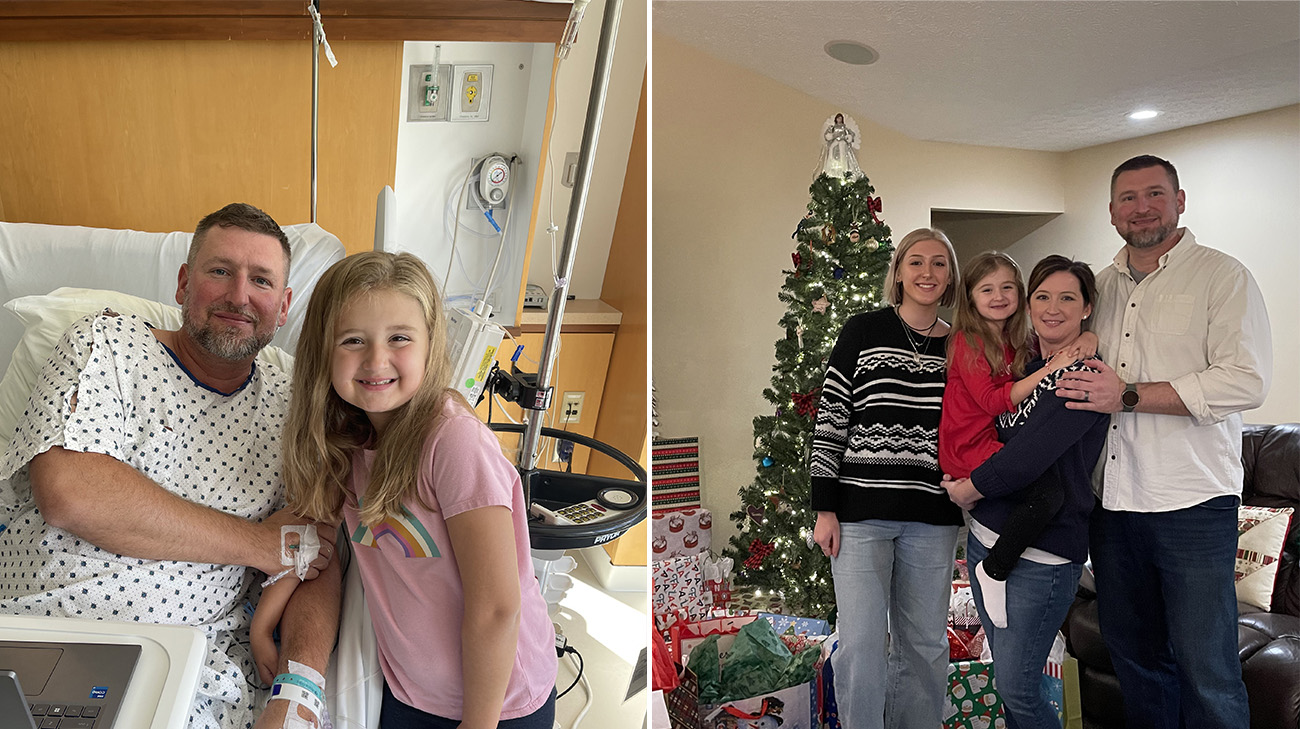
In May 2025, Timothy Beckner was living his best life, returning from a vacation in Punta Cana with extended family members to celebrate wedding anniversaries, birthdays and his daughter’s college graduation.
Once home, Tim experienced some stomach issues that lingered, and eventually developed a fever. His wife Stefanie told him to get checked out, so Tim went to a local urgent care, where the doctor performed an initial exam and recommended he go to the emergency department.
“I went to the ED at Cleveland Clinic Lakewood Family Health Center, where I underwent various exams, a CT scan, and was asked to provide stool and urine samples,” says Tim, who was diagnosed with salmonella and a mild case of diverticulitis. The emergency medicine physician prescribed antibiotics and suggested he schedule a follow-up with Cleveland Clinic colorectal surgeon, Ajaratu Keshinro, MD.
Tim was feeling much better at the time of that appointment. He had no symptoms but due to the diverticulitis, Dr. Keshinro recommended he have a colonoscopy.
“I had zero symptoms, and no idea what was inside me. Because everyone did their job, I’m here. If Dr. Keshinro did not recommend that colonoscopy, I may not have been around in a few years. I credit Cleveland Clinic 100% with saving my life.”
“At 43, Tim is younger than the current recommendation of age 45 for an initial colon cancer screening, but I suggested he get one because it is the standard of care to obtain one (if no priors) to make sure that no other pathology was mimicking the diverticulitis,” says Dr. Keshinro who explained that due to a documented increase in early-onset colorectal cancer, that recommendation was lowered from age 50. “I support this change because earlier screening increases the likelihood of detecting cancer at an earlier, more treatable stage, and in some cases, prevents cancer altogether through the removal of precancerous polyps.”
What happens during a colorectal screening depends on the type of testing done. Colonoscopy is the most common test, and the most accurate screening method available. However, there are also stool-based at-home tests and other that use CT scans and flexible sigmoidoscopy to visualize the colon. These may be options for patients with medical comorbidities or other challenges related to the bowel preparation required for colonoscopy, or for those with average risk of colon or rectal cancer.
Tim agreed to a colonoscopy, and shares that the worst part was the prep the day before. “The procedure itself, there is no pain, you don’t feel anything,” he says.
However, that colonoscopy in late July led to an unexpected result. Despite his lack of symptoms, never feeling bad and not having a clue that anything could be wrong, there was a tumor in Tim’s cecum, the first pouch-like part of the large intestine, just above the appendix. Dr. Keshinro shares that Tim’s case was unique because the tumor wasn’t even at the site of the diverticulitis.
“Dr. Keshinro told me they’d biopsy the tumor, but regardless of the results, I needed surgery to remove it,” says Tim, who admits that time kind of stopped for him upon hearing the news. “I was in disbelief, but knew this had to be taken care of, now.”
A positive biopsy result led to additional testing, including a CT scan with contrast and blood work prior to surgery to determine if the cancer may have spread to his lungs, liver, kidneys or lymph nodes.
Dr. Keshinro performed laparoscopic minimally invasive surgery at Cleveland Clinic Fairview Hospital to remove the tumor just before Labor Day weekend.
“There are a couple options for minimally invasive surgery, including laparoscopic and robotic,” says Dr. Keshinro. “The choice of approach is often based on surgeon preference and resource availability, though in some cases, robotic surgery is reserved for more complex cases. In Tim’s case, I did not anticipate any challenges, and using a laparoscopic approach allowed us to proceed with surgery sooner.”
After a few days in the hospital, Tim was discharged home. A week or so later, Dr. Keshinro called to tell him they had caught the cancer very early, it was Stage I. She was able to declare he was cancer-free.
After a short time recovering at home, Tim returned to work and living his best life. For Stage I disease, and because patients with a history of colorectal cancer have an increased risk of recurrence, ongoing surveillance is the recommended treatment protocol. Tim will have another colonoscopy a year from when he had his first, and if all is good then, he’ll have one every five years.
“I had zero symptoms, and no idea what was inside me. Because everyone did their job, I’m here. If Dr. Keshinro did not recommend that colonoscopy, I may not have been around in a few years. I credit Cleveland Clinic 100% with saving my life,” says Tim, who is sharing his story to hopefully help others. “If you are of the age to get that colonoscopy, don’t wait. It could literally be a matter of life and death.”
To hear an interview with Tim and Dr. Keshinro, please listen to this episode of the podcast Butts & Guts.
Related Institutes: Digestive Disease & Surgery Institute , Cleveland Clinic Cancer CenterPatient Stories
Personalised Neurorehabilitation Helps British Paralympian Redefine What Matters
Sep 10, 2026

Black Eye On Baby Monitor Helps Mother Uncover Daughter's Rare Eye Cancer
Sep 7, 2026