



Your appendix is a small organ in your lower right abdomen. Once thought to be useless, we now know it helps balance good and bad bacteria in your gut and supports your immune system. At the same time, most people can live without it. Your body has a way of shifting gears to make sure you stay strong and healthy.
Advertisement
Cleveland Clinic is a non-profit academic medical center. Advertising on our site helps support our mission. We do not endorse non-Cleveland Clinic products or services. Policy
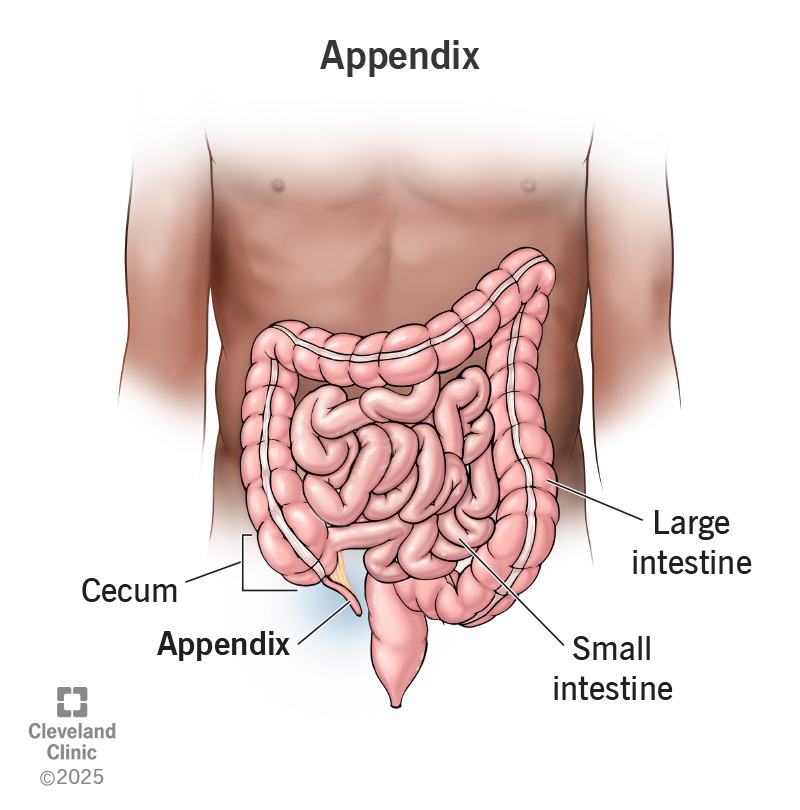
Image content: This image is available to view online.
View image online (https://my.clevelandclinic.org/-/scassets/images/org/health/articles/appendix.jpg)
Your appendix is a small, thin pouch of tissue attached to your large intestine. It’s in the lower right part of your abdomen. Scientists used to think it was a vestigial organ. That means it had no known function. Research now shows that your appendix is an important organ for your overall health. This is especially true in early life, when your immune system is developing.
Advertisement
Cleveland Clinic is a non-profit academic medical center. Advertising on our site helps support our mission. We do not endorse non-Cleveland Clinic products or services. Policy
For a long time, scientists didn’t think your appendix had any purpose. But research now shows it plays a role in keeping your body healthy.
Appendix functions include:
Your appendix is located on the lower right side of your abdomen, where your small intestine meets your large intestine. It sticks out from your cecum. Your cecum is the first part of your large intestine near the end of your small intestine.
Your appendix is a small, tube-shaped organ that hangs off your large intestine. It’s usually about 3 to 4 inches long — about the length of a middle finger.
Advertisement
Even though it’s small, your appendix has a complex structure. Its layers include:
The most common condition affecting your appendix is appendicitis. This occurs when an infection causes swelling and irritation. Appendicitis is a medical emergency. If left untreated, your appendix can burst (rupture). You need surgery immediately to remove your appendix (appendectomy).
Less commonly, conditions that affect the appendix can include:
If you have any of the following symptoms, it could have something to do with your appendix:
These symptoms usually mean your appendix is inflamed or your microbiome/immune function is disrupted. It’s important to get medical attention right away.
Your appendix plays a role in immunity and gut bacteria. You can keep it healthy by supporting your gut and immune system:
Your appendix has several important immune and microbiome roles. If you need to have it removed, you may have fewer good bacteria in your gut. You also have a small increase in your risk of developing certain infections or immune-related conditions over time.
Advertisement
But most people go on to live healthy lives without the appendix. This is because your body adjusts. The rest of your gut and immune system make up for the loss.
People used to think your appendix didn’t matter. But research shows it plays a role in supporting your immune system and gut health. Eating well, staying active and listening to your body can help keep it healthy. At the same time, if you ever need to have it removed, your body will learn to adapt. Your immune system will step up to keep your body strong and working well.
Advertisement



Sign up for our Health Essentials emails for expert guidance on nutrition, fitness, sleep, skin care and more.
Learn more about the Health Library and our editorial process.
Cleveland Clinic’s health articles are based on evidence-backed information and review by medical professionals to ensure accuracy, reliability and up-to-date clinical standards.
Cleveland Clinic’s health articles are based on evidence-backed information and review by medical professionals to ensure accuracy, reliability and up-to-date clinical standards.
Cleveland Clinic’s primary care providers offer lifelong medical care. From sinus infections and high blood pressure to preventive screening, we’re here for you.
