Several years ago, Mike Ray received a life-altering diagnosis. His colon cancer had spread to his liver, and he also learned he had Lynch syndrome — a genetic condition that significantly increases the risk of developing certain cancers. To have a chance at long‑term survival, Mike would need a liver transplant. However, most medical centers were unable to offer surgery for someone with metastatic cancer and Lynch syndrome. Most could only offer palliative care.
The 39-year-old from Hilliard, Ohio, wasn’t ready to give up. While participating in an online support group, Mike learned Cleveland Clinic was performing liver transplants for select patients with similar diagnoses. That possibility inspired him to make the trip to Cleveland, Ohio, and meet the team who might offer him a chance.
Doctors believed he could be a transplant candidate but told him meeting the requirements for surgery would take time. Because of the complexity of his condition, the process lasted about two and a half years. His treatment plan included chemotherapy, radiation, and placement of a hepatic artery infusion pump, all aimed at fully controlling the cancer before moving forward with transplant.
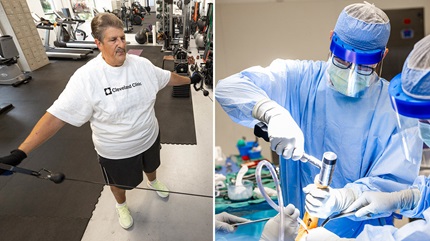
Mike felt the only way he’d get through this process was to be as physically active as possible. He exercised up to three times a day, typically only taking one day off a week. He ran, swam, rode his bike, lifted weights and did high intensity interval training. He kept up this intense regimen despite being on chemotherapy and having the pump attached to him.

Mike with his daughter, showing an Ironman medal from a competition completed after his cancer diagnosis. (Courtesy: Mike Ray)
“I knew I had to keep fighting,” Mike recalls. “You can’t stay in a dead cockroach position. You have to get up and move. Get help to do it if you need to, but don’t quit!”
Mazhar Khalil, MD, Mike’s transplant surgeon, explains that since Cleveland Clinic developed new protocols, the team has successfully performed liver transplants for carefully selected patients with metastatic colorectal cancer.
“For Mike, it was an even greater challenge because of his Lynch syndrome. He would not have been a candidate anywhere else,” Dr. Khalil says.
The protocols are designed to aggressively control the cancer before transplant, preventing progression that would otherwise disqualify a patient from receiving a donor organ and significantly reducing the risk of recurrence afterward.
“With this unique approach, we essentially take charge of the cancer’s biology,” Dr. Khalil says. “Usually, it's the other way around. Most centers allow the cancer to show how aggressive it is. We changed our philosophy and approach to treat the cancer aggressively and not allow it to spread anywhere else.”

Mike ringing the bell alongside his family signifying he no longer has evidence of cancer. (Courtesy: Mike Ray)
Mike was in excellent physical condition when he received his transplant in May 2025, a factor that helped speed up his recovery. He spent just one week in the hospital, far less than the typical three‑week stay for most patients who undergo a transplant.
As his strength and stamina returned, Mike gradually resumed training. By February 2026, he was once again running up to 6 miles, taking only occasional walk breaks and had returned to lifting weights. Now, he is setting his sights on a triathlon in July 2026 — a 70‑mile event that includes swimming, biking and running — along with several other competitions.
Dr. Khalil credits Mike’s commitment to exercise with playing a meaningful role in his recovery.
“He came in so healthy, after prepping for marathons even while he was on chemo,” Dr. Khalil says. “That helped speed his postoperative recovery and supported his return to daily activities.”

Surrounded by friends, Mike has always tried to stay active throughout cancer treatment and recovery. (Courtesy: Mike Ray)
Dr. Khalil encourages others with colorectal cancer that has spread to the liver to continue exploring their options. “Our ability to treat colorectal liver metastases continues to evolve as we learn more and refine our approach,” he says.
Today, Mike connects with others facing health challenges, encouraging them to seek second opinions when possible and remain physically active.
“I always tell them, ‘Don’t Give Up,’” he says. “Define your own goals and push on. You can overcome anything, and I’m proof of that.”
Mike adds, “There are no setbacks, only setups for something great. Every day is a new chance to improve something in your life.”
Related Institutes: Digestive Disease & Surgery Institute , Cleveland Clinic Cancer CenterPatient Stories
Cleveland Clinic Team Helps Florida Patient Breathe Easier After Complex Lung Surgery
Oct 21, 2026

Teen Athlete Returns to Sports After Two Head Injuries Trigger Yearlong Headache
Oct 19, 2026