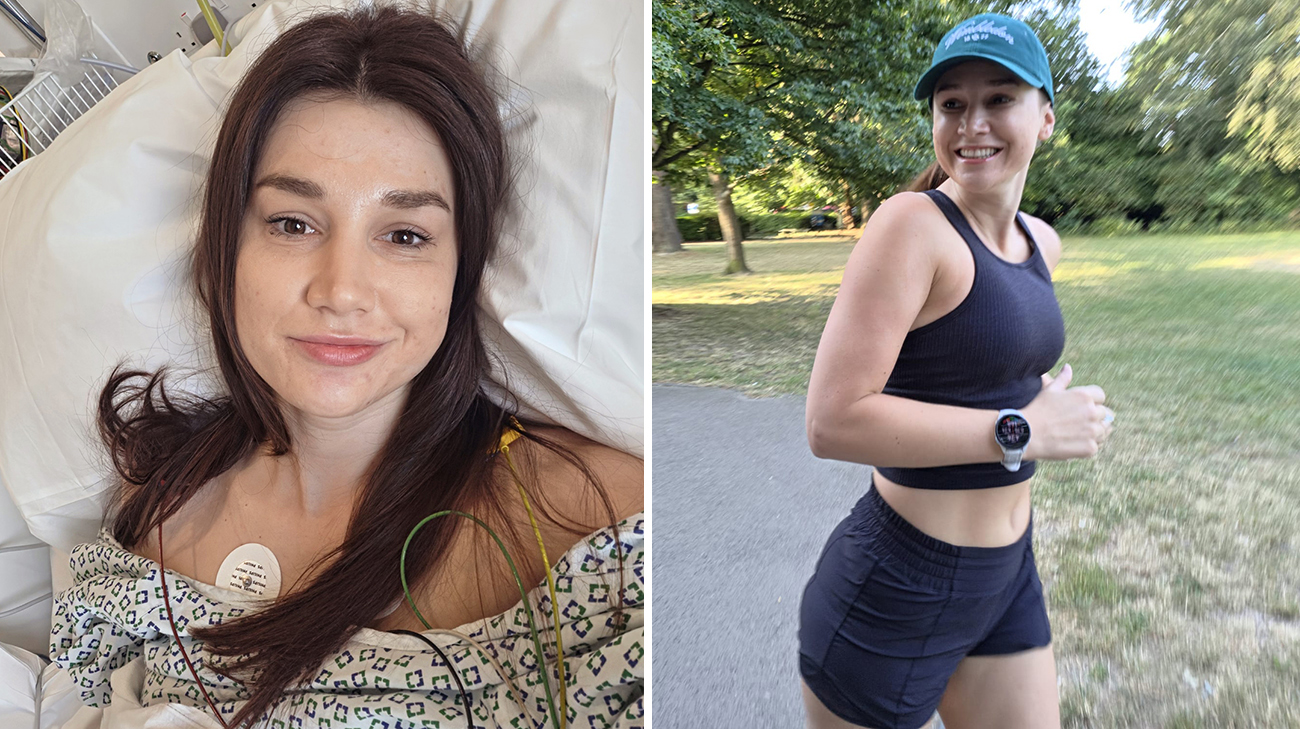
At 33, Denisa Fraser had no reason to suspect anything was wrong. Active and healthy, she had planned to stop at a Pilates class after a routine health assessment at Cleveland Clinic London.
Encouraged by a colleague, Denisa decided to undergo the testing, which she regarded as a routine health MOT.
As part of the evaluation, she underwent several standard tests, including an electrocardiogram (ECG), a simple, noninvasive procedure that measures the heart's electrical activity. When a caregiver told her the test had revealed an abnormal heart rhythm, she was stunned.
“He asked whether I sometimes felt my heart racing, and I looked at him like he was having me on,” recalls Denisa, a procurement manager who lives in West Sussex with her husband, Richard. “I thought, ‘There’s nothing wrong with me.’”
It soon became clear the finding was more serious than Denisa had initially believed. The clinician suspected she had Wolff-Parkinson-White (WPW) syndrome, a condition caused by an extra electrical pathway in the heart that can trigger episodes of rapid or irregular heartbeat, including supraventricular tachycardia and atrial fibrillation.
Denisa’s care team recommended she see Cleveland Clinic London consultant cardiologist and electrophysiologist Matt Wright, MBBS, PhD, who specialises in heart rhythm disorders. At first, she questioned whether a specialist appointment was necessary. Then she began reflecting on episodes she had experienced throughout her life, times when her heart would suddenly race or she would feel lightheaded, particularly during intense exercise.

Denisa says treatment allowed her to experience exercise and everyday activities differently than she had before. (Courtesy: Denisa Fraser)
“I thought this was normal for everybody, not just me. When I would feel a bit dizzy working out, or when my heart would flutter, I assumed it’s because I was weak and needed to exercise harder,” Denisa admits. “Little did I know I was on the borderline of something much more sinister happening.”
Because Denisa had lived with episodes of rapid heartbeat and lightheadedness for so long, she had never considered them symptoms worth mentioning. As a result, the true extent of her WPW did not become apparent until her catheter ablation.
Minutes into the procedure, used to eliminate the extra electrical pathway responsible for the abnormal heart rhythm, Denisa's heart rate surged to more than 250 beats per minute. What was expected to be a relatively straightforward ablation suddenly became much more complex.
“When my heart started beating really, really fast, I wasn't scared because it had happened so many times before,” she says. “I assumed it would pass. But then I looked around and saw the expressions on the doctors' and nurses' faces change. That's when I realised this wasn't normal. They explained living with a heart rhythm like that wasn't something most people experience.”
"Almost immediately, her heart went into a very rapid tachycardia," Dr Wright says. "Not only was it fast, but it was dangerously fast. I knew I needed to treat it quickly."
As Dr Wright worked to eliminate the abnormal electrical pathway, advanced imaging revealed another challenge: the pathway was located within a coronary sinus diverticulum (CSD), a rare pouch-like structure in the wall of the heart's main vein that can make WPW significantly more difficult to treat.
At that point, Dr Wright ended the procedure, and Denisa was scheduled for a longer and more complex operation three weeks later. For that ablation, Dr Wright would be joined by Cleveland Clinic London consultant cardiologist and electrophysiologist, John Whitaker, BM BCh, PhD.
While awaiting a second procedure, Denisa was advised to avoid activities that could push her heart rate into a potentially dangerous range. Despite the uncertainty, she remained confident in her care team.
“I felt very comfortable they knew exactly what they were doing,” Denisa says. “Dr Wright has such a positive approach. He was calm and in control throughout the entire process, and that helped keep me calm, too.”

Denisa with her husband, Richard. (Courtesy: Denisa Fraser)
During the second procedure, which lasted eight hours, physicians accessed Denisa's heart through two routes: a vein in her leg and a small incision beneath her ribcage. They guided an ultra-thin wire, about the width of a human hair, directly to her heart. Using the two access points and advanced imaging techniques, the team precisely mapped the coronary sinus diverticulum and successfully isolated the abnormal electrical pathway. Completing the ablation prevented electrical signals from reaching the extra pathway responsible for her arrhythmia.
Although she experienced some discomfort during the first few weeks of recovery, Denisa soon noticed a remarkable difference. During her first spin class after surgery, she realised she was experiencing vigorous exercise in a way she never had before.
“At the point where my heart would normally start to race or flutter, everything just felt steady,” Denisa says. “That’s when I became quite emotional, because I realised I'd never experienced exercise like that before. And I haven’t had even a hiccup in my heart rhythm since.”
Today, Denisa encourages others not to overlook preventive health screenings.
“My advice, and what I say to all my colleagues, is simple: if you have access to a health check, go,” she says. “All it takes is showing up, and you never know what it might uncover.”
For Dr Wright, Denisa's case highlighted the value of having specialists from different disciplines working together to solve complex problems.
“Some cases require expertise from across multiple teams,” he says. “Having access to those resources and being able to offer advanced treatment options is one of the things I value most about my work.”
Related Institutes: Heart, Vascular & Thoracic Institute (Miller Family)Patient Stories
Routine Health Assessment Reveals Abnormal Heart Rhythm Hidden for Years
Sep 23, 2026
After Early Ovarian Cancer Diagnosis, Woman Finds Relief From Chemotherapy-Related Nerve Pain
Sep 18, 2026