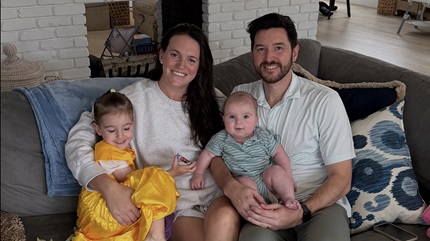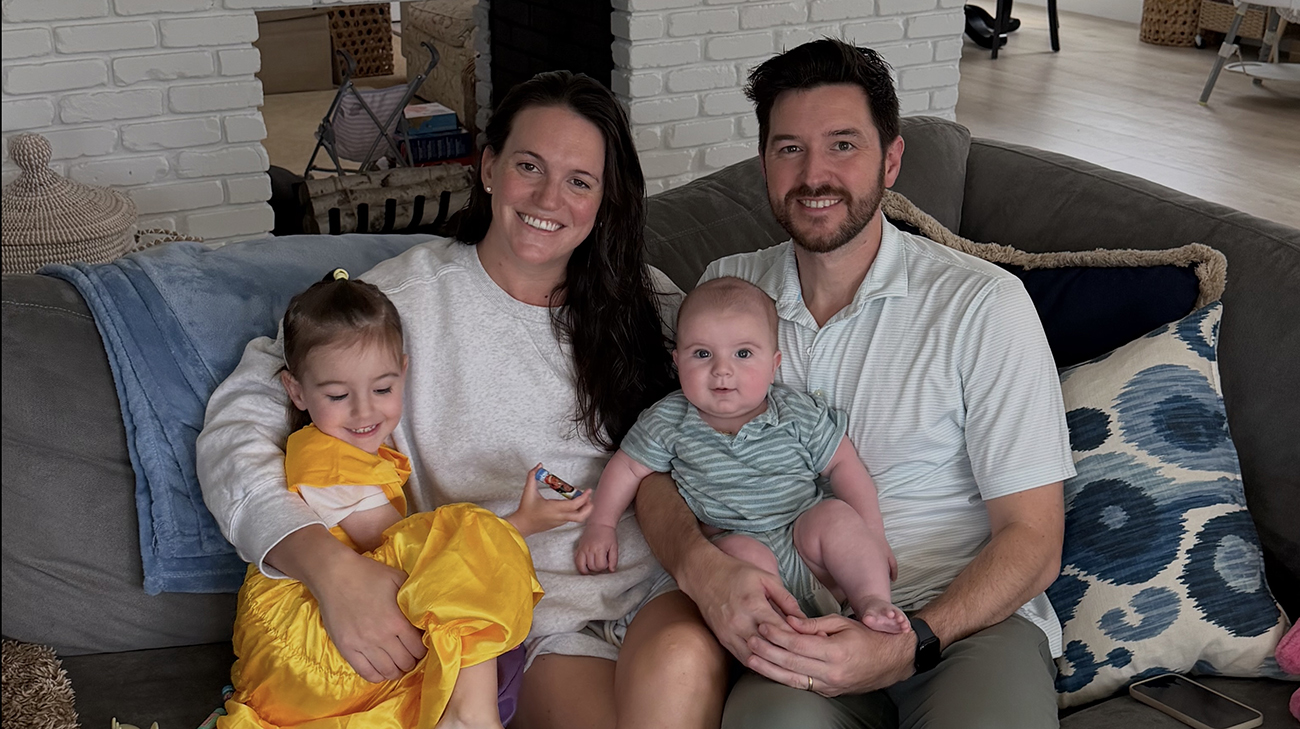
Jen Romey gets choked up when she talks about being here for her two young children after surviving a major health scare earlier this year. And she credits the team at Cleveland Clinic Indian River Hospital with saving her life.
In March, Jen, then 34, her husband Patrick and their two children, Reese, then 2 years old, and Brendan, just four months old, were visiting family in Vero Beach. Jen had just sat down with her sister and parents when she started feeling pressure in her chest.
“I looked at my sister and joked that I thought I was having a heart attack,” Jen says. Her sister said it must be heartburn and gave her an antacid, but the pressure remained.
When her left arm began tingling her family became more concerned and decided to drive her to the nearest emergency room (ER) at Cleveland Clinic Indian River Hospital.
On the way there, Jen began sweating and getting chills.
“I just knew something was very wrong,” she says. “My body felt unfamiliar and I felt a sense of impending doom.”
Shortly after arriving at the ER, Jen went into cardiac arrest, which lasted 12 minutes. It took two shocks with a defibrillator to get her heartbeat back. She was in cardiogenic shock, but the team was able to stabilize her to run tests to determine what caused her heart to stop.
Carlos Gonzalez, MD, a specialist in structural heart disease and interventional cardiology at Cleveland Clinic Indian River Hospital, diagnosed Jen with spontaneous coronary artery dissection (SCAD), a condition in which a coronary artery wall tears or separates without warning.
“After doing the cardiac catheterization, Dr. Gonzalez identified SCAD,” Jen says, adding that his diagnosis and decision to insert the Impella CP was critical and kept her alive, allowing her organs to perfuse. SCAD, which typically affects women (pregnant, postpartum, or perimenopausal), is often misdiagnosed as stress, anxiety, or a typical heart attack. Treatments for a typical heart attack, such as stenting, can cause more problems for a SCAD patient. Jen didn’t have prior cardiac history and was in very good health before her event, so she appreciates any opportunity to educate people on SCAD.
While keeping her sedated and stable in the intensive care unit (ICU), Dr. Gonzalez and his team inserted a temporary catheter-based heart pump (Impella CP) through Jen’s leg. The device kept blood flowing through her heart and other organs until she could be transported to a hospital in Orlando, near her home, because she would likely need a heart transplant.

After 2 days in the ICU at Indian River Hospital, she was transported by helicopter to the hospital in Orlando. A few days after arriving there, she was extubated and the reality of what happened, and a potential heart transplant started to sink in for Jen.
“The entire experience felt out of body,” Jen says. “My mindset was ‘Do what you need to do.’ If a transplant was the only option to be there for my kids, then of course I’d do it. It was a lot to absorb in a short period of time but I trusted my doctors.”
In an unexpected turn of events, however, Jen began to improve on her own. The tear in her artery improved and because of that the Impella CP was removed, she no longer needed a transplant, and after a period of monitoring, was discharged from the hospital the day before her 35th birthday.
“My recovery was possible because Dr. Gonzalez made the right call,” Jen says. “He diagnosed me correctly and didn’t do anything invasive that would cause more problems. My recovery was possible because of the care I received at Cleveland Clinic. They just knew what to do and the local hospital near my home I was transferred to sang their praises throughout the remainder of my hospitalization.”
Jen completed 3 months of cardiac rehabilitation – a medically supervised exercise and nutrition program – and runs regularly. She sees her transplant cardiologist, an annual cardiologist, and a SCAD specialist on a regular basis as well.
All of this, she says, gives her comfort and confidence in her body.
“Cardiac rehab was super important for my physical and mental health,” she says. “While it is scary to think about this happening again, I’m so grateful to be here. Every day is such a gift”.
Jen recently went back to Cleveland Clinic Indian River Hospital with her husband, her children and her parents to thank everyone who helped with her care. She brought her care team goodies and handwritten notes expressing her gratitude. Her daughter Reese gave each of the caregivers a sparkly heart sticker.
“That was such a special day I’ll never forget,” she says. “It was really cool to be able to let them see me healthy and walking - very different from their first experience meeting me. It was truly an honor to be able to thank and hug them. I will never be able to thank them enough for saving my life.”
Related Institutes: Heart, Vascular & Thoracic Institute (Miller Family)Patient Stories
Two Triplet Sisters Share Rare Heart Condition Detected Soon After Birth
Nov 5, 2026

When Seizures Returned, Rhonda Found a New Option: Responsive Neurostimulation
Nov 4, 2026