Malunion happens when the pieces of a broken bone heal together incorrectly. Your bone heals back into one piece, but it’s not lined up right, or it’s not in the exact right place. Malunion can increase your risk of breaking that bone again or experiencing other complications. Your healthcare provider will let you know if you’ll need treatment.
Advertisement
Cleveland Clinic is a non-profit academic medical center. Advertising on our site helps support our mission. We do not endorse non-Cleveland Clinic products or services. Policy
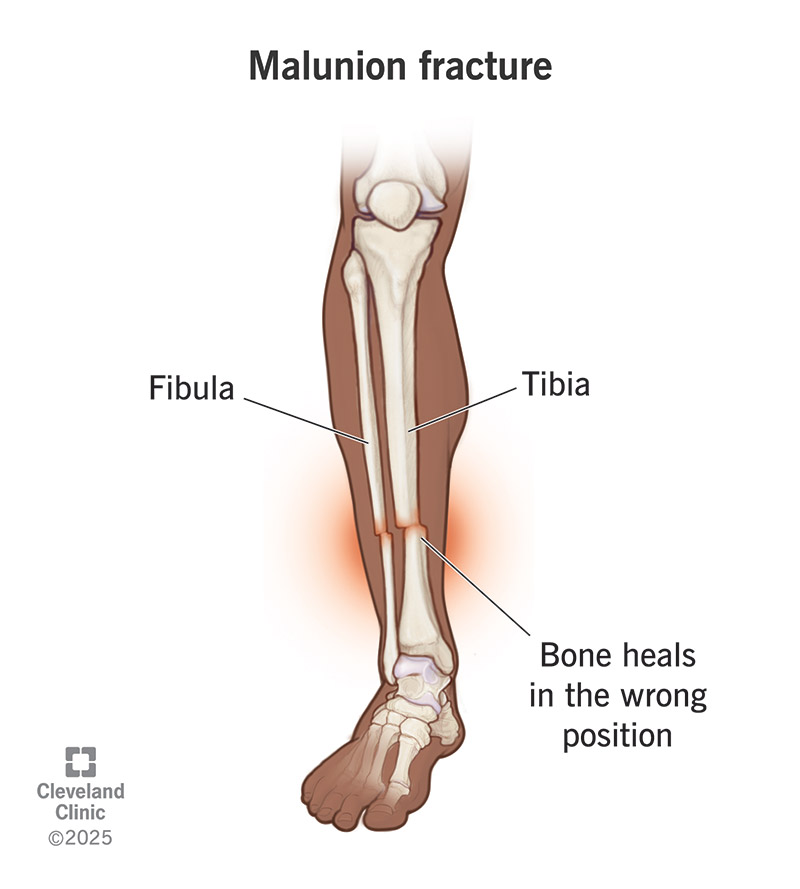
Image content: This image is available to view online.
View image online (https://my.clevelandclinic.org/-/scassets/images/org/health/articles/malunion-fracture)
Malunion is a type of poorly healed broken bone. It happens when the broken parts of your bone grow back together in the wrong position. A malunion fracture can impact your skeleton’s stability. It can also make it hard for you to move or use that part of your body.
Advertisement
Cleveland Clinic is a non-profit academic medical center. Advertising on our site helps support our mission. We do not endorse non-Cleveland Clinic products or services. Policy
Most bone fractures heal well with treatment. If they don’t, it’s because something has affected the healing process. Sometimes, the broken pieces weren’t lined up correctly. Or something prevented your body from healing right.
A malunion fracture is technically healed. But it can limit how well you can use that part of your body. If the bone heals too far out of alignment, you may have a higher risk of breaking it again.
You won’t be able to see your bone inside your body. But a malunion fracture can make the affected part of your body look noticeably different. It might look:
You might experience symptoms when you use that body part, including:
Weakness at the malunion can put extra stress on other parts of your skeleton. This may cause pain in another area of your body when you use the injured bone.
If the misshapen bone stretches or pinches a nerve, you might feel:
Many factors can contribute to bone fracture malunion, including:
Advertisement
Lots of factors can increase your malunion risk, including:
A healthcare provider will check your medical history. They’ll learn about the original injury and any health conditions you have. Your provider will physically examine your bone to look for signs of malunion. They might gently move it. Tell them if any movement or position hurts. Your provider might want to watch you walk or measure the bone’s length.
You’ll need imaging tests to take pictures of your bone, including:
Your provider will diagnose malunion if your bone has healed in the wrong position. Healing times can vary based on a few factors, including:
Your provider may diagnose malunion six, nine or 12 months after the fracture.
Yes, but not all malunion fractures need to be fixed. It depends on:
Malunion can affect your ability to move. It can also hurt. Sometimes, malunion can increase your risk of other complications. In these cases, you might need surgery to fix your bone. Your provider will usually suggest nonsurgical treatment options first.
Nonsurgical treatments for malunion fractures may include:
Surgery for a malunion fracture may include:
Both nonsurgical and surgical treatments have high success rates. But healing and rehab take time. You may need to use a cane or walker while healing. You’ll need physical therapy, too.
The treatment may fail if the bone doesn’t stay in position or if your provider can’t manage the condition that caused the malunion.
Waiting for a broken bone to heal can feel like a long, hard process. And that wait can turn to frustration when you find out your bone didn’t heal correctly.
Malunion can be scary and annoying. But it’s treatable. No matter what caused it, your healthcare provider will help you find the right way to make sure your bone heals back into the correct position.
Advertisement
Don’t be afraid to ask lots of questions. You deserve to know what’s going on inside your body. Your provider will explain what happened and what comes next.
Advertisement



Sign up for our Health Essentials emails for expert guidance on nutrition, fitness, sleep, skin care and more.
Learn more about the Health Library and our editorial process.
Cleveland Clinic’s health articles are based on evidence-backed information and review by medical professionals to ensure accuracy, reliability and up-to-date clinical standards.
Cleveland Clinic’s health articles are based on evidence-backed information and review by medical professionals to ensure accuracy, reliability and up-to-date clinical standards.
From sudden injuries to chronic conditions, Cleveland Clinic’s orthopaedic providers can guide you through testing, treatment and beyond.