



An aberrant right subclavian artery means the artery that supplies blood to your right arm starts from the left side of the aortic arch rather than the right. This may cause the artery to press on your esophagus or trachea, leading to issues with breathing or swallowing. Surgery can help relieve symptoms and prevent complications.
Advertisement
Cleveland Clinic is a non-profit academic medical center. Advertising on our site helps support our mission. We do not endorse non-Cleveland Clinic products or services. Policy
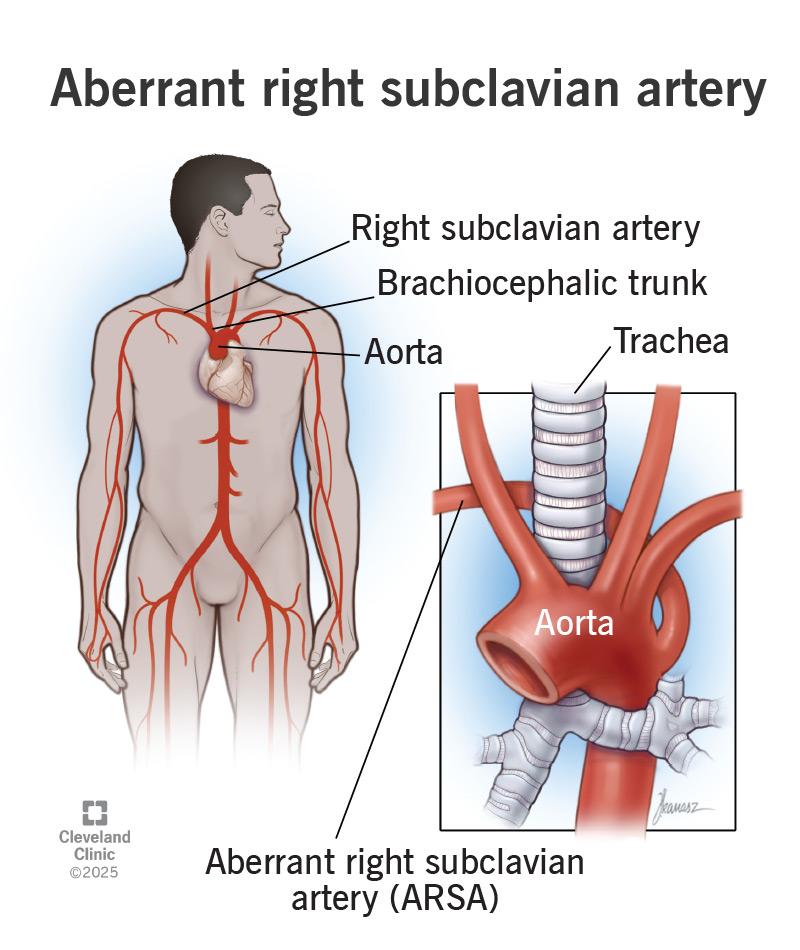
Image content: This image is available to view online.
View image online (https://my.clevelandclinic.org/-/scassets/images/org/health/articles/aberrant-right-subclavian-artery)
An aberrant right subclavian artery (ARSA) is a change to your blood vessel anatomy that’s present at birth. It means your right subclavian artery starts on the left side of your chest rather than the expected right side. This artery supplies blood to the upper right side of your body. Normally, it starts from the first major branch of your aortic arch. But with an ARSA, it starts farther down your aorta as a direct branch.
Advertisement
Cleveland Clinic is a non-profit academic medical center. Advertising on our site helps support our mission. We do not endorse non-Cleveland Clinic products or services. Policy
Even though it’s on your left, an aberrant right subclavian artery still must supply blood to your right arm and the right side of your neck and head. So, it must travel back toward that side. Along the way, it passes your windpipe (trachea) and esophagus. This may cause no problems. But in some cases, the artery loops around or presses on these structures. This can cause symptoms, like trouble breathing or swallowing.
Experts estimate that 1 in 100 people have an aberrant right subclavian artery. It’s the most common change to aortic arch anatomy that’s present at birth.
Many people with an ARSA have no symptoms. Others have them in infancy or childhood. You may also feel fine for many years, but then develop symptoms as you get older. The most common symptoms are:
Changes that occur early in fetal development cause an aberrant right subclavian artery. Normally, certain fetal blood vessels go away and others remain. In babies born with ARSA, vessels along the aortic arch don’t develop in expected ways. This affects how the aortic arch looks and where branch vessels begin.
Advertisement
With an ARSA, the right subclavian artery comes out of the aortic arch just beyond where your left subclavian artery starts. It’s also possible for the right subclavian artery to be wider than expected at its base, where it connects to the aorta.
Experts don’t know if ARSA is due to gene changes or passed down within families. But some babies born with the condition also have genetic disorders, like Down syndrome. We need more research to understand the links between ARSA and our genes.
Having an aberrant right subclavian artery raises your risk for problems with your aorta and its branch arteries. Possible complications include:
Healthcare providers sometimes diagnose an ARSA through prenatal ultrasound. Other times, it might be an unplanned finding on a test you have done for other reasons. In some cases, you don’t know you have an ARSA until you start having symptoms. Or your provider may notice different blood pressure measurements between your two arms.
If you develop signs or symptoms, a provider will run tests to find the cause. Tests that commonly diagnose an aberrant right subclavian artery include an echocardiogram and a barium swallow test. The gold-standard test is CT angiography. MRI angiography is used as an alternative if you’re allergic to iodinated contrast.
An aberrant right subclavian artery doesn’t always need treatment. It depends on your symptoms and risk of complications. If you don’t have symptoms, your healthcare provider may monitor your condition over time. This means they’ll ask you to come in for routine imaging tests. These allow your provider to check for any changes or problems with your aorta and its branches.
You may need surgery if imaging tests reveal concerns or if you develop symptoms. The exact details of the surgery vary based on your symptoms and anatomy. In general, surgery reroutes blood flow to relieve pressure on your esophagus or trachea. Your surgeon can also repair damaged areas of your blood vessels.
Your surgeon will tailor the technique to your needs. Most people have one of the following:
Advertisement
Contact a provider if you have symptoms that concern you. If you get an ARSA diagnosis, your provider will tell you how often you need to come in for check-ups or testing. They’ll also explain the timeline for your recovery and follow-up visits.
Your healthcare provider will explain how ARSA may affect your outlook. In most cases, surgery can relieve your symptoms and lower your risk of complications. It’s important to keep all of your appointments and let your provider know if you start having symptoms again.
An aberrant right subclavian artery (ARSA) isn’t a diagnosis you hear about every day. And maybe the last thing you expected was to learn that you have it. But now that you know, you can do something about it. This might simply mean seeing your healthcare provider for routine visits. Or you might need surgery to help you feel better and avoid issues down the road. Each person with ARSA is different. Your care team will explain what’s best in your case and talk with you about any concerns you may have.
Advertisement



Sign up for our Health Essentials emails for expert guidance on nutrition, fitness, sleep, skin care and more.
Learn more about the Health Library and our editorial process.
Cleveland Clinic’s health articles are based on evidence-backed information and review by medical professionals to ensure accuracy, reliability and up-to-date clinical standards.
Cleveland Clinic’s health articles are based on evidence-backed information and review by medical professionals to ensure accuracy, reliability and up-to-date clinical standards.
Whether you were diagnosed as a child or later in life, Cleveland Clinic is here to treat your adult congenital heart disease.
