



Varicose veins are swollen, twisted and bulging veins that appear just under the skin in your legs, feet or ankles. When your vein walls are weak and your valves aren’t working right, blood backs up in your vein. This causes blue and purple bulges. A healthcare provider can treat them to relieve symptoms and lower the risk of complications.
Advertisement
Cleveland Clinic is a non-profit academic medical center. Advertising on our site helps support our mission. We do not endorse non-Cleveland Clinic products or services. Policy
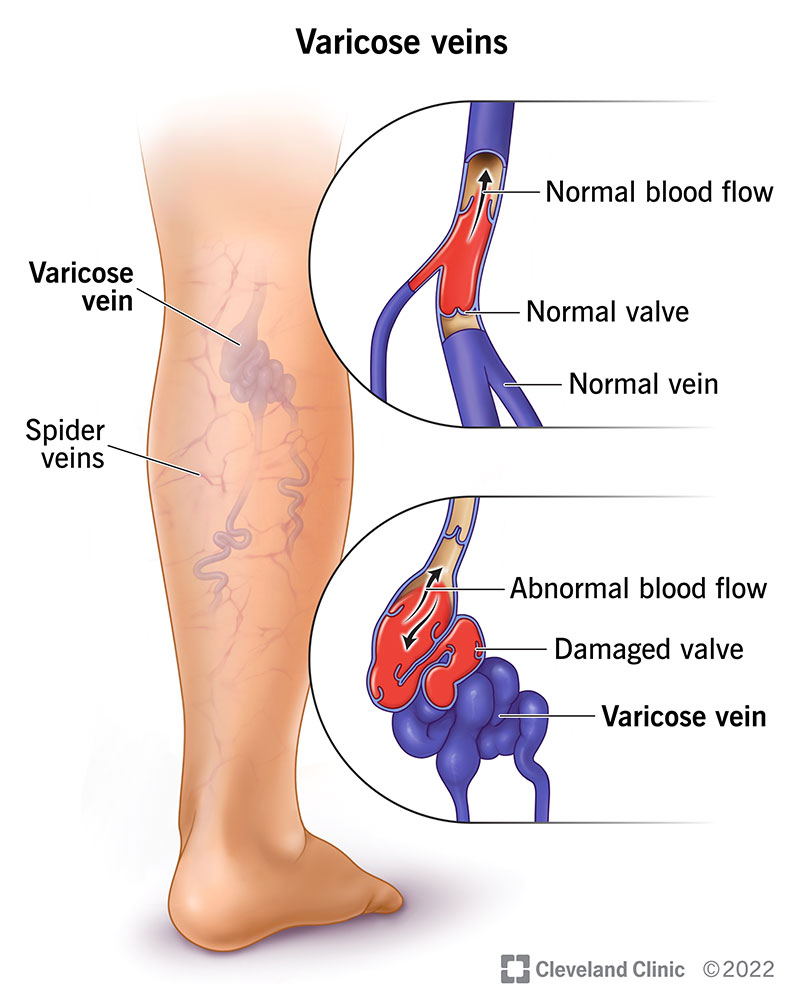
Image content: This image is available to view online.
View image online (https://my.clevelandclinic.org/-/scassets/images/org/health/articles/4722-varicose-veins-illustration)
Varicose veins are swollen blood vessels that bulge just under your skin’s surface and look blue or purple. They usually appear in your legs, feet and ankles. They can be painful or itchy. Spider veins, which are smaller red or purple lines, may surround the varicose veins.
Advertisement
Cleveland Clinic is a non-profit academic medical center. Advertising on our site helps support our mission. We do not endorse non-Cleveland Clinic products or services. Policy
For many people, varicose veins are a cosmetic issue. But in some cases, they can mean you have a more serious health concern. A healthcare provider can help you determine if home remedies to relieve symptoms are enough or you need further treatment.
Weakening of your vein walls causes varicose veins. Normally, tiny valves in your leg veins keep blood moving back toward your heart. But if those valves weaken or break down, they can’t control blood flow as they should. Blood becomes “sluggish.” It backs up or pools in your vein. This raises the pressure against the vein walls, in turn, making your vein swell, bulge and twist.
Experts can’t always identify the exact reason why veins weaken in this way.
Some risk factors include:
Advertisement
Most often, varicose veins develop on the lower half of your body, usually on your calves, ankles and feet. They can also develop in the pelvic area, especially if you’ve given birth. Hemorrhoids, which form in your rectum, are also varicose veins.
Varicose vein symptoms include:
Most people don’t have serious complications from varicose veins. But it’s possible to develop:
Varicose veins are sometimes an early sign of chronic venous insufficiency (CVI), which can get worse over time.
Varicose veins are close to your skin’s surface and easy to see. Healthcare providers can diagnose them during a physical exam. They’ll feel and examine your veins while you’re sitting and standing. They’ll also ask about your medical history and symptoms you’ve noticed.
Providers usually don’t need additional diagnostic tests to diagnose varicose veins. But they may recommend an ultrasound to see detailed images of your veins and check for complications.
There isn’t a cure. But treatments — and in some cases, procedures — can help you feel better and lower the risk of complications. Your healthcare provider may recommend:
Advertisement
There’s a lot you can do in your daily life to manage symptoms and prevent new varicose veins from forming:
Contact a provider if you notice new varicose veins. They’ll examine the veins and recommend treatments and/or home remedies that can help.
See your provider as soon as possible if varicose veins or nearby skin are:
Call 911 or your local emergency number if a varicose vein is bleeding heavily.
Although you can effectively treat them, varicose veins can return. You have a higher chance of varicose veins reappearing if you:
Advertisement
Your healthcare provider will discuss treatment options if varicose veins return.
Varicose veins may make you want to avoid wearing shorts. They may even cause discomfort. But the good news is that they’re manageable. Talking with a healthcare provider about varicose veins early on — even before they bother you — can help lower your risk of complications down the road.
Advertisement



Sign up for our Health Essentials emails for expert guidance on nutrition, fitness, sleep, skin care and more.
Learn more about the Health Library and our editorial process.
Cleveland Clinic’s health articles are based on evidence-backed information and review by medical professionals to ensure accuracy, reliability and up-to-date clinical standards.
Cleveland Clinic’s health articles are based on evidence-backed information and review by medical professionals to ensure accuracy, reliability and up-to-date clinical standards.
Vascular disease may affect your life in big and small ways. Cleveland Clinic’s specialists treat the many types of vascular disease so you can focus on living.
