



An EKG/ECG test (electrocardiogram) is an easy way to get information to diagnose a problem with your heart. It doesn’t take long and doesn’t cause pain. An EKG can tell your healthcare provider if you’ve had a heart attack, heart failure or heart damage. It can also tell them if your heart rhythm isn’t normal or how well your pacemaker is working.
Advertisement
Cleveland Clinic is a non-profit academic medical center. Advertising on our site helps support our mission. We do not endorse non-Cleveland Clinic products or services. Policy
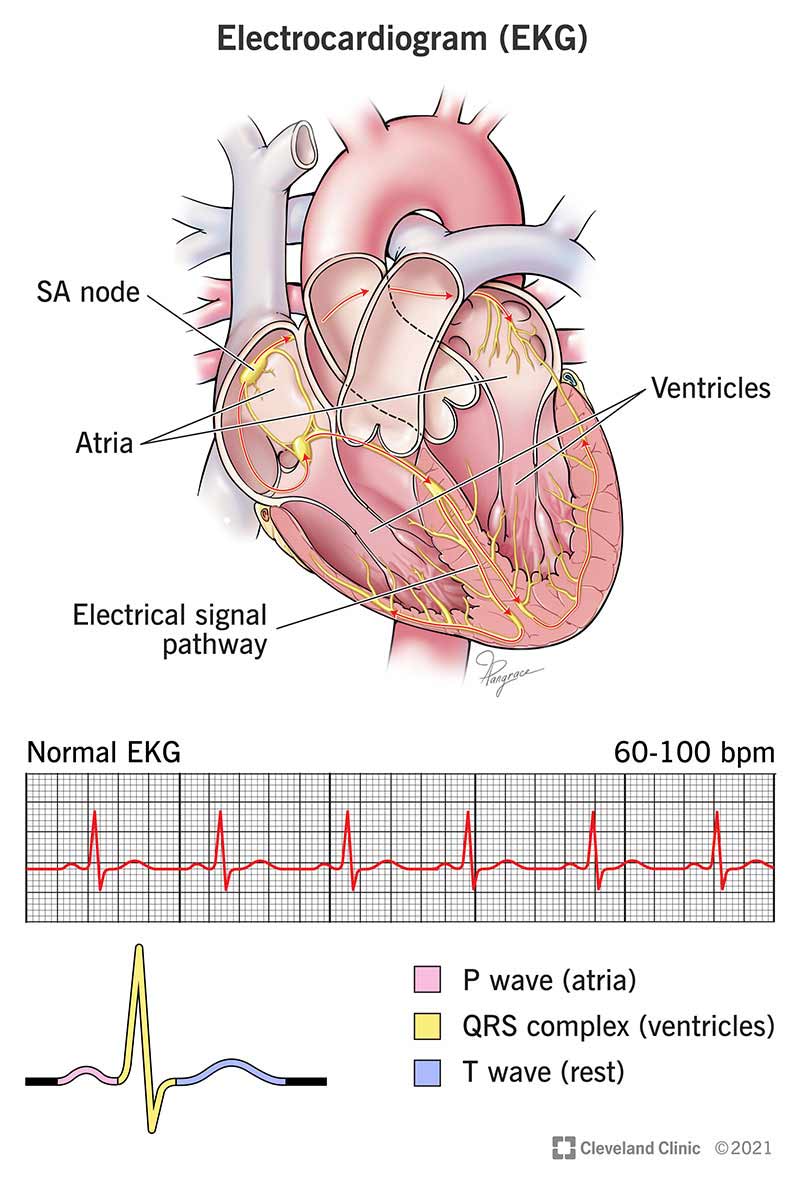
Image content: This image is available to view online.
View image online (https://my.clevelandclinic.org/-/scassets/images/org/health/articles/16953-electrocardiogram-ekg-ecg)
An electrocardiogram (EKG or ECG) is a quick, noninvasive test that records your heart’s electrical activity. Healthcare providers use it for many reasons, such as to diagnose heart rhythm issues or to monitor how well a treatment is working. You may get an EKG in your provider’s office, at a hospital or even in an ambulance, depending on why you need one.
Advertisement
Cleveland Clinic is a non-profit academic medical center. Advertising on our site helps support our mission. We do not endorse non-Cleveland Clinic products or services. Policy
A typical EKG must be done in a medical facility and only tracks your heart’s electrical activity for a short time. This is sometimes called a standard 12-lead EKG. You may get it while lying down and resting or while you’re exercising as part of a stress test.
But some heart rhythm problems only happen once in a while. That means a standard EKG may not show them. It’s like when your internet is acting up, but it seems fine when someone comes to repair it. So, in some cases, your healthcare provider may recommend a device that records your heart’s electrical activity for a longer time, like a Holter monitor or implantable loop recorder.
Healthcare providers use EKGs to:
Your provider may give you an EKG if you have these symptoms:
Advertisement
Video content: This video is available to watch online.
View video online (https://cdnapisec.kaltura.com/p/2207941/sp/220794100/playManifest/entryId/1_110yby2o/flavorId/1_5f3sgelj/format/url/protocol/https/a.mp4)
Electrocardiograms, or EKGs, record the electrical activity of your heart. Here’s what you can expect ahead of the medical test.
Before an electrocardiogram, you can eat and drink as you normally would. But on the day of your EKG test, try to:
A healthcare provider will attach 12 electrodes with adhesive pads to the skin on your chest, arms and legs. They’ll put six electrodes (sensors) on your chest and six on your limbs. To allow a better connection, your provider may shave any hair that’s in the way. The sensors send information through wires or leads, which is why people call it a 12-lead EKG.
For a resting EKG, you’ll lie flat and relax. If you’re doing a stress test, you’ll walk on a treadmill or pedal on a stationary bike.
It takes about 10 minutes to attach the electrodes and complete a resting EKG test. But the actual recording takes only 10 seconds. An EKG that’s part of an exercise stress test may take longer.
A computer creates a picture (on graph paper or a screen) of the electrical impulses traveling through your heart. The impulses form a wave pattern that your healthcare provider can look at. You won’t feel anything different when the electrodes communicate with the computer.
The electrodes will stay on your skin until the EKG test is done. Then, your provider will remove them, and you can return to your normal activities.
An electrocardiogram is a low-risk test. It doesn’t use radiation or put electricity into your skin. You might have some skin irritation after your healthcare provider removes the sticky patches that were attached to the sensors.
An EKG test produces a picture of your heart’s electrical activity. Your healthcare provider will “read” this picture to see how much electrical activity there is and how strong it is. They’ll also look at how much time passes between the different waves or peaks that represent the electrical impulses.
A normal EKG should show a regular series of waves that repeat. These include, in order:
These waves should happen again and again with the same distance (which represents time) between them. This means your heart rate is regular and its rhythm is normal.
Unusual wave patterns can mean there’s a problem. Abnormal EKG results can help a provider know which part of your heart has an issue. The process of making your heart beat is a complex one that involves many parts of your heart.
Advertisement
Problems that an EKG can help diagnose include:
If your healthcare provider can review your EKG test results right away, they may speak to you soon afterward. This is especially true when you need treatment immediately. But if your electrocardiogram test is routine or part of a group of tests before a planned surgery, you may not hear from your provider for a few days.
Your provider will keep your EKG records on file to compare with future ones.
The next steps depend on why your provider performed the EKG. Based on what they learn, your provider may:
Contact your healthcare provider if:
You may hear the terms EKG and ECG. Both mean the same thing: an electrocardiogram. EKG comes from the German word, which uses “k” instead of “c.”
Advertisement
Heart tests can be intimidating. But an EKG is a very quick and pain-free test your healthcare provider can do to check your heart rhythm and evaluate your heart. The information from your EKG will help your provider make a diagnosis and decide what treatment would be best for you. EKG results can get you on your way to feeling better. Ask your provider if you have questions about your EKG and what it means for you.
Advertisement



Sign up for our Health Essentials emails for expert guidance on nutrition, fitness, sleep, skin care and more.
Learn more about the Health Library and our editorial process.
Cleveland Clinic’s health articles are based on evidence-backed information and review by medical professionals to ensure accuracy, reliability and up-to-date clinical standards.
Cleveland Clinic’s health articles are based on evidence-backed information and review by medical professionals to ensure accuracy, reliability and up-to-date clinical standards.
When your heart needs some help, the cardiology experts at Cleveland Clinic are here for you. We diagnose and treat the full spectrum of cardiovascular diseases.
