



Tricuspid valve replacement and repair are surgical procedures that treat diseases affecting one of four heart valves. The procedures can ease symptoms and increase survival in people with tricuspid regurgitation or tricuspid stenosis. Traditional tricuspid valve surgery requires open-heart surgery. Less invasive procedures may also be available.
Advertisement
Cleveland Clinic is a non-profit academic medical center. Advertising on our site helps support our mission. We do not endorse non-Cleveland Clinic products or services. Policy
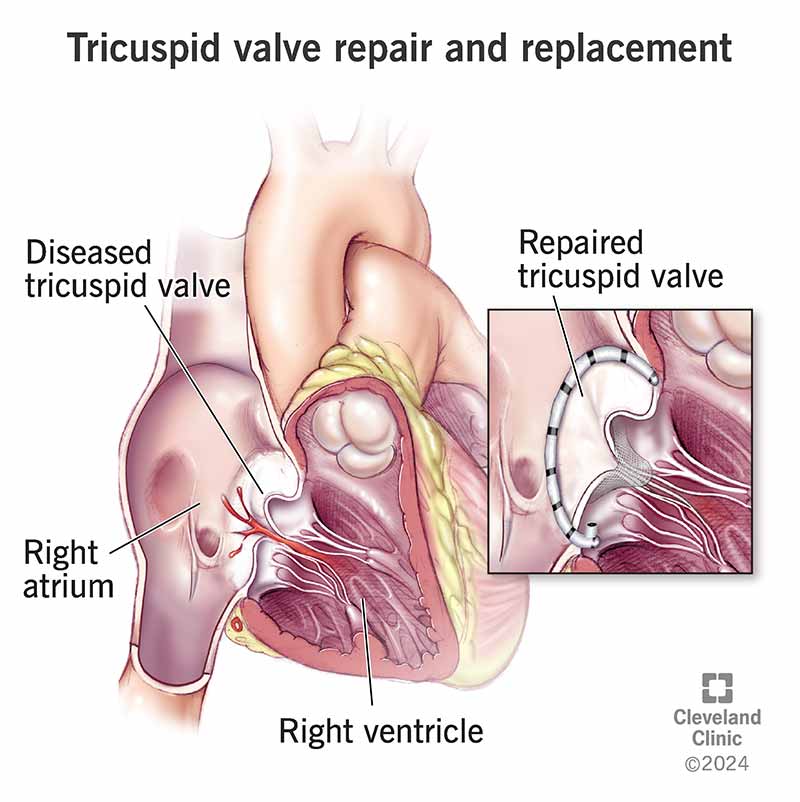
Image content: This image is available to view online.
View image online (https://my.clevelandclinic.org/-/scassets/images/org/health/articles/17579-tricuspid-valve-repair-replacement)
Tricuspid valve replacement and repair are procedures that fix issues with your heart’s tricuspid valve.
Advertisement
Cleveland Clinic is a non-profit academic medical center. Advertising on our site helps support our mission. We do not endorse non-Cleveland Clinic products or services. Policy
Your tricuspid valve is one of four valves that manage blood flow through your heart. It’s on the right side of your heart, between the upper chamber (atrium) and lower chamber (ventricle). It ensures that blood flows in the correct direction — from the right atrium down to the right ventricle. A tricuspid valve has three flaps (leaflets) that open and close as blood flows through it.
It’s not easy to hear that your heart isn’t working well. But it’s good to know that valve repair or replacement can improve your daily life and help you do the things you want to do.
Tricuspid valve replacement or repair treats tricuspid valve disease conditions. These affect how well your valve works. The main types are:
When your tricuspid valve doesn’t function correctly, your heart may have to work harder to supply your body with blood. This can cause symptoms like fatigue and shortness of breath. It also may lead to complications like heart failure.
Usually, repairing your tricuspid valve and keeping your own heart tissue is best. But you may need a replacement valve if you have too much damage on your valve and surrounding tissue.
Advertisement
There are two types of replacement valves: biological and mechanical. A biological valve may come from an animal or deceased human donor. A mechanical valve is made completely out of synthetic material.
If you receive a valve from an animal or human donor, you may not need to take blood thinners afterward. But mechanical valves increase the risk of blood clots, so you’ll need to take blood thinners for life.
Tricuspid valve surgery is rare, especially as an isolated surgery. This is an operation where a surgeon doesn’t fix anything else. Surgeons performed about 5,000 isolated tricuspid valve surgeries in the U.S. from 2004 through 2013. Many people with tricuspid valve issues didn’t receive surgery in the past because of the high risk. That may be changing with newer procedures that offer a minimally invasive option.
Before surgery to repair or replace your tricuspid valve, you may:
You may need to take certain tests before tricuspid valve surgery. These tests ensure you’re healthy enough for surgery and help your provider plan the procedure. Tests may include:
Surgeons often perform tricuspid valve surgery with an open-heart approach. This involves an incision either through the middle of your chest or from the side.
The surgical team will:
Depending on the valve problem, there are several approaches to tricuspid valve surgery. The surgeon might:
There are less invasive options for tricuspid valve surgery that use smaller incisions and may not require a bypass machine. Your surgeon will let you know which type of surgery is best for you. Minimally invasive options include:
Advertisement
Yes, it’s common for surgeons to perform other procedures at the same time as tricuspid valve repair or replacement. For example:
After tricuspid valve surgery, you’ll probably stay in the hospital for a few nights. The length of your stay depends on several factors, including your overall health and the type of procedure you received.
Before you leave the hospital, your healthcare team will monitor you and order imaging tests to ensure the repair or replacement is working.
Advertisement
To prevent complications, you may have to take medications. These may include anticoagulants for blood clots and antibiotics for infection.
Tricuspid repair or replacement can:
Tricuspid valve repair or replacement is invasive and has several potential risks, including:
Recovery time after tricuspid valve repair or replacement depends on several factors, including your overall health. Most people need several months after open-heart surgery to return to normal activities. Recovery from transcatheter procedures is shorter — usually a few weeks.
A biological replacement valve can last 10 to 20 years. A mechanical valve can last indefinitely — possibly the rest of your life.
After tricuspid valve surgery, report any symptoms that could mean the valve or heart isn’t functioning well, like:
Advertisement
Also, call your healthcare provider if you have signs of infection, like:
Seek emergency medical help if you have any of these symptoms, which may indicate a life-threatening problem with heart function:
Just getting through the day can be a challenge when a valve in your heart isn’t working well. But you may find relief with tricuspid valve replacement and repair. If you have tricuspid regurgitation or tricuspid stenosis, talk to your cardiologist about whether this type of surgery can help. Don’t be afraid to ask questions about the procedure you’re discussing.



Sign up for our Health Essentials emails for expert guidance on nutrition, fitness, sleep, skin care and more.
Learn more about the Health Library and our editorial process.
Cleveland Clinic’s health articles are based on evidence-backed information and review by medical professionals to ensure accuracy, reliability and up-to-date clinical standards.
Cleveland Clinic’s health articles are based on evidence-backed information and review by medical professionals to ensure accuracy, reliability and up-to-date clinical standards.
Problems with your heart can be scary. Our experts can diagnose and treat mitral & tricuspid heart valve disease.
