



Your heart rate is the speed at which your heart is beating. A normal resting heart rate for most adults is 60 to 100 beats per minute. Factors that can affect your heart rate include your emotions, weight, fitness level and sleep quality. Some medicines and substances like alcohol and caffeine can also affect it. Pregnancy increases your heart rate.
Advertisement
Cleveland Clinic is a non-profit academic medical center. Advertising on our site helps support our mission. We do not endorse non-Cleveland Clinic products or services. Policy
Heart rate is the number of times your heart beats in one minute. Your body automatically controls your heartbeat to match whatever you’re doing or what’s happening around you. That’s why your heartbeat gets faster when you’re active, excited or scared. And why it slows down when you’re resting, calm or comfortable. Certain medical conditions can make your heart beat faster or slower than what’s normal for you.
Advertisement
Cleveland Clinic is a non-profit academic medical center. Advertising on our site helps support our mission. We do not endorse non-Cleveland Clinic products or services. Policy
A healthcare provider may measure your heart rate:
You can also check your heart rate yourself to keep an eye on your health or gauge how hard your body is working during physical activity.
A heart rate that’s too fast or too slow can be a sign of heart issues or other health problems. When checking your heart rate on your own, it’s important to share anything unusual with a healthcare provider so they can find the cause.
Your provider can use various devices and methods to check your heart rate. For example, they may do an electrocardiogram (EKG/ECG). This test records your heart’s electrical activity. It can show if your heart is beating too fast or too slow, or if there are any abnormal rhythms. Devices like blood pressure monitors and pulse ox devices also show your heart rate.
If you’re in the hospital, your care team may connect you to a monitor called telemetry. It continuously checks your vital signs, including your heart rate. In some cases, your provider may ask you to wear a form of mobile telemetry at home to monitor for abnormal heart rates and rhythms.
There are two main ways:
Advertisement
A normal resting heart rate for most adults is 60 to 100 beats per minute (bpm). Resting means you’re sitting or lying down but awake. Babies and kids have higher resting heart rates than adults do. The table below shows typical resting heart rates by age:
| Age | Normal resting heart rate* |
|---|---|
| Birth to 4 weeks (newborn) | 100 to 205 bpm |
| 4 weeks to 1 year (infant) | 100 to 180 bpm |
| 1 to 3 years (toddler) | 98 to 140 bpm |
| 3 to 5 years (preschool age) | 80 to 120 bpm |
| 5 to 12 years (school age) | 75 to 118 bpm |
| 13 to 17 years (adolescent) | 60 to 100 bpm |
| 18 and above (adult) | 60 to 100 bpm |
| Age | |
| Birth to 4 weeks (newborn) | |
| Normal resting heart rate* | |
| 100 to 205 bpm | |
| 4 weeks to 1 year (infant) | |
| Normal resting heart rate* | |
| 100 to 180 bpm | |
| 1 to 3 years (toddler) | |
| Normal resting heart rate* | |
| 98 to 140 bpm | |
| 3 to 5 years (preschool age) | |
| Normal resting heart rate* | |
| 80 to 120 bpm | |
| 5 to 12 years (school age) | |
| Normal resting heart rate* | |
| 75 to 118 bpm | |
| 13 to 17 years (adolescent) | |
| Normal resting heart rate* | |
| 60 to 100 bpm | |
| 18 and above (adult) | |
| Normal resting heart rate* | |
| 60 to 100 bpm |
*These rates are when you’re awake and not exercising. They may be lower when you’re asleep. They may be faster when you’re active.
Keep in mind that there’s a range of “normal” when it comes to healthy heart rates. While knowing the normal range for your age is helpful, it’s even more important to know what’s typical for you. If your resting heart rate is normally in the 60s, but it suddenly keeps clocking in at 90, there might be something going on to cause that change.
There may be cause for concern if your:
But it depends on the person and the situation. For example, a low heart rate in the 40s or 50s is common among athletes. It’s also common in people who take medications like beta-blockers or calcium channel blockers that their providers prescribe.
A resting heart rate above 100 usually isn’t normal. But it can be temporary. For example, you might be really stressed or anxious at the time. It’s a good idea to check your heart rate again later to see if it comes down.
Various health conditions, medications and situations can influence your resting heart rate throughout the day, including:
Advertisement
Sometimes, the cause of a low or high heart rate is your heart itself. An arrhythmia (abnormal heartbeat) is when abnormal electrical activity in your heart makes it beat too fast, too slow or in an irregular pattern. Some arrhythmias require treatment to prevent serious complications.
Your target heart rate is the ideal range for your heart during physical activity. It’s high enough that it’s good for your heart, but not so high that it’s dangerous. If you exercise regularly, your target heart rate is typically 60% to 85% of your maximum (max) heart rate.
Your max heart rate is the fastest your heart can go during vigorous exercise. The simplest way to estimate this number is to subtract your age from 220. So, if you’re 50, your predicted max heart rate is 220 minus 50, or 170.
But many things besides your age affect how fast your heart can beat. A healthcare provider can calculate a more accurate max heart rate by giving you an exercise stress test.
The graphic below lists target heart rates by age. These are based on predicted max heart rates. So, your actual range might be a little different. It’s important to talk to your healthcare provider to get advice tailored to your needs.
Advertisement
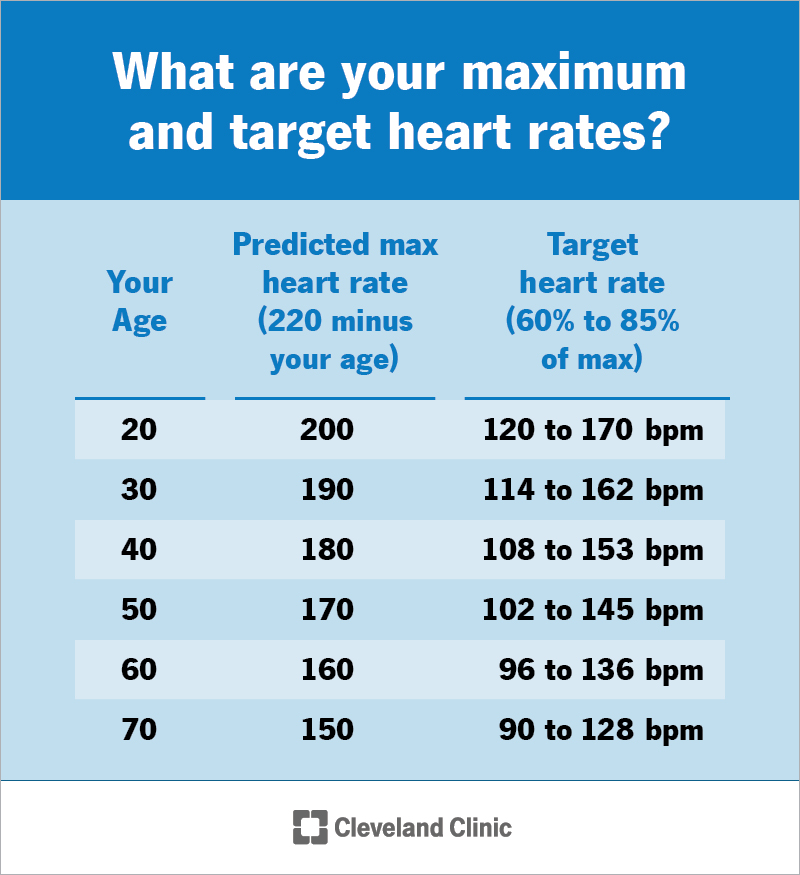
Image content: This image is available to view online.
View image online (https://my.clevelandclinic.org/-/scassets/images/org/health/articles/maximum-and-target-heart-rates-infographic)
Your max heart rate is the fastest your heart can beat when you’re active. Your target heart rate is a goal for giving your heart a workout.
If you want to calculate your maximum and target heart rates yourself, you can use these formulas:
If you want to dive deeper into math, you can:
If you don’t get regular physical activity, you should talk to a healthcare provider before starting a workout routine. This is especially important if you have issues with your heart, breathing or circulation. They’ll guide you on safe, effective ways to stay active without putting your overall well-being at risk. They’ll also give you a target heart rate range to aim for.
Seek medical attention right away if your heart rate is below 35 to 40 bpm or above 100 bpm and you have symptoms like:
If you have any concerns about your heart rate, talk to your primary care provider. They can answer your questions or refer you to a cardiologist if necessary. Here are some signs you should discuss:
Advertisement
You should also see a healthcare provider at least once a year for an annual check-up. Taking your heart rate is a normal part of that visit. Your provider can diagnose and treat problems like abnormal heartbeats. The sooner you get treatment for serious issues, the lower your risk of complications down the road.
Your heart rate is easy to measure by yourself. If you check it regularly, you can get to know what’s normal for you. If you see an unusual number, pay attention to what you were doing right before you checked it.
Chances are, there’s a logical reason for getting a different number. But if you’re concerned, contact a healthcare provider. They can look into why your heart rate may be outside the normal range.



Sign up for our Health Essentials emails for expert guidance on nutrition, fitness, sleep, skin care and more.
Learn more about the Health Library and our editorial process.
Cleveland Clinic’s health articles are based on evidence-backed information and review by medical professionals to ensure accuracy, reliability and up-to-date clinical standards.
Cleveland Clinic’s health articles are based on evidence-backed information and review by medical professionals to ensure accuracy, reliability and up-to-date clinical standards.
When your heart needs some help, the cardiology experts at Cleveland Clinic are here for you. We diagnose and treat the full spectrum of cardiovascular diseases.
