Tell us what's important to you. We'll build you a better ClevelandClinic.org.

close
Chat Live With a Health Educatoronline health chatonline health chatChat Live With a Health Educator

Birth Control Options


Print this ContentEmail this Content
What is birth control?

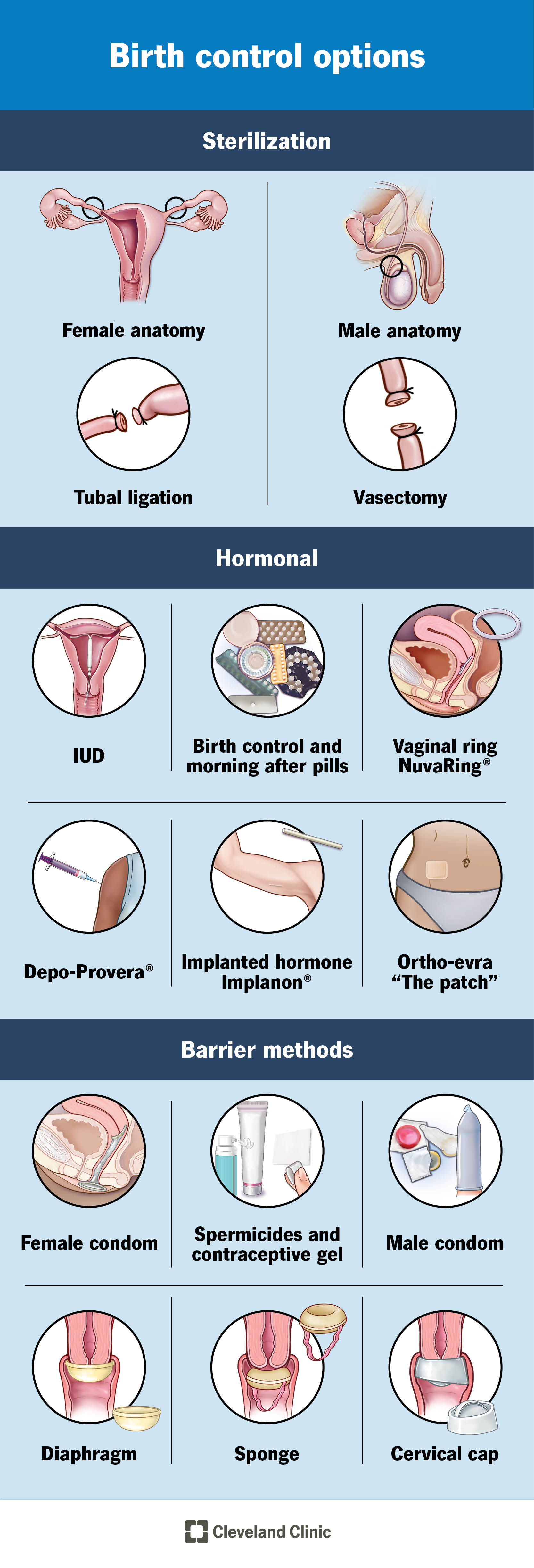
Birth control is a way for men and women to prevent pregnancy. There are many different methods of birth control. By learning more about the options, you can decide which method is right for you and your partner.

If you are sexually active and don't want a baby, don't wait to use birth control. An unwanted pregnancy can happen any time you have unprotected sex.

What are the types of birth control?

The following information describes many different birth control methods. Before you choose a method, you should discuss birth control with your partner and your health care provider.

Birth control methods only are effective if used properly. Make sure that you understand how to correctly use the method you choose.

Male condom

What is it? — The male condom, or "rubber," is a thin covering made of latex, plastic or animal membrane that is rolled over an erect penis. The covering prevents semen, the fluid that contains sperm, from entering a woman's vagina. Latex condoms are best for most people. Use plastic (Avanti®) condoms if you or your partner is allergic to latex. Condoms made from animal skins may not provide good protection from sexually transmitted diseases.

How is it used? — The condom is rolled over the erect penis before sexual activity begins. If the condom does not have a built-in nipple, leave 1/4-inch of the condom free at the tip of the penis so that semen has a place to collect. A new condom must be used each time you have sex. For the best protection, condoms should be used with a spermicidal foam or jelly. The condom must be in place before the penis gets near the vagina.

How can I get it? — Condoms can be purchased at most drug stores. Condoms also are sold in vending machines in restrooms.

How effective is it? — Condoms are about 85 percent effective if used correctly. With careful use, they are even more effective.

You should know — Latex condoms provide protection from sexually transmitted diseases by preventing the infected area from coming into contact with the partner. Use only water-based lubricants, such as K-Y Jelly®. Oil-based lubricants (Vaseline®) can cause condoms to leak or break.

Female condom

What is it? — The female condom is a lubricated polyurethane (plastic) tube that has a flexible ring at each end. One end of the tube is closed.

How is it used? — Before sexual activity begins, the woman inserts the condom into her vagina so that the closed end of the tube covers the cervix, and the other end slightly covers the labia (lips on the outside of the vagina). The condom blocks sperm from entering the womb.

How can I get it? — Like the male condom, the female condom is available at drug stores without a prescription.

How effective is it? — The female condom is about 75 percent effective if used correctly.

You should know — Female condoms provide some protection against sexually transmitted diseases, but the male condom provides the best protection.

Spermicides

What is it? — Spermicides are foams, jellies, tablets or suppositories that a woman places in her vagina and up next to the cervix (the opening leading from the vagina to the womb) before sex. Spermicides block the cervix and paralyze the sperm, making them unable to travel into the womb.

How is it used? — The woman places the spermicide inside the vagina within an hour before intercourse. More spermicide must be used each time you have sex. Follow the directions on the package carefully.

How can I get it? — Spermicides can be bought at most drug stores. Be careful not to confuse them with feminine hygiene products, such as douche or lubricants.

How effective is it? — Spermicides are 70 percent to 80 percent effective. Spermicides have a high failure rate because they often are used incorrectly. Used correctly and together, spermicides and condoms are about 97 percent effective.

You should know — Do not douche for at least eight hours after sex when using a spermicide. You can wear a feminine pad to absorb spermicide that comes out. Spermicides alone may not protect against some sexually transmitted diseases (STDs), including HIV (the virus that causes AIDS). The male condom provides the best protection from most STDs.

Contraceptive foam

What is it? — Contraceptive foam is a spermicide.

How does it work? — The contraceptive foam is placed into a woman’s vagina with an applicator. The spermicide kills the sperm, and the foam blocks the opening to the cervical canal. The foam may be put into the vagina up to 20 minutes before intercourse and is effective immediately.

How is it available? — Contraceptive foam is available without a prescription at most drug stores and supermarkets.

How effective is it? — If vaginal spermicides are used consistently and correctly, they are about 94 percent effective.

You should know — Contraceptive foam may not protect against some sexually transmitted diseases (STDs), including HIV (the virus that causes AIDS). The male condom provides the best protection from most STDs.

Sponge

What is it? — The sponge is a small, donut-shaped device that is coated with spermicide.

How does it work? — The sponge is moistened with water and inserted into the vagina. It is made of polyurethane foam that feels like natural vaginal tissue. The sponge protects against pregnancy in three ways:
-- The sponge releases a spermicide to kill sperm cells.
-- The sponge is constructed to trap and absorb semen before the sperm have a chance to enter the cervix.
-- It acts as a barrier between the sperm and the cervix.

How is it available? — The sponge is available without a prescription at most drug stores.

How effective is it? — With correct and consistent use, the sponge is 89 percent to 91 percent effective.

You should know — The sponge provides a continuous presence of spermicide throughout a 24-hour period, allowing for multiple acts of intercourse within that time without the need for additional spermicide. Spermicides alone may not protect against some sexually transmitted diseases (STDs), including HIV (the virus that causes AIDS). The male condom provides the best protection from most STDs.

Vaginal contraceptive film

What is it? — Vaginal contraceptive film is a paper-thin translucent film that contains a spermicide.

How is it done? — The film is placed in the vagina on or near the cervix, where it dissolves in seconds.

How is it available? — Vaginal contraceptive film is available without a prescription in most drug stores.

How effective is it? — Used consistently and correctly, vaginal contraceptive film is 75 percent to 94 percent effective.

You should know — Vaginal contraceptive film is effective for one hour, and you must wait at least 15 minutes after inserting the film before having intercourse. You must use a new film each time you have intercourse. Spermicides alone may not protect against some sexually transmitted diseases (STDs), including HIV (the virus that causes AIDS). The male condom provides the best protection from most STDs.

Diaphragm

What is it? — A diaphragm is a round piece of flexible rubber with a rigid rim. The woman places the diaphragm in her vagina and against her cervix. The diaphragm prevents semen from entering the womb. Spermicide must be used with a diaphragm.

How is it used? — Spermicide is put in and around the rim of the diaphragm no more than two hours before intercourse. The diaphragm is then inserted into the vagina. More spermicide should be inserted into the vagina each time you have sex without removing the diaphragm.

How can I get it? — You must visit your health care provider and get a pelvic exam so that you can be fitted for a diaphragm that is right for you.

How effective is it? — A diaphragm is 82 percent to 94 percent effective if used correctly.

You should know — Do not remove the diaphragm for at least eight hours after intercourse. Using a diaphragm and spermicide may not protect against some sexually transmitted diseases (STDs), including HIV (the virus that causes AIDS). The male condom provides the best protection from most STDs. If you gain or lose 10 to 15 pounds, you may have to be refitted for a new diaphragm.

Cervical cap

What is it? — The cervical cap is a thimble-shaped cup made out of plastic or soft rubber that fits snugly over the cervix.

How is it used? — It is used the same way as a diaphragm. The woman coats the cup with spermicide, and inserts the cap into her vagina and up to her cervix before sex. The cap blocks the cervix, and the spermicide paralyzes the sperm. More spermicide must be inserted into the vagina each time you have sex. (Do not remove the cap each time you have sex.)

How can I get it? — You must visit your health care provider and get a pelvic exam so that you can be fitted for a cervical cap.

How effective is it? — The cervical cap is 82 percent to 94 percent effective if used correctly.

You should know — Do not remove the cervical cap for at least eight hours after intercourse. The cap can be kept in place for up to 48 hours, but spermicide must be applied inside the vagina no more than two hours before sex. Using a cervical cap and spermicide may not protect against some sexually transmitted diseases (STDs), including HIV (the virus that causes AIDS). The male condom provides the best protection from most STDs.

IUD

What is it? — An IUD, or intrauterine device, is a small, plastic, flexible, T-shaped device that is placed into the uterus (womb). There are several types of IUDs. One type, ParaGard T380A, can be kept in place for 10 years. (It contains copper, which is slowly released into the uterine cavity. The copper stops the sperm from making it through the vagina and uterus to reach the egg, thus preventing fertilization.) Mirena® is an IUD that contains a hormone and is kept in place for five years. IUDs, such as Mirena, release the hormone progesterone, which causes the cervical mucus to become thicker so the sperm cannot reach the egg. The hormone also changes the lining of the uterus, so implantation of a fertilized egg cannot occur.

How is it used? — Once the IUD has been inserted, the woman does not need to take any further steps to prevent pregnancy.

How is it available? — You must get a pelvic exam and set of cultures. The IUD is placed into the uterus through the cervix by a trained health care provider.

How effective is it? — The IUD is 99 percent effective.

You should know — IUDs rarely cause serious side effects when used in a monogamous relationship (having only one sex partner). Side effects are different for the different IUDs. In some cases copper IUDs can cause more painful and heavy periods and backaches. Mirena, because of the hormone, lightens periods and some women will stop bleeding all together. IUDs should not be used if you have a recent history of pelvic infections or are at risk for infections. Discuss these side effects with your health care provider. IUDs are placed while you are on your period to insure you are not pregnant and make the placement easier. IUDs do not protect against sexually transmitted diseases (STDs), including HIV (the virus that causes AIDS). The male condom provides the best protection from most STDs.

The pill

What is it? — The Pill is a medication that women take to prevent pregnancy. The Pill comes in the form of a pill pack that contains enough pills for one month of protection.

How is it used? — A pill is taken at the same time every day. There are several different types of pills some are designed to allow the women to have a period every month and other have a period every 3 months or not at all. You need to discuss which pills is best for you with your health care provider Follow your health care provider's instructions for how to take the pill.

How can I get it? — The Pill must be ordered for you by your health care provider. It is obtained by prescription.

How effective is it? — The Pill is 99 percent effective, if taken correctly. Typically it is about 93% effective.

You should know — Occasionally you need to use an additional form of birth control for the first month you are on the pill. Certain medications, especially antibiotics, cause the Pill to lose effectiveness. You should use back-up birth control while taking these medications. The Pill can cause minor and/or serious side effects. You should discuss these side effects with your health care provider. The Pill is not recommended for women who are over 35 years of age and smoke, but it can be used until menopause if you don't smoke cigarettes. The Pill does not protect against sexually transmitted diseases (STDs), including HIV (the virus that causes AIDS). The male condom provides the best protection from most STDs.

Mini pills

What is it? — These are pills that contain only one hormone (progestin).

How do they work? — Mini pills work by thickening the cervical mucus so the sperm cannot reach the egg. The hormone in the pills also changes the lining of the uterus, so implantation of a fertilized egg cannot occur. In some cases, mini pills stop ovulation (the release of an egg). A pill is taken every day.

How is it available? — The Pill must be ordered for you by your health care provider. It is obtained by prescription.

How effective is it? — If the pills are used consistently and correctly, they are about 95 percent effective.

You should know — Mini pills tend to make periods short and scant. Some women go several months with no bleeding at all. Mini pills do not protect against sexually transmitted diseases (STDs), including HIV (the virus that causes AIDS). The male condom provides the best protection from most STDs.

Depo-Provera

What is it? — Depo-Provera® is a form of the hormone progestin.

How is it used? — It is given as an injection into the woman's buttocks or arm. Each injection provides protection against pregnancy for 12 weeks.

How is it available? — Depo-Provera must be ordered and given by a health care provider.

How effective is it? — Depo-Provera is 99 percent effective.

You should know — Depo-Provera has side effects similar to Norplant® and the Pill. Fifty percent of women who use Depo-Provera for more than a year stop getting their periods while on the medication. Depo-Provera does not protect against sexually transmitted diseases (STDs), including HIV (the virus that causes AIDS). The male condom provides the best protection from most STDs.

Ortho Evra® – "the patch"

What is it? — Ortho Evra is a patch that prevents pregnancy by delivering continuous levels of the hormones estrogen and progesterone transdermally (through the skin) and into the bloodstream. The hormones in the patch prevent the release of an egg by the ovaries. They also increase mucus production in the cervix, making it more difficult for sperm to enter.

How is it used? — Ortho Evra is a 1¾-inch square patch with hormones embedded in its adhesive layer. It is worn on the lower abdomen, buttocks, upper arm or upper torso (excluding the breasts). The hormones are slowly released when the patch is applied to the skin. One patch is worn continuously for 1 week and is replaced with a new patch on the same day of the week (patch change day) for a total of 3 weeks. No patch is worn during the fourth week (patch-free week), when the menstrual period occurs. Although the patch is designed to remain in place during bathing, showering and swimming, you should not apply lotion or oil on or near the patch site.

How can I get it? — Your health care provider must order the patch, which is obtained by prescription. You apply the patch yourself.

How effective is it? — The patch is about 99 percent effective, if used correctly. It is slightly less effective (92 percent) in women weighing more than 198 pounds.

You should know — You should use an additional form of birth control the first 7 days after your first patch is applied. Certain medications—such as antibiotics, anti-seizure medications and migraine medications—can cause the hormones in Ortho Evra to be less effective at preventing pregnancy. You should use a back-up birth control method while taking these medications. The patch can cause side effects, including mood swings, irregular bleeding, headaches, nausea, menstrual cramps, breast pain/tenderness and an allergic reaction to the adhesive. In addition, women taking hormones are at greater risk for blood clots, heart attack and stroke. Smoking increases the risk of developing these conditions. You should discuss these risks and side effects with your health care provider. The patch does not protect against sexually transmitted diseases (STDs), including HIV (the virus that causes AIDS). The male condom provides the best protection from most STDs.

Vaginal ring (NuvaRing®)

What is it? — A vaginal ring is a small, flexible, donut-shaped device that slowly releases the hormones estrogen and progesterone into the bloodstream to prevent pregnancy. The hormones in the vaginal ring prevent the release of an egg by the ovaries. They also increase mucus production in the cervix, making it more difficult for sperm to enter.

How is it used? — A vaginal ring is inserted high into the vagina. It stays in place for 3 weeks in a row. It is removed for a 1-week break—when the menstrual period occurs—before a new ring is inserted.

How can I get it? — Your health care provider must order the vaginal ring, which is obtained by prescription. Your provider will teach you how to insert and remove the ring, which you can do yourself. (It is inserted and removed much like a tampon.)

How effective is it? — The vaginal ring is 98 percent to 99 percent effective, if used correctly. Because it is not a barrier method of contraception, the ring cannot be incorrectly inserted. It is effective as long as it stays in the vagina. If the ring is removed for more than 3 hours, an additional form of birth control should be used.

You should know — You should use an additional form of birth control the first 7 days after inserting the first vaginal ring. Certain medications—such as antibiotics, anti-seizure medications, migraine medications and herbal remedies containing St. John’s Wort—can cause the hormones in the vaginal ring to be less effective at preventing pregnancy. You should use a back-up birth control method while taking these medications. The vaginal ring can cause side effects, including irregular bleeding, breast tenderness, weight gain, headaches, and vaginal discharge and irritation. In addition, women taking hormones are at greater risk for blood clots, heart attack and stroke. Smoking increases the risk of developing these conditions. You should discuss these risks and side effects with your health care provider. The vaginal ring does not protect against sexually transmitted diseases (STDs), including HIV (the virus that causes AIDS). The male condom provides the best protection from most STDs.

Rhythm

What is it? — A woman practices rhythm, or natural family planning, by learning to recognize the days she is fertile, and abstaining from sex before and during those days.

How is it done? — Methods include keeping track of changes in body temperature and vaginal discharge (fluid from the vagina.)

How is it learned? — Your health care provider can describe how to practice natural family planning.

How effective is it? — The rhythm method is 53 percent effective.

You should know — Natural family planning also can be used to help a woman get pregnant by pinpointing her most fertile times. It also has no side effects and is inexpensive. The rhythm method does not work for all couples. Women who have regular menstrual cycles and who are very careful about when they have sex usually find it to be effective. Women who have irregular cycles and who are not so careful often end up becoming pregnant. Rhythm does not protect against sexually transmitted diseases (STDs), including HIV (the virus that causes AIDS). The male condom provides the best protection from most STDs.

Female sterilization – tubal ligation

What is it? — Tubal ligation is surgery to "tie the tubes" (fallopian tubes) of a woman, which causes permanent sterility by preventing transport of the egg (ovum) to the uterus. This also blocks the passage of sperm up the tube to the ovulating ovary where fertilization normally occurs.

How is it done? — Tubal ligation is done in a hospital or outpatient surgical clinic while the patient is anesthetized. One or two small incisions (cuts) are made in the abdomen at the navel, and a device similar to a small telescope on a flexible tube (called a laparoscope) is inserted. Using instruments that are inserted through the laparoscope, the fallopian tubes are burned or sealed shut. The skin incision is then stitched closed. The patient is able to return home within a few hours after the procedure. Tubal ligation can be performed immediately after childbirth through a small incision near the navel or during a Cesarean section.

Female sterilization can now also be done without an incision in the belly. The procedure is call Essure. The doctor puts a camera in your uterus through the vagina and inserts coils in the openings of the fallopian tubes. The body scars around the coils and blocks the tubes. It takes about 3 months for the tubes to be blocked, so you must use an alternative method of contraception during that time. It is recommended that you get and x-ray dye study after the 3 months to prove the tubes are blocked.

How is it available? — Tubal ligation must be performed by a health care provider.

How effective is it? — Except in rare cases, this procedure is 100 percent effective. Depending on the technique your doctor uses, tubal ligation has about 3-17 failures in 1000 procedures.

You should know — Sterilization does not protect against sexually transmitted diseases (STDs), including HIV (the virus that causes AIDS). The male condom provides the best protection from most STDs.

Male sterilization – vasectomy

What is it? — A vasectomy is a simple, permanent sterilization procedure for men. The operation, usually done in a physician's office, requires cutting and sealing the vas deferens, the tubes in the male reproductive system that carry sperm. A vasectomy prevents the transport of sperm out of the testes. This surgery does not affect the man's ability to achieve orgasm or ejaculate (potency). There will still be a fluid ejaculate, but there will be no sperm in this fluid.

How is it done? — Vasectomy usually is done in the surgeon's office while the patient is awake but pain-free (using local anesthesia). A small incision is made in the upper part of the scrotum, under the penis. The tubes (vas deferens) are tied off and cut apart. The skin incision is stitched closed. The patient is able to return home immediately.

How is it available? — Vasectomy must be performed by a health care provider.

How effective is it? — Except in rare cases, this procedure is nearly100 percent effective. Although vasectomy has a failure rate of less than 1 percent, failure, while rare, is possible.

You should know — Sterilization does not protect against sexually transmitted diseases (STDs), including HIV (the virus that causes AIDS). The male condom provides the best protection from most STDs.

Emergency contraception

What is it? — Emergency contraception—also called Plan B® or the "morning after pill"—is a form of birth control that may be used by women within 72 hours of having unprotected sex. The most commonly used emergency contraception consists of two doses of hormone pills taken in one day 12 hours apart.

How does it work? — The pill may prevent pregnancy by temporarily blocking eggs from being produced, by stopping fertilization or keeping a fertilized egg from becoming implanted in the uterus.

How is it available? — Plan B can be purchased at a pharmacy without a prescription if you are over 16. For those under 16 a health care provider must order the medication.

How effective is it? — Plan B is about 90 percent effective when take within 72 hours of unprotected intercourse.

You should know — Plan B generally is reserved for emergency situations and is not a regular method of birth control. Emergencies include being raped, having a condom break or slip off during sex, missing two or more birth control pills during a monthly cycle and having unplanned sex.

Abstinence

Of course, the best way to avoid getting pregnant is to not have sex (abstinence). You may not be ready to have sex. Don't let someone pressure you into having sex if you don't feel ready.

© Copyright 1995-2008 The Cleveland Clinic Foundation. All rights reserved

Can't find the health information you’re looking for?Ask a Health Educator, Live!

Know someone who could use this information?....send them this link.

This information is provided by the Cleveland Clinic and is not intended to replace the medical advice of your doctor or health care provider. Please consult your health care provider for advice about a specific medical condition. This document was last reviewed on: 9/12/2008...#11427