



Spermicides are a type of birth control that work by damaging sperm to stop them from reaching an egg. They comes in many forms, like gels, creams, foams and suppositories. You can buy spermicides at most supermarkets or drugstores. Spermicides are more effective when you use them with other forms of birth control.
Advertisement
Cleveland Clinic is a non-profit academic medical center. Advertising on our site helps support our mission. We do not endorse non-Cleveland Clinic products or services. Policy
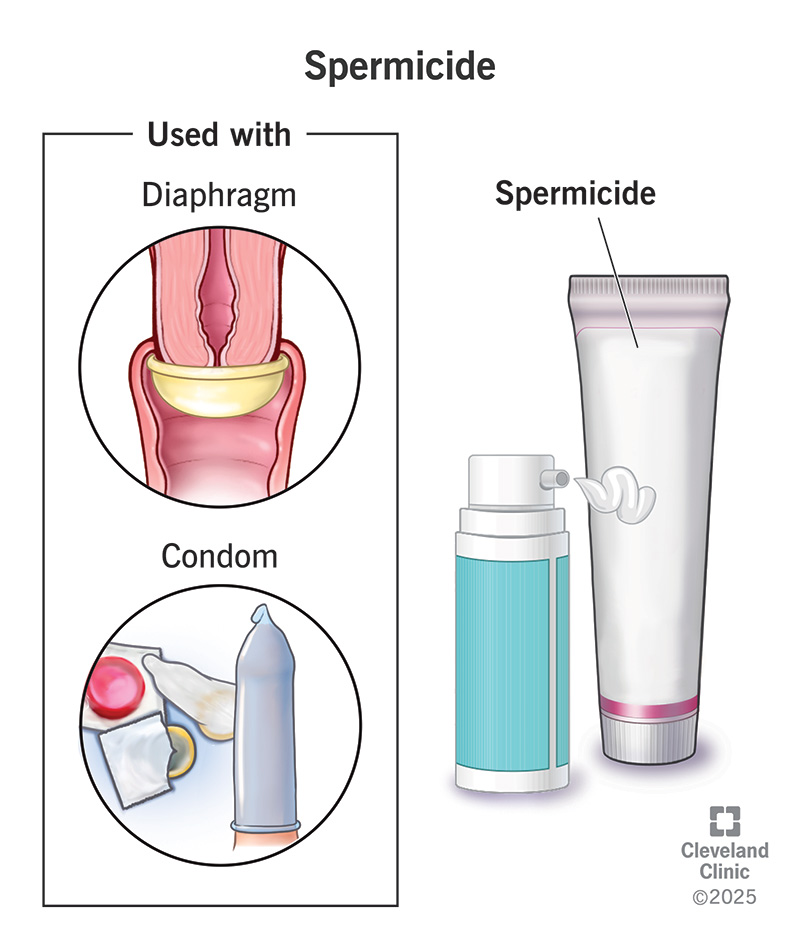
Image content: This image is available to view online.
View image online (https://my.clevelandclinic.org/-/scassets/images/org/health/articles/22493-spermicide)
Spermicides are a type of birth control that works by damaging sperm so it can’t cause pregnancy. You can find them in many different forms — like gels, creams and foams — that you put in your vagina before sex. Most spermicides contain a chemical called nonoxynol-9 (N-9). It stops sperm from moving. This prevents sperm from reaching and joining (fertilizing) an egg.
Advertisement
Cleveland Clinic is a non-profit academic medical center. Advertising on our site helps support our mission. We do not endorse non-Cleveland Clinic products or services. Policy
But spermicides aren’t the most reliable birth control method when you use them by themselves. They work best when you use them with another form of protection, like a condom. If you’re considering spermicide, it’s a good idea to talk to your healthcare provider. They can help you decide whether it’s right for you or suggest other options that might be a better fit for your lifestyle.
Spermicides come in many forms. Each type works differently. Be sure to read the label and wash your hands before use.
Spermicide gel, cream or jelly typically comes in tubes, bottles or prefilled applicators. Some brands have applicators that are prefilled with spermicide. Others require you to fill it yourself. To release the medication, insert the applicator deep into your vagina. Spermicide in this form is most effective when you apply it 10 to 15 minutes before sex. It’s effective for about an hour, but you must reapply it if you have sex multiple times within an hour.
Spermicide foams come in an aerosol can and contain an applicator. You’ll fill the applicator with the foam according to the directions on the package. Typically, you shake the can to activate the foam. Then, you fill the applicator. You must insert the foam at least 10 to 15 minutes before sex. This type begins to lose its effectiveness after about 30 minutes. So, you have a small window of time for sex.
Advertisement
This type of spermicide comes in a tablet that melts once it’s inside your vagina. You might feel it melt. But not everyone does. Put it as deep into your vagina as possible. Insert the tablet at least 10 to 15 minutes before sex. This will give the tablet time to melt. It also becomes ineffective after about one hour.
These are regular condoms that have spermicide coating. They can be pricier than regular condoms. They also expire sooner. But they offer two forms of pregnancy protection in one product — a barrier method and a spermicide.
You insert a small, thin sheet of film deep into your vagina. It’s coated in spermicide and fully melts once it’s inside. You must insert it at least 15 minutes before intercourse so it has time to dissolve. It becomes ineffective after about an hour.
You wet a small sponge containing spermicide with water. Once it’s wet, you insert the sponge deep into your vagina. The benefit of this method is you can insert it up to 24 hours prior to sex. After sex, leave it in for at least six hours. It’s also one of the more expensive forms of spermicide.
If you decide to use a spermicide, it’s important to use it correctly every time and follow the instructions on the package. Using it the right way every time is important for it to work. The instructions vary depending on the type of spermicide you use.
Here are some general rules about spermicide:
Spermicides are generally safe. But if they cause redness or irritation, it’s best to stop using them. There are many other forms of birth control that may work better for you.
Some of the advantages of using a spermicide are:
The biggest disadvantages of spermicides are:
The most common side effect of spermicide is pain and irritation in your vagina or penis. Once this irritation occurs, it’s easier for infection to enter your skin. Irritation can increase your risk of urinary tract infections (UTIs) and HIV infection.
Spermicide alone is one of the least effective methods of birth control. Even if you use it exactly right, 21 out of 100 women will get pregnant each year. If you’re trying to prevent pregnancy, you should combine it with another form of birth control to increase its effectiveness.
Advertisement
No, spermicide doesn’t protect you against sexually transmitted infections (STIs). In fact, using it may irritate your skin, which increases the risk of infection. Using a condom is the best way to protect against STIs when having sexual intercourse.
Contact your healthcare provider if you’re using a spermicide and have:
Spermicide is one of the many options available to prevent pregnancy. It’s easy to get and simple to use. But it also has some downsides. On its own, spermicide isn’t as effective as other methods. That’s why many providers recommend using it with another form of birth control to boost protection.
Spermicide can also cause irritation. If you notice any discomfort, stop using spermicides. Ask your healthcare provider about birth control options that may work better for you.
Advertisement



Sign up for our Health Essentials emails for expert guidance on nutrition, fitness, sleep, skin care and more.
Learn more about the Health Library and our editorial process.
Cleveland Clinic’s health articles are based on evidence-backed information and review by medical professionals to ensure accuracy, reliability and up-to-date clinical standards.
Cleveland Clinic’s health articles are based on evidence-backed information and review by medical professionals to ensure accuracy, reliability and up-to-date clinical standards.
Your birth control needs to work for you. At Cleveland Clinic, we help you find the right birth control option to fit your goals and lifestyle.
