



Herpes simplex virus (HSV) causes oral herpes, genital herpes and infections in other areas of your body. Fluid-filled blisters on your skin are common symptoms, but many people have no symptoms at all. A simple blood test can tell you if you have HSV in your body. Antiviral medications can treat single outbreaks or help you manage HSV long term.
Advertisement
Cleveland Clinic is a non-profit academic medical center. Advertising on our site helps support our mission. We do not endorse non-Cleveland Clinic products or services. Policy
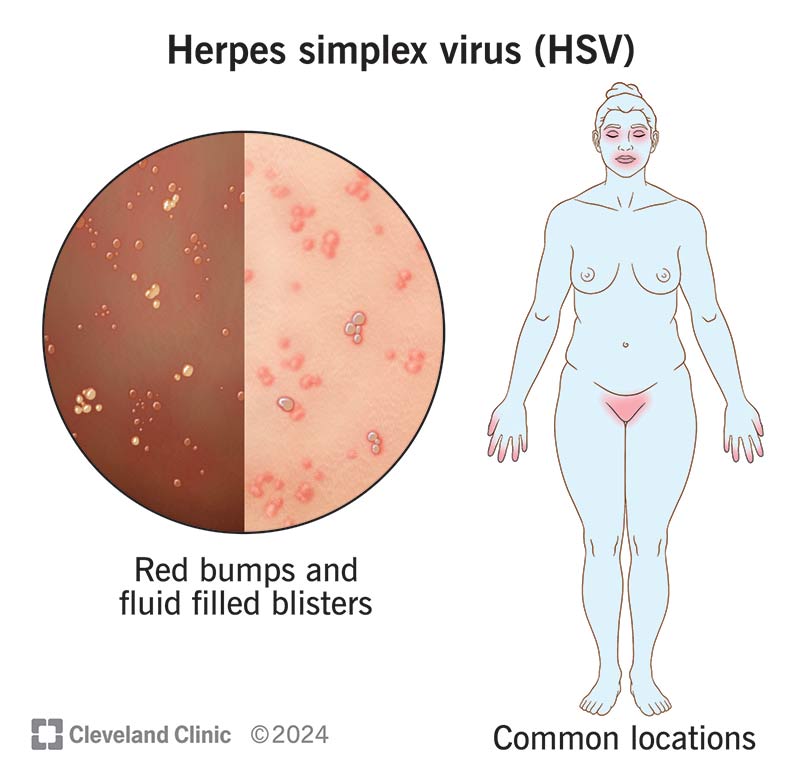
Image content: This image is available to view online.
View image online (https://my.clevelandclinic.org/-/scassets/images/org/health/articles/herpes-simplex-virus.jpg)
Herpes simplex virus (HSV) can infect many different parts of your body, most commonly your mouth area (oral herpes) and genitals (genital herpes). HSV causes fluid-filled blisters that break open and crust over wherever the infection is. This is known as a herpes outbreak. But it’s also possible to have no symptoms and not realize you’re infected.
Advertisement
Cleveland Clinic is a non-profit academic medical center. Advertising on our site helps support our mission. We do not endorse non-Cleveland Clinic products or services. Policy
HSV is common and highly contagious. It spreads from person to person through skin-to-skin contact. A herpes simplex infection occurs when the virus enters your body through your skin and mucous membranes (mucosa). The virus uses your cells to make copies of itself (replication).
Once you’re infected, the virus stays in your body for life. It’s usually asleep (dormant), but it may “wake up” (reactivate) and cause outbreaks. How HSV affects you depends on many things, including the virus type and your overall health.
There’s no cure for HSV. But treatments can make outbreaks more manageable and lower the odds of spreading the virus to others.
There are two types of herpes simplex virus:
People used to link HSV-1 with oral herpes and HSV-2 with genital herpes. But that old distinction is misleading. We know that both virus types cause both types of infections.
Herpes simplex virus can cause infections in your:
Advertisement
It’s rare but possible for newborns to get herpes simplex. This is called neonatal herpes, and it can affect many different parts of a newborn’s body. It’s dangerous and needs treatment soon after birth.
The symptoms of a herpes simplex infection are the same for females and males, but can vary by infection type:
You catch HSV through direct contact with someone who has an HSV infection. This means part of your body touches someone else’s:
Someone with HSV doesn’t transmit (or “shed”) the virus from every part of their body. They only shed it from the area that’s infected. Usually, that’s the part of their body where HSV first entered.
For example:
How the virus affects you depends on which part of your body touches an infected area.
| Type of contact | How HSV spreads |
|---|---|
| Genital-to-genital contact | HSV spreads from one person’s genital area to another person’s genital area (giving them genital herpes). |
| Oral-to-oral contact | HSV spreads from one person’s mouth to another person’s mouth (giving them oral herpes). |
| Oral-to-genital contact | HSV spreads from one person’s mouth to another person’s genitals (giving them genital herpes). |
| Genital-to-oral contact | HSV spreads from one person’s genitals to another person’s mouth (giving them oral herpes). |
| Sore-to-skin contact | It’s rare but possible to get an HSV infection on your finger by touching a sore on yourself or someone else. |
| Type of contact | |
| Genital-to-genital contact | |
| How HSV spreads | |
| HSV spreads from one person’s genital area to another person’s genital area (giving them genital herpes). | |
| Oral-to-oral contact | |
| How HSV spreads | |
| HSV spreads from one person’s mouth to another person’s mouth (giving them oral herpes). | |
| Oral-to-genital contact | |
| How HSV spreads | |
| HSV spreads from one person’s mouth to another person’s genitals (giving them genital herpes). | |
| Genital-to-oral contact | |
| How HSV spreads | |
| HSV spreads from one person’s genitals to another person’s mouth (giving them oral herpes). | |
| Sore-to-skin contact | |
| How HSV spreads | |
| It’s rare but possible to get an HSV infection on your finger by touching a sore on yourself or someone else. |
It ranges from one to 26 days, but the incubation period is typically six to eight. This is how long it takes for you to develop symptoms after first getting infected with HSV. Some people get infected but don’t develop symptoms for months or years.
Things that may cause an oral or genital herpes outbreak include:
Triggers specific to oral herpes include:
Outbreaks can also occur randomly without any obvious trigger.
Advertisement
A healthcare provider will do a physical exam and run tests. During the exam, they’ll look for signs of infection, like sores. They may take a sample to send for lab testing. If your provider suspects encephalitis and/or meningitis, they may do a spinal tap.
If you don’t have sores, your provider can use a blood test to check for antibodies against HSV-1 or HSV-2. Antibodies are a sign that you were infected with the virus in the past. Blood test results can help your provider plan treatment. But in general, they’re not routinely useful or used.
An HSV infection has three stages:
This happens after HSV enters your body. The virus travels to nearby nerve cells, like those near your mouth or in your pelvis. It starts making copies of itself.
HSV then travels through your nerves to nearby skin or mucosa. By now, your immune system is on alert. It sends out cells that cause inflammation. This can make blisters form on your skin. You may also notice swollen lymph nodes in that area (like below your jaw or in your groin). It’s also possible to have no symptoms at this stage and not know you’re infected.
Within a few weeks, your immune system clears the primary infection. But HSV stays in the nerve cells it first infected. This is called latency. The virus is there in your nerve cells, but is mostly inactive or “asleep.” If enough infected cells wake up, your immune system will take notice. This leads to HSV reactivation.
Advertisement
This is when infected cells wake up and trigger an immune response. A few things are possible now:
Prescription antiviral medications are the main treatment for HSV infections. These come in different forms, including:
Your provider will tell you which medicines are best for you based on the type of infection, its severity and your immune health. They’ll also let you know the proper dose and how long you need to take it.
Advertisement
Treatment for oral and genital herpes falls into two categories: episodic therapy and chronic suppressive therapy.
This is short-term treatment that targets a single outbreak. You take antiviral medicine when you first notice signs of an outbreak, like skin tingling or itching. The sooner you take it, the better it works. It can help with primary HSV infections and later outbreaks.
Episodic therapy can:
Treating a single outbreak does not stop you from having future outbreaks or make those less severe. To do that, you need chronic suppressive therapy.
This means you take antivirals long term. Your provider might recommend this if you have genital herpes and any of the following are true:
They may also recommend it if you have severe oral herpes outbreaks and/or at least six outbreaks per year.
For genital herpes, chronic therapy can:
Contact a provider if you have symptoms of a herpes infection or were exposed to HSV. Your provider will tell you if you need an exam or testing.
If you have oral or genital herpes, it may help to ask your provider:
Herpes simplex is a lifelong infection. The virus may reactivate and cause outbreaks every now and then. How often it does this can vary widely from person to person. But thanks to antivirals, most people can still live normal lives in ways that are meaningful to them. Being open with your partners before having sex can foster trust and help you both feel more comfortable.
Most people with oral herpes have fewer outbreaks as they get older, particularly after age 35. Similarly, the frequency of genital herpes outbreaks typically goes down over time. Genital HSV-1 causes fewer outbreaks than genital HSV-2.
In most cases, the answer is no. But there are a couple of exceptions:
HSV is a common virus that spreads easily between people. So, it’s hard to prevent. But you can lower your risk by:
No. HPV and herpes simplex are two different viruses. HPV stands for human papillomavirus, and it’s not part of the herpes family of viruses. But both HPV and HSV:
Yes, it’s possible if all these are true:
These precautions are important, but they’re still not a 100% guarantee. Talk to your healthcare provider about the risks and what to do in your situation.
Herpes simplex virus (HSV) is anything but simple. It can spread even when you don’t have symptoms. But that doesn’t mean it has to upend your life. Thankfully, antivirals make HSV much easier to manage than in the past. If you think you have an HSV infection, contact a healthcare provider. They know how common this virus is. And they’re prepared to help you manage it.



Sign up for our Health Essentials emails for expert guidance on nutrition, fitness, sleep, skin care and more.
Learn more about the Health Library and our editorial process.
Cleveland Clinic’s health articles are based on evidence-backed information and review by medical professionals to ensure accuracy, reliability and up-to-date clinical standards.
Cleveland Clinic’s health articles are based on evidence-backed information and review by medical professionals to ensure accuracy, reliability and up-to-date clinical standards.
Don’t ignore sexually transmitted infections. Cleveland Clinic experts will treat them confidentially and quickly in a judgment-free environment.
