



Lactose intolerance occurs in people who lack the enzyme they need to break down lactose, the sugar in milk. It causes digestive distress when you eat dairy products. A food intolerance is different from a food allergy.
Advertisement
Cleveland Clinic is a non-profit academic medical center. Advertising on our site helps support our mission. We do not endorse non-Cleveland Clinic products or services. Policy
Lactose intolerance is a reaction in your digestive system to lactose, the sugar in milk. It causes uncomfortable symptoms after you eat dairy products. Many people have difficulty digesting lactose, but not everyone experiences noticeable symptoms from it. If you do, it’s called lactose intolerance.
Advertisement
Cleveland Clinic is a non-profit academic medical center. Advertising on our site helps support our mission. We do not endorse non-Cleveland Clinic products or services. Policy
Lactose malabsorption is the inability to break down and absorb lactose molecules in your digestive system. It’s common — in fact, about 65% of adults worldwide can't break down and absorb lactose. Unabsorbed lactose passes undigested through your gastrointestinal tract, causing symptoms for some people.
Everyone with lactose intolerance has lactose malabsorption, but not everyone with lactose malabsorption has lactose intolerance. One way of thinking about it is that malabsorption happens in your small intestine, while symptoms of food intolerance happen later in your large intestine.
Your small intestine is where most of the nutrients from your food are absorbed. Your small intestine breaks nutrients down into smaller molecules that can pass through the intestinal wall into your bloodstream. Everything that isn’t absorbed in your small intestine passes to your large intestine.
Undigested sugar molecules in your large intestine produce more water and more gas. They trigger your large intestine (colon) to secrete extra fluid to help pass them through. They produce gas when the bacteria in your colon ferment them. This can lead to digestive symptoms such as diarrhea and gas pain.
Advertisement
How noticeable your symptoms are will depend on other variables. Can you break down lactose a little bit, or not at all? How much lactose do you eat at a time? What other conditions might affect the water and gas content in your colon? These are some of the factors your healthcare provider will explore.
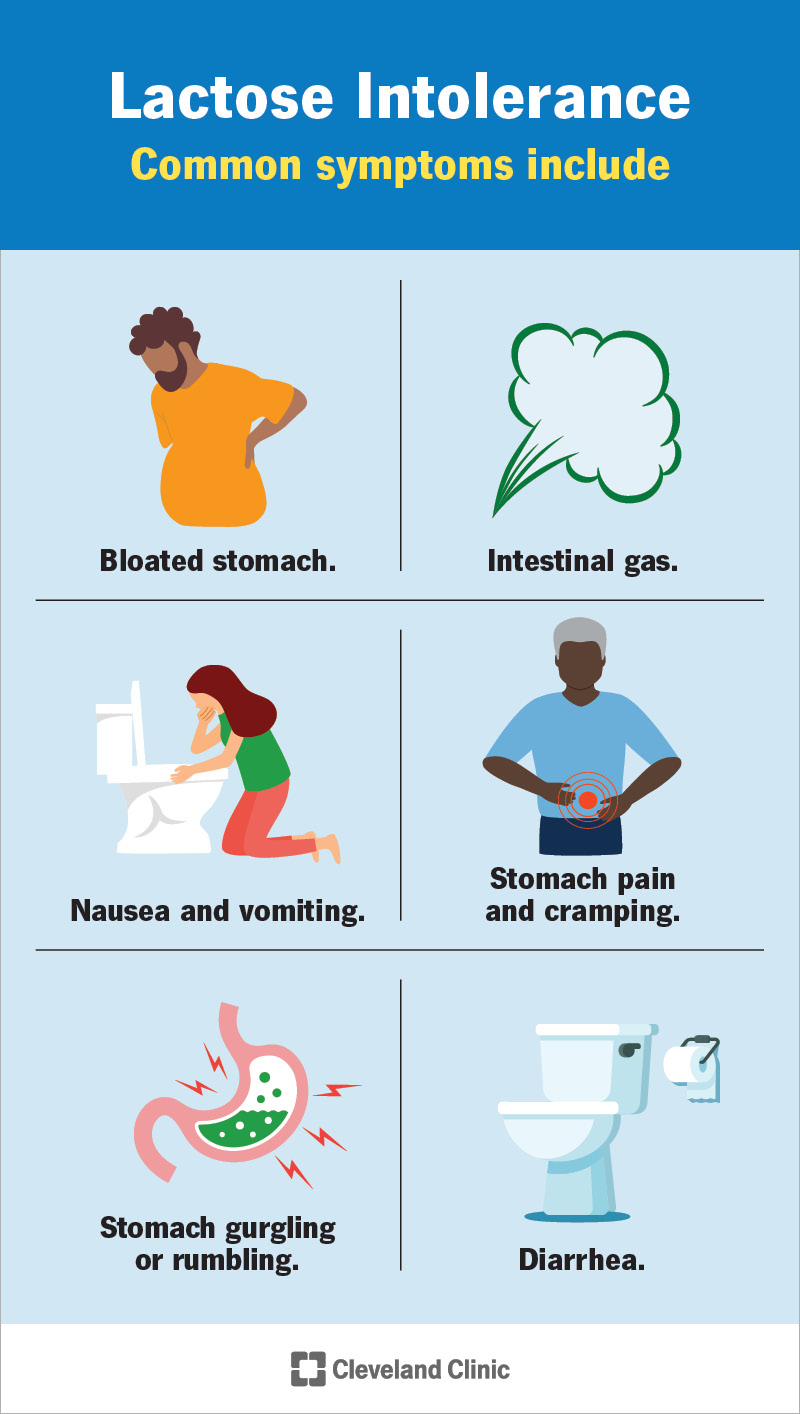
Image content: This image is available to view online.
View image online (https://my.clevelandclinic.org/-/scassets/Images/org/health/articles/7317-lactose-intolerance)
Signs and symptoms of lactose intolerance may include:
These symptoms come from undigested lactose in your large intestine. It takes between six to 10 hours for food to reach your large intestine after you eat it, and another 24-36 hours after that to travel through your large intestine. So your symptoms might occur up to a day or two after you eat lactose.
Lactose is in most dairy products unless it’s been removed. That includes cow’s milk and goat’s milk products. There’s more in some types than others. For example, fresh milk and cream are higher in lactose, while hard cheeses have less. You might be OK with a sprinkling of parmesan on your salad.
On the other hand, if you’re very sensitive to lactose, you might react to even small amounts. Check nutrition labels and ingredient lists on food. Lactose is often added to processed foods, including soups, salad dressings and snack foods. It may even be added to your prescription medications.
Two factors contribute to lactose intolerance: lactose malabsorption and gut sensitivity. Lactose malabsorption is the most important factor. It’s the inability to break down and absorb lactose in your small intestine that leads to lactose later entering your large intestine and triggering symptoms.
Your small intestine needs a specific enzyme, called lactase, to break down lactose into smaller molecules that it can absorb. Most people naturally produce lactase in their small intestines during infancy to help digest breast milk. Most people begin to make less of it as they grow up.
If you don’t have enough lactase, you won’t be able to digest lactose. Some people produce more or less lactase than others. But technically, the majority of people worldwide have lactose malabsorption due to lactase deficiency. Only certain populations continue to produce lactase into adulthood.
This is where your gut sensitivity factors in. We all consume things from time to time that we can’t fully digest. Certain dietary fibers and sugars go straight through our digestive systems to feed the bacteria living in our guts. Most of us tolerate a little of this to some extent, without overwhelming symptoms.
Advertisement
But everyone is a little different. Our genes, intestinal health, sensitivities and diet all factor in. Your unique gut microbiome — the different types of bacteria living in your colon — may process lactose differently from someone else’s. Your symptoms will tell you how much lactose you can tolerate.
The four types, and their causes, are:
Genes determine how likely you are to continue to produce lactase, the enzyme that helps you digest lactose. Genes may also partly affect your gut sensitivity and the types of bacteria you have in your gut. Some bacteria convert lactose into gas, but others convert it into lactic acid, which may not cause symptoms.
You’re more likely to have lactose malabsorption and lactose intolerance if your genetic profile is:
You may be more likely to have lactase persistence and lactose tolerance if your genetic profile is:
Advertisement
Rarely, some people are born with congenital lactase deficiency. This is a genetic disorder that causes lactose intolerance from birth.
Most people develop lactose intolerance as they grow from childhood into adulthood. The most common type of lactose intolerance, primary lactose intolerance, happens because you gradually stop producing lactase, the enzyme that digests lactose. Your gut sensitivity can also change over time.
Separately from lactose malabsorption, you may be more likely to experience symptoms if you have:
These are conditions that tend to develop gradually over your lifetime.
You can develop secondary lactose intolerance suddenly as a result of damage to your small intestine. Injury, surgery, infections or chronic diseases may damage the cells that produce lactase. This can cause sudden lactose malabsorption and intolerance, even if you could previously digest lactose.
Secondary causes of lactose intolerance include:
Secondary lactose intolerance may not be permanent. If your small intestine recovers its usual function, you may regain the ability to digest lactose.
Advertisement
You might suspect you’re lactose intolerant if you notice a pattern of gastrointestinal symptoms after you eat dairy products. However, many people with lactase deficiency can tolerate some lactose, sometimes. If you’re not sure whether lactose is affecting you, visit a healthcare provider.
Healthcare providers have several ways of testing for lactose intolerance. Common tests include:
If you want to be able to digest lactose, you need lactase in your gut. Most people with lactose intolerance can’t produce lactase naturally. Lactase supplements can give your body the lactase it needs to break down lactose. You can take these as tablets or drops before consuming lactose.
Researchers are also experimenting with lactic acid bacteria as a possible fix for lactose intolerance symptoms. These are bacteria that convert lactose into lactic acid instead of gas. Ingesting these bacteria as probiotics, together with prebiotics that feed them, may improve lactose tolerance.
Experiment with your diet to find out what your personal lactose threshold is. Some people find they can tolerate certain dairy foods in certain amounts, or when combined with other foods. Begin with a lactose-free diet, then gradually reintroduce lactose-containing foods to see how your system responds.
Some people with lactose intolerance can tolerate up to 12 grams (g) of lactose at one time, which is a cup of milk or a scoop of ice cream. You can also find lactose-reduced and lactose-free versions of most dairy products at the supermarket. Experiment with these and other dairy alternatives in your diet.
Secondary lactose intolerance caused by damage to your small intestine might be reversible after your small intestine recovers. This will depend on how permanent the damage is. It may also take some time. Babies born prematurely who have developmental lactose intolerance usually grow out of it.
If you have primary or congenital lactose intolerance, you won’t ever start naturally producing more lactase. But it’s possible your symptoms could change if your intestinal health or microbiome changes. In theory, your tolerance might improve a little, or you might notice your symptoms a little less.
Lactose intolerance won’t seriously harm you. If you can cope with the symptoms while the lactose passes through your digestive system, they’ll eventually end. However, you can easily avoid lactose intolerance symptoms with lactase supplements and lactose-free dairy products.
Lactose intolerance will affect your diet, which means you’ll have to pay attention to the nutrients you’re getting. If you avoid all dairy products, you could end up low in calcium and vitamin D. You can get these nutrients from other food sources, but dairy products are some of the most common ones.
Calcium deficiency or vitamin D deficiency can affect your bones, muscles and nervous system. Deficiencies can particularly affect growing children. Your healthcare provider might recommend taking calcium or vitamin D supplements — or giving them to your child — if you can’t get enough from your diet.
No. A food allergy is a reaction from your immune system, usually to a protein in your food. Your immune system registers the protein as a threat and reacts to remove it. Even a small amount of the protein can cause a big reaction if you’re allergic, and it usually occurs very soon after ingesting it.
An allergic reaction can cause symptoms throughout your body, not just in your digestive system. It may include swelling, hives and shortness of breath. You may also have stomach pain, nausea and vomiting, but this would usually occur early in the digestive process when the protein is still in your stomach.
The main difference is that a milk allergy is a reaction from your immune system to a milk protein. Lactose intolerance is a reaction in your digestive system to a milk sugar. An allergic reaction has an emergency quality. It can be immediate, severe and, in some cases, life-threatening (anaphylaxis).
When your digestive system reacts to a sugar that it can’t digest, it can mean uncomfortable symptoms during digestion, but it isn’t dangerous. Undigested lactose will produce extra water and gas in your colon. It might give you diarrhea and gas while it’s processing through, but it won’t harm you.
Like lactose intolerance, milk protein intolerance begins with malabsorption in your small intestine. When your small intestine can’t break down and absorb one of the proteins in milk (usually casein or whey), the undigested protein passes on through your intestines, just like undigested sugars do.
The difference is that undigested proteins in your digestive system can raise a red flag in your immune system. Your immune system may register the protein as an allergen sometime later in the digestive process, producing a delayed immune response. You may later develop an allergy to the protein.
Lactose intolerance isn’t a disorder. It’s just a natural variation in how our digestive systems work. Actually, the ability to digest lactose past infancy is a relatively recent genetic adaptation in humans. Not all of us have that adaptation, and that’s OK. You can live a healthy life with lactose intolerance.
If you have digestive symptoms and think they might be related to dairy products, a healthcare provider can help. They can test you for lactose intolerance and other possible causes of your symptoms. If you do have lactose intolerance, a provider can help you adjust your lifestyle to avoid those symptoms.



Sign up for our Health Essentials emails for expert guidance on nutrition, fitness, sleep, skin care and more.
Learn more about the Health Library and our editorial process.
Cleveland Clinic’s health articles are based on evidence-backed information and review by medical professionals to ensure accuracy, reliability and up-to-date clinical standards.
Cleveland Clinic’s health articles are based on evidence-backed information and review by medical professionals to ensure accuracy, reliability and up-to-date clinical standards.
Cleveland Clinic’s primary care providers offer lifelong medical care. From sinus infections and high blood pressure to preventive screening, we’re here for you.
