What are the symptoms of heart failure?
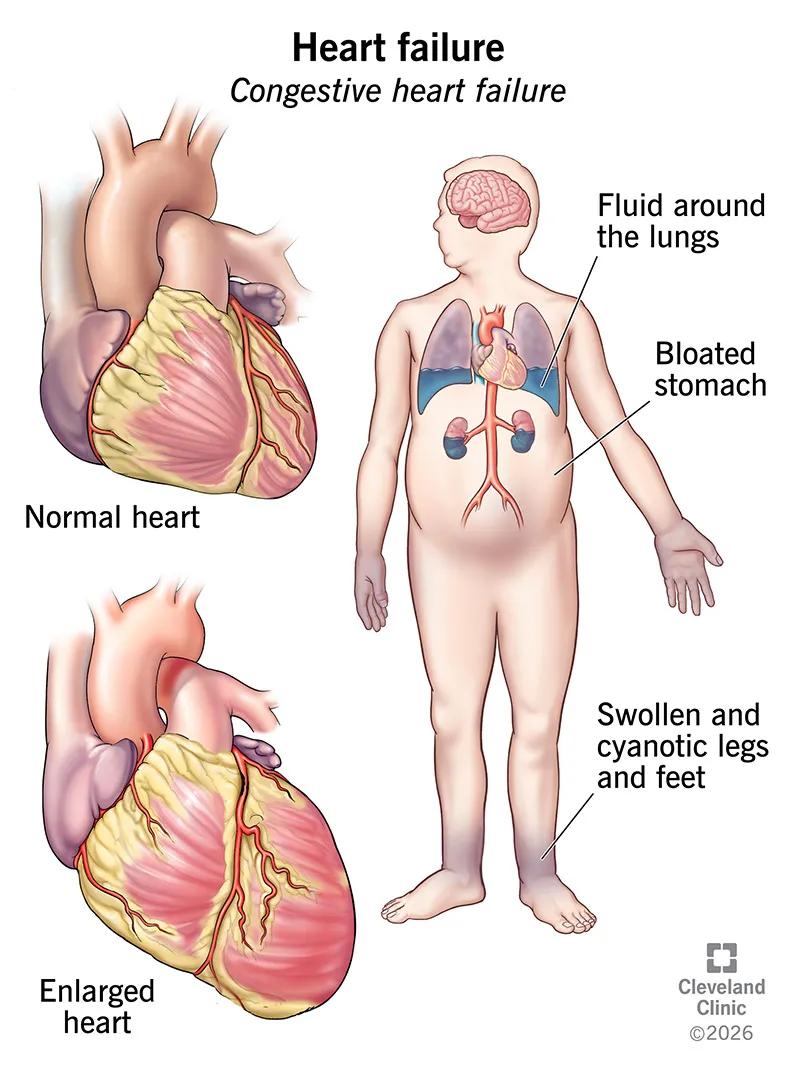
You may not have any symptoms of heart failure, or the symptoms may be mild to severe. Symptoms can be constant, or can come and go. Symptoms are due to the changes that occur in your heart and body and include:
- Shortness of breath or difficulty breathing with exercise, at rest, or when lying flat in bed. Shortness of breath occurs when fluid backs up into the lungs (congestion) or when your body does not have enough oxygen-rich blood to let you go on with your activity or exercise without a rest period. Even though you think of breathing as a lung problem, your heart condition can cause periods of shortness of breath. In some cases, symptoms may cause you to wake up suddenly at night, disrupting your normal sleep patterns.
- A dry, hacking cough or wheezing
- Swollen ankles, legs and abdomen, and weight gain. Less blood to the kidneys causes you to retain fluid and water, resulting in edema (swelling) and water weight gain.
- Need to urinate while resting at night. Gravity causes more blood to get to the kidneys when you are lying down.
- Tiredness (fatigue) and weakness during exercise or activities occur because the heart is not pumping enough oxygen-rich blood to major organs and muscles.
- Dizziness, confusion, difficulty concentrating or fainting may occur because the heart is not pumping enough oxygen-rich blood to the brain.
- Rapid or irregular heartbeats (palpitations): When the heart muscle does not pump well, the heartbeat speeds up to help the heart get enough oxygen-rich blood to major organs and muscles, or the heartbeat may become abnormal.
Other symptoms include a feeling of fullness (bloating) in your stomach, loss of appetite or nausea. If you have heart failure, you may have one or all of these symptoms. Sometimes, people with heart failure do not have any symptoms.
What are the types of heart failure?
Systolic left ventricular dysfunction (or systolic heart failure) occurs when the muscle in the heart’s left ventricle doesn’t contract with enough force, so less oxygen-rich blood is pumped throughout the body.
Heart failure with preserved left ventricular function (diastolic heart failure) occurs when the heart contracts normally, but the ventricles do not relax properly or are stiff, and less blood enters the heart during normal filling.
Your ejection fraction (EF) is used to measure how well your heart pumps with each beat to determine the level of systolic dysfunction. Data obtained on an echocardiogram (ECG or EKG) can tell us if you have heart failure with diastolic dysfunction.
Left ventricular ejection fraction (LVEF) is the measurement of how much blood is being pumped out of the left ventricle of the heart (the main pumping chamber) with each contraction. Right ventricular ejection fraction (RVEF) is the measurement of how much blood is being pumped out of the right side of the heart to the lungs for oxygen. In most cases, the term "ejection fraction" refers to LVEF.
| EF % |
Pumping Ability of the Heart |
| 55% to 70% |
Normal |
| 36% to 54% |
Below normal |
| 35% to 40% |
Moderately below normal |
| <35% |
Severely below normal; may be at risk of life-threatening irregular heartbeats or uncoordinated contraction of heart muscle |
What do the numbers mean?
Ejection fraction is usually expressed as a percentage. A normal heart pumps a little more than half the heart’s blood volume with each beat.
A normal LVEF ranges from 55% to 70%. An LVEF of 65, for example, means that 65% of the total amount of blood in the left ventricle is pumped out with each heartbeat.
The LVEF may be lower when the heart muscle has become damaged due to a heart attack, heart muscle disease (cardiomyopathy) or other causes.
A reduced EF may confirm a diagnosis of systolic heart failure. In diastolic failure, the EF is normal, since the heart pumps normally. Often, the heart is also enlarged. An EF of less than 35% increases the risk of life-threatening irregular heartbeats that can cause sudden cardiac arrest (loss of heart function) and sudden cardiac death. An implantable cardioverter defibrillator (ICD) may be recommended.
Patients who develop severe, advanced heart failure may benefit from special treatments, such as cardiac transplantation or a ventricular assist device (VAD). If your quality of life is very poor or your doctor has told you that your condition is very severe, please ask about other treatments.
Your EF can go up and down, based on your heart condition and the therapies that have been prescribed.
How is EF measured?
Your EF can be measured in your doctor’s office during tests such as:
- Ultrasound of the heart (echocardiography)
- Magnetic resonance imaging (MRI) scan of the heart
- Nuclear medicine scan (multiple gated acquisition [MUGA]) of the heart; also called a nuclear stress test
Why it’s important to know your EF
If you have a heart condition, it is important for you and your doctor to know your EF. Your EF can help your doctor determine the best course of treatment for you and the effectiveness of the therapies that have been prescribed.
You should have your EF measured when you are first diagnosed with a heart condition, and again as needed, based on changes in your condition. Ask your doctor how often you should have your EF checked.
What causes heart failure?
Heart failure is caused by many things that damage the heart muscle, including:
- Coronary artery disease (also called coronary atherosclerosis) — a disease of the arteries that supply blood and oxygen to the heart. Coronary artery disease occurs when the normal lining of the arteries breaks down, the walls of the arteries thicken, and deposits of fat and plaque block the flow of blood through the arteries. The arteries that supply blood to the heart become very narrowed and the heart can no longer respond to increased activity. Extra strain on the heart may result in chest pain (angina pectoris) and other symptoms of heart disease.
- Heart attack — occurs when a coronary artery becomes blocked, stopping the flow of blood to the heart muscle and damaging it. All or part of the heart muscle becomes cut off from its supply of oxygen. A heart attack can damage the heart muscle, resulting in a scarred area which does not function.
- Cardiomyopathy — damage to the heart muscle from causes other than artery or blood flow problems. Causes include viruses, alcohol or drug abuse and genetics.
- Heart defects present at birth
- Diabetes
- High blood pressure (hypertension) —Blood pressure is the force of blood pushing against blood vessel walls. High blood pressure means the pressure in the arteries is above the normal range.
- Arrhythmia (abnormal heart rhythms)
- Kidney disease
- Obesity (being overweight)
- Medications — some chemotherapy agents
Heart failure often occurs when several diseases or conditions are present at once.
How is heart failure treated?
Together, you and your doctor or nurse will discuss your treatment options. Your doctor or nurse will determine which treatment methods are right for you. More information about heart failure treatments and management is included later in this notebook.
Treatment is a team effort
Heart failure management is a team effort, and you are the key player on the team.
Your heart doctor or nurse will prescribe your medications and manage other medical problems. Other team members, including nurses, dietitians, pharmacists, exercise specialists and social workers, will help you achieve success. Most important, it is up to YOU to take your medications, make dietary changes, live a healthy lifestyle, keep your follow-up appointments and be an active member of the team.
How common is heart failure?
Heart failure affects an estimated 5.7 million Americans, and about 670,000 people are diagnosed with heart failure each year. Heart failure is the leading cause of hospitalization in people over age 65.
Women and heart failure
Heart failure affects about 2.5 million women in the United States. Women tend to develop heart failure with preserved left ventricular function and with a more normal EF than men. Heart failure in women is often linked to high blood pressure, coronary artery disease, valve disease and diabetes.
The signs and symptoms of heart failure are the same among men and women, but women tend to experience lower exercise ability and shortness of breath than do men. Women also have ankle swelling more frequently. In general, women with heart failure live longer than men with heart failure.
What is the outlook?
With the right care, heart failure will not stop you from doing the things you enjoy. Your prognosis, or outlook for the future, will depend on how well your heart muscle is working, your symptoms and how well you respond to and follow your treatment plan.
Patients with a long-term illness, such as heart failure, should talk to their doctor and their family about their desires for extended medical care. An “advance directive” or “living will” is one way to let everyone know your wishes. A living will includes your desires about the use of medical treatments to prolong your life. This document is prepared while you are well, in case you are unable to make these decisions at a later time.
Stages of Heart Failure
In 2001, the American Heart Association (AHA) and American College of Cardiology (ACC) developed the “Stages of Heart Failure.” These stages will help you understand that heart failure is a chronic condition that worsens over time. The stages will also help you understand why a new medication was added to your treatment plan and may help you understand why lifestyle changes and other treatments are needed.
The stages classified by the AHA and ACC are different from the New York Heart Association (NYHA) clinical classifications of heart failure that rank patients as class I-II-III-IV, according to the degree of symptoms or functional limits. Ask your health care provider what stage of heart failure you are in.
Check the information below to see if your therapy matches what the AHA and ACC recommend. Note that you cannot go backward in stage, only forward. The table below outlines a basic plan of care that may or may not apply to you. Ask your doctor or nurse to explain the therapies that are listed if you do not understand why you are not receiving them. Refer to other parts of this notebook to learn more about specific medications, diet, and exercise.
Definition of Stage A
People at high risk of developing heart failure (pre heart failure), including people with:
- Hypertension
- Diabetes
- Coronary artery disease
- Metabolic syndrome
- History of alcohol abuse
- History of rheumatic fever
- Family history of cardiomyopathy
- History of taking drugs that can damage heart muscle, e.g., some anticancer agents
Usual treatments for Stage A
- Exercise regularly
- Quit smoking
- Treat hypertension (medication and low-sodium diet)
- Treat lipid disorders (cholesterol)
- Discontinue alcohol or illegal drug use
- An angiotensin converting enzyme inhibitor (ACE-I) or an angiotensin II receptor blocker (ARB) is prescribed if you have coronary artery disease, or if you have diabetes, high blood pressure, or other vascular or cardiac conditions
- A beta-blocker may be prescribed if you have high blood pressure
Definition of Stage B
People diagnosed with systolic left ventricular dysfunction but who have never had symptoms of heart failure (pre heart failure), including people with:
- Prior heart attack
- Valve disease
- Cardiomyopathy
The diagnosis is usually made when an ejection fraction of less than 40% is found during an echocardiogram test.
Usual treatments for Stage B
- Treatment methods for Stage A apply
- All people should take an angiotensin converting enzyme inhibitor (ACE-I) or angiotensin II receptor blocker (ARB)
- A beta -blocker and an aldosterone antagonist (eplerenone) should be prescribed after a heart attack to minimize the risk of the heart muscle enlarging and pumping poorly
- Surgery or interventional options for coronary artery blockage, heart attack, and valve repair or replacement (as appropriate) should be discussed
Definition of Stage C
Patients with known systolic heart failure and current or prior symptoms. The most common symptoms include:
- Shortness of breath
- Fatigue
- Reduced ability to exercise
Usual Treatments for Stage C
- Treatment methods above for Stage A and Stage B apply
- An angiotensin converting enzyme inhibitor (ACE-I) or angiotensin II receptor blocker and a beta-blocker will be prescribed to help the heart muscle pump with less work
- An aldosterone antagonist may be prescribed when symptoms remain present with other therapies
- Hydralazine/nitrate combination may be prescribed if symptoms persist
- Diuretics (water pills) and digoxin may be prescribed if symptoms persist
- Restrict dietary sodium (salt) to 2,000 mg per day
- Monitor weight daily and report a change of 4 pounds above or below “dry” weight
- Restrict fluids (as appropriate)
- Cardiac resynchronization therapy (biventricular pacemaker) may be recommended
- Implantable cardiac defibrillator (ICD) therapy may be recommended
Definition of Stage D
Patients with systolic heart failure and presence of advanced symptoms after receiving optimum medical care.
Usual treatments for Stage D
- Treatment methods for Stages A, B & C apply
- Patients should be evaluated to determine if the following treatments are available options: heart transplant, ventricular assist devices, surgery options, continuous infusion of intravenous inotropic drugs, end-of-life (palliative or hospice) care, or research therapies
References
- American Heart Association. Heart Failure. www.heart.org Accessed 4/18/2012
- American College of Cardiology. CardioSmart: Heart Failure. cardiosmart.org Accessed 4/18/2012
- National Heart Lung and Blood Institute. What is Heart Failure? www.nhlbi.nih.gov Accessed 4/18/2012
Can't find the health information you’re looking for?
This information is provided by the Cleveland Clinic and is not intended to replace the medical advice of your doctor or health care provider. Please consult your health care provider for advice about a specific medical condition. This document was last reviewed on: 12/31/2011…#8116