Polycystic kidney disease (PKD) is a genetic disorder characterized by the
growth of numerous cysts in the kidneys. The kidneys are two organs, each about
the size of a fist, located in the upper part of a person’s abdomen, toward the
back. The kidneys filter wastes and extra fluid from the blood to form urine.
They also regulate amounts of certain vital substances in the body. When cysts
form in the kidneys, they are filled with fluid. PKD cysts can profoundly
enlarge the kidneys while replacing much of the normal structure, resulting in
reduced kidney function and leading to kidney failure.
When PKD causes kidneys to fail—which usually happens after many years—the
patient requires dialysis or kidney transplantation. About one-half of people
with the most common type of PKD progress to kidney failure, also called
end-stage renal disease (ESRD).
PKD can also cause cysts in the liver and problems in other organs, such as
blood vessels in the brain and heart. The number of cysts as well as the
complications they cause help doctors distinguish PKD from the usually harmless
"simple" cysts that often form in the kidneys in later years of life.
In the United States, about 600,0001
people have PKD, and cystic disease is the fourth leading cause of kidney
failure. Two major inherited forms of PKD exist:
- Autosomal dominant PKD is the most common inherited form. Symptoms
usually develop between the ages of 30 and 40, but they can begin earlier,
even in childhood. About 90 percent of all PKD cases are autosomal dominant PKD.
- Autosomal recessive PKD is a rare inherited form. Symptoms of
autosomal recessive PKD begin in the earliest months of life, even in the womb.
1. Grantham JJ, Nair V, Winklhoffer F. Cystic diseases of the
kidney. In: Brenner BM, ed. Brenner & Rector’s The Kidney. Vol. 2. 6th ed.
Philadelphia: WB Saunders Company; 2000: 1699–1730.
Autosomal Dominant PKD
What is autosomal dominant PKD?
Autosomal dominant PKD is the most common inherited disorder of the kidneys.
The phrase "autosomal dominant" means that if one parent has the disease, there
is a 50 percent chance that the disease gene will pass to a child. In some
cases—perhaps 10 percent—autosomal dominant PKD occurs spontaneously in
patients. In these cases, neither of the parents carries a copy of the disease
gene.
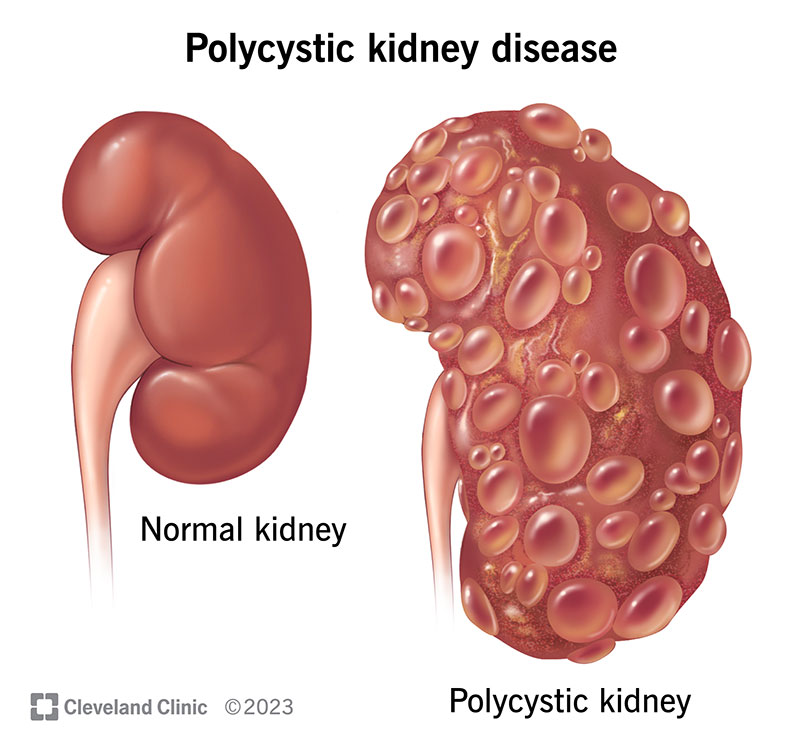
The polycystic kidney roughly retains the same shape as the healthy kidney.
Many people with autosomal dominant PKD live for several decades without
developing symptoms. For this reason, autosomal dominant PKD is often called
"adult polycystic kidney disease." Yet, in some cases, cysts may form earlier in
life and grow quickly, causing symptoms in childhood.
The cysts grow out of nephrons, the tiny filtering units inside the kidneys.
The cysts eventually separate from the nephrons and continue to enlarge. The
kidneys enlarge along with the cysts—which can number in the thousands—while
roughly retaining their kidney shape. In fully developed autosomal dominant PKD,
a cyst-filled kidney can weigh as much as 20 to 30 pounds. High blood pressure
is common and develops in most patients by age 20 or 30.
What are the symptoms of autosomal dominant PKD?
The most common symptoms are pain in the back and the sides—between the ribs
and hips—and headaches. The pain can be temporary or persistent, mild or severe.
People with autosomal dominant PKD also can experience the following complications:
- urinary tract infections—specifically, in the kidney cysts
- hematuria—blood in the urine
- liver and pancreatic cysts
- abnormal heart valves
- high blood pressure
- kidney stones
- aneurysms—bulges in the walls of blood vessels—in the brain
- diverticulosis—small pouches bulge outward through the colon
How is autosomal dominant PKD diagnosed?
Autosomal dominant PKD is usually diagnosed by kidney imaging studies. The
most common form of diagnostic kidney imaging is ultrasound, but more precise
studies, such as computerized tomography (CT) scans or magnetic resonance
imaging (MRI) are also widely used. In autosomal dominant PKD, the onset of
kidney damage and how quickly the disease progresses can vary. Kidney imaging
findings can also vary considerably, depending on a patient’s age. Younger
patients usually have both fewer and smaller cysts. Doctors have therefore
developed specific criteria for diagnosing the disease with kidney imaging
findings, depending on patient age. For example, the presence of at least two
cysts in each kidney by age 30 in a patient with a family history of the disease
can confirm the diagnosis of autosomal dominant PKD. If there is any question
about the diagnosis, a family history of autosomal dominant PKD and cysts found
in other organs make the diagnosis more likely.
In most cases of autosomal dominant PKD, patients have no symptoms and their
physical condition appears normal for many years, so the disease can go
unnoticed. Physical checkups and blood and urine tests may not lead to early
diagnosis. Because of the slow, undetected progression of cyst growth, some
people live for many years without knowing they have autosomal dominant PKD.
Once cysts have grown to about one-half inch, however, diagnosis is possible
with imaging technology. Ultrasound, which passes sound waves through the body
to create a picture of the kidneys, is used most often. Ultrasound imaging does
not use any injected dyes or radiation and is safe for all patients, including
pregnant women. It can also detect cysts in the kidneys of a fetus, but large
cyst growth this early in life is uncommon in autosomal dominant PKD.
More powerful and expensive imaging procedures such as CT scans and MRI also
can detect cysts. Recently, MRI has been used to measure kidney and cyst volume
and monitor kidney and cyst growth, which may serve as a way to track
progression of the disease.
Diagnosis can also be made with a genetic test that detects mutations in the
autosomal dominant PKD genes, called PKD1 and PKD2. Although this test can
detect the presence of the autosomal dominant PKD mutations before large cysts
develop, its usefulness is limited by two factors: detection of a disease gene
cannot predict the onset of symptoms or ultimate severity of the disease, and if
a disease gene is detected, no specific prevention or cure for the disease
exists. However, a young person who knows of a PKD gene mutation may be able to
forestall the loss of kidney function through diet and blood pressure control.
The genetic test may also be used to determine whether a young member of a PKD
family can safely donate a kidney to a family member with the disease.
Individuals with a family history of PKD who are of childbearing age might also
want to know whether they have the potential of passing a PKD gene to a child.
Anyone considering genetic testing should receive counseling to understand all
the implications of the test.
How is autosomal dominant PKD treated?
Although a cure for autosomal dominant PKD is not available, treatment can ease symptoms and prolong life.
Pain. Pain in the area of the kidneys can be caused by cyst infection,
bleeding into cysts, kidney stone, or stretching of the fibrous tissue around
the kidney with cyst growth. A doctor will first evaluate which of these causes
are contributing to the pain to guide treatment. If it is determined to be
chronic pain due to cyst expansion, the doctor may initially suggest
over-the-counter pain medications, such as aspirin or acetaminophen (Tylenol).
Consult your doctor before taking any over-the-counter medication because some
may be harmful to the kidneys. For most but not all cases of severe pain due to
cyst expansion, surgery to shrink cysts can relieve pain in the back and sides.
However, surgery provides only temporary relief and does not slow the disease’s
progression toward kidney failure.
Headaches that are severe or that seem to feel different from other headaches
might be caused by aneurysms—blood vessels that balloon out in spots—in the
brain. These aneurysms could rupture, which can have severe consequences.
Headaches also can be caused by high blood pressure. People with autosomal
dominant PKD should see a doctor if they have severe or recurring headaches—even
before considering over-the-counter pain medications.
Urinary tract infections. People with autosomal dominant PKD tend to have
frequent urinary tract infections, which can be treated with antibiotics. People
with the disease should seek treatment for urinary tract infections immediately
because infection can spread from the urinary tract to the cysts in the kidneys.
Cyst infections are difficult to treat because many antibiotics do not penetrate the cysts.
High blood pressure. Keeping blood pressure under control can slow the
effects of autosomal dominant PKD. Lifestyle changes and various medications can
lower high blood pressure. Patients should ask their doctors about such
treatments. Sometimes proper diet and exercise are enough to keep blood pressure controlled.
End-stage renal disease. After many years, PKD can cause the kidneys to fail.
Because kidneys are essential for life, people with ESRD must seek one of two
options for replacing kidney functions: dialysis or transplantation. In
hemodialysis, blood is circulated into an external filter, where it is cleaned
before re-entering the body; in peritoneal dialysis, a fluid is introduced into
the abdomen, where it absorbs wastes and is then removed. Transplantation of
healthy kidneys into ESRD patients has become a common and successful procedure.
Healthy—non-PKD—kidneys transplanted into PKD patients do not develop cysts.
Autosomal Recessive PKD
What is autosomal recessive PKD?
Autosomal recessive PKD is caused by a mutation in the autosomal recessive
PKD gene, called PKHD1. Other genes for the disease might exist but have not yet
been discovered by scientists. We all carry two copies of every gene. Parents
who do not have PKD can have a child with the disease if both parents carry one
copy of the abnormal gene and both pass that gene copy to their baby. The chance
of the child having autosomal recessive PKD when both parents carry the abnormal
gene is 25 percent. If only one parent carries the abnormal gene, the baby
cannot get autosomal recessive PKD but could ultimately pass the abnormal gene
to his or her children.
The signs of autosomal recessive PKD frequently begin before birth, so it is
often called "infantile PKD." Children born with autosomal recessive PKD often,
but not always, develop kidney failure before reaching adulthood. Severity of
the disease varies. Babies with the worst cases die hours or days after birth
due to respiratory difficulties or respiratory failure.
Some people with autosomal recessive PKD do not develop symptoms until later
in childhood or even adulthood. Liver scarring occurs in all patients with
autosomal recessive PKD and tends to become more of a medical concern with
increasing age.
What are the symptoms of autosomal recessive PKD?
Children with autosomal recessive PKD experience high blood pressure, urinary
tract infections, and frequent urination. The disease usually affects the liver
and spleen, resulting in low blood cell counts, varicose veins, and hemorrhoids.
Because kidney function is crucial for early physical development, children with
autosomal recessive PKD and decreased kidney function are usually smaller than
average size. Recent studies suggest that growth problems may be a primary
feature of autosomal recessive PKD.
How is autosomal recessive PKD diagnosed?
Ultrasound imaging of the fetus or newborn reveals enlarged kidneys with an
abnormal appearance, but large cysts such as those in autosomal dominant PKD are
rarely seen. Because autosomal recessive PKD tends to scar the liver, ultrasound
imaging of the liver also aids in diagnosis.
How is autosomal recessive PKD treated?
Medicines can control high blood pressure in autosomal recessive PKD, and
antibiotics can control urinary tract infections. Eating increased amounts of
nutritious food improves growth in children with autosomal recessive PKD. In
some cases, growth hormones are used. In response to kidney failure, autosomal
recessive PKD patients must receive dialysis or transplantation. If serious
liver disease develops, some people can undergo combined liver and kidney
transplantation.
Genetic diseases
Genes are segments of DNA, the long molecules that reside in each of a
person’s cells. The genes, through complex processes, build proteins for growth
and maintenance of the body. At conception, DNA—or genes—from both parents are
passed to the child.
A genetic disease occurs when one or both parents pass abnormal genes to a
child at conception. If receiving an abnormal gene from just one parent is
enough to produce a disease in the child, the disease is said to have dominant
inheritance. If receiving abnormal genes from both parents is needed to produce
disease in the child, the disease is said to be recessive. A genetic disease can
also occur through a spontaneous mutation.
The chance of acquiring a dominant disease is higher than the chance of
acquiring a recessive disease. A child who receives only one gene copy for a
recessive disease at conception will not develop the genetic disease—such as
autosomal recessive PKD—but could pass the gene to the following generation.
Hope through research
Scientists have begun to identify the processes that trigger formation of PKD
cysts. Advances in the field of genetics have increased our understanding of the
abnormal genes responsible for autosomal dominant and autosomal recessive PKD.
Scientists have located two genes associated with autosomal dominant PKD. The
first was located in 1985 on chromosome 16 and labeled PKD1. PKD2 was localized
to chromosome 4 in 1993. Within 3 years, scientists had isolated the proteins
these two genes produce—polycystin-1 and polycystin-2.
When both the PKD1 and PKD2 genes are normal, the proteins they produce work
together to foster normal kidney development and inhibit cyst formation. A
mutation in either of the genes can lead to cyst formation, but evidence
suggests that disease development also requires other factors, in addition to
the mutation in one of the PKD genes.
Genetic analyses of most families with PKD confirm mutations in either the
PKD1 or PKD2 gene. In about 10 to 15 percent of cases, however, families with
autosomal dominant PKD do not show obvious abnormalities or mutations in the
PKD1 and PKD2 genes, using current testing methods.
Researchers have also recently identified the autosomal recessive PKD gene,
called PKHD1, on chromosome 6. Genetic testing for autosomal recessive PKD to
detect mutations in PKHD1 is now offered by a limited number of molecular
genetic diagnostics laboratories in the United States.
Researchers have bred rodents with a genetic disease that parallels both
inherited forms of human PKD. Studying these mice will lead to greater
understanding of the genetic and nongenetic mechanisms involved in cyst
formation. In recent years, researchers have discovered several compounds that
appear to inhibit cyst formation in mice with the PKD gene. Some of these
compounds are in clinical testing in humans. Scientists hope further testing
will lead to safe and effective treatments for humans with the disease.
Recent clinical studies of autosomal dominant PKD are exploring new imaging
methods for tracking progression of cystic kidney disease. These methods, using
MRI, are helping scientists design better clinical trials for new treatments of autosomal dominant PKD.
People interested in participating in clinical trials of new treatments for PKD can find a list of centers recruiting patients at
www.ClinicalTrials.gov.
Can't find the health information you’re looking for?
This information is provided by the Cleveland Clinic and is not intended to replace the medical advice of your doctor or health care provider. Please consult your health care provider for advice about a specific medical condition. This document was last reviewed on: 11/2007...#5791