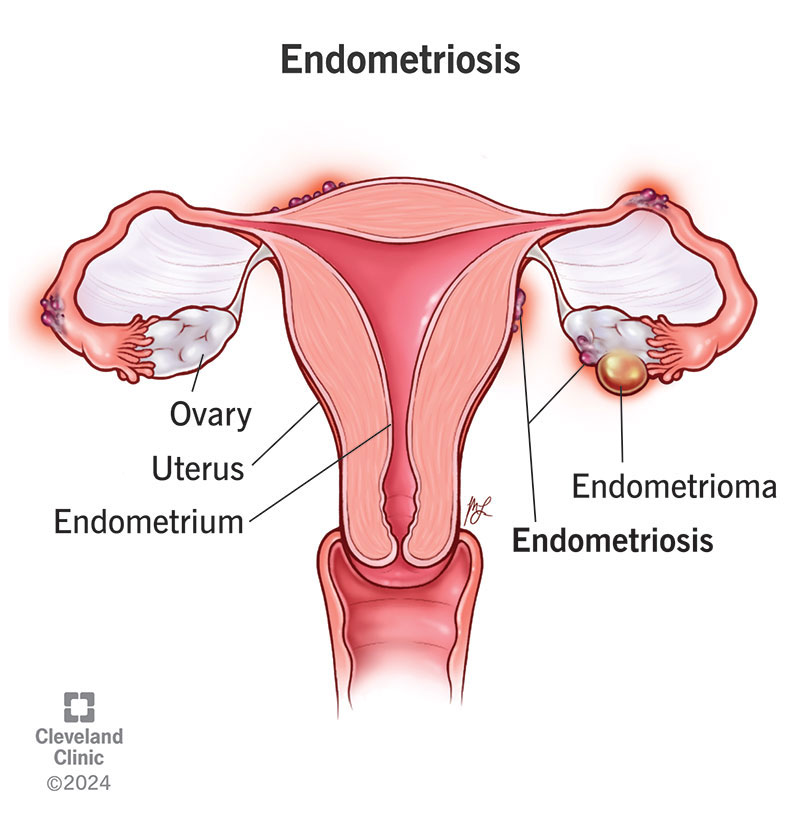
Medical name: Endometriosis or Endo
Number of women affected: At least 5.5 million women in North America alone
have endometriosis.
Common symptoms: Very painful cramps or periods, heavy periods, chronic
pelvic pain (which includes lower back pain and pelvic pain), intestinal pain,
pain during or after sex, infertility.
Common treatments:
- Pain medication
- Hormone therapy
- Surgery — laparoscopy or laparotomy
Does this disorder affect fertility/childbearing?
About 30 percent to 40 percent of women with endometriosis are infertile, making it one of
the top three causes for female infertility.
However, endometriosis-related infertility is often treated successfully
using hormones and surgery.
Endometriosis is one of the most common gynecological diseases, affecting
more than 5.5 million women in North America alone. The two most common symptoms
of endometriosis are pain and infertility. Some women have pain before and
during their periods, as well as during or after sex. This pain can be so
intense that it affects a woman’s quality of life, from her relationships, to
her day-to-day activities. Some women don’t have any symptoms from
endometriosis. Others may not find out they have the disease until they have
trouble getting pregnant.
The Eunice Kennedy Shriver National Institute of Child Health and Human
Development (NICHD), part of the National Institutes of Health (NIH), conducts
and funds important research into the causes of and treatments for
endometriosis. The NICHD hopes that through research, we will someday be able to
cure and even prevent this painful disease.
What is endometriosis?
Endometriosis occurs when tissue like that which lines the inside of uterus
grows outside the uterus, usually on the surfaces of organs in the pelvic and
abdominal areas, in places that it is not supposed to grow.
The word endometriosis comes from the word “endometrium” — endo means “inside” and
metrium means “mother.” Health care providers call the tissue that lines the inside of the uterus
(where a mother carries her baby) the endometrium.
Health care providers may call areas of endometriosis by different names, such
as implants, lesions, or nodules.
In what places, outside of the uterus, do areas of endometriosis grow?
Most endometriosis is found in the pelvic cavity:
- On or under the ovaries
- Behind the uterus
- On the tissues that hold the uterus in place
- On the bowels or bladder
In extremely rare cases, endometriosis areas can grow in the lungs or other
parts of the body.
What are the symptoms of endometriosis?
One of the most common symptoms of endometriosis is pain, mostly in the abdomen,
lower back, and pelvic areas. The amount of pain a woman feels is not linked to
how much endometriosis she has. Some women have no pain even though their
endometriosis is extensive, meaning that the affected areas are large, or that
there is scarring. Some women, on the other hand, have severe pain even though
they have only a few small areas of endometriosis.
General symptoms of endometriosis can include (but are not limited to):
- Extremely painful (or disabling) menstrual cramps; pain may get worse over time
- Chronic pelvic pain (includes lower back pain and pelvic pain)
- Pain during or after sex
- Intestinal pain
- Painful bowel movements or painful urination during menstrual periods
- Heavy menstrual periods
- Premenstrual spotting or bleeding between periods
- Infertility
In addition, women who are diagnosed with endometriosis may have
gastrointestinal symptoms that resemble a bowel disorder, as well as fatigue.
Who gets endometriosis?
Endometriosis can affect any menstruating woman, from the time of her first
period to menopause, regardless of whether or not she has children, her race or
ethnicity, or her socio-economic status. Endometriosis can sometimes persist
after menopause; or hormones taken for menopausal symptoms may cause the
symptoms of endometriosis to continue.
Current estimates place the number of women with endometriosis between 2 percent
and 10 percent of women of reproductive age. But, it’s important to note that
these are only estimates, and that such statistics can vary widely.
Does having endometriosis mean I’ll be infertile or unable to have children?
About 30 percent to 40 percent of women with endometriosis are infertile, making
it one of the top three causes of female infertility. Some women don’t find out
that they have endometriosis until they have trouble getting pregnant.
If you have endometriosis and want to get pregnant, your health care provider
may suggest that you have unprotected sex for six months to a year before you
have any treatment for the endometriosis.
The relationship between endometriosis and infertility is an active area of
research. Some studies suggest that the condition may change the uterus so it
does not accept an embryo. Other work explores whether endometriosis changes the
egg, or whether endometriosis gets in the way of moving a fertilized egg to the uterus.
What causes endometriosis?
We don’t know the exact cause of endometriosis. Right now, a number of theories
try to explain the disease.
Endometriosis may result from something called “retrograde menstrual flow,” in
which some of the tissue that a woman sheds during her period flows into her
pelvis. While most women who get their periods have some retrograde menstrual
flow, not all of these women have endometriosis. Researchers are trying to
uncover what other factors might cause the tissue to grow in some women, but not
in others.
Another theory about the cause of endometriosis involves genes. This disease
could be inherited, or it could result from genetic errors, making some women
more likely than others to develop the condition. If researchers can find a
specific gene or genes related to endometriosis in some women, genetic testing
might allow health care providers to detect endometriosis much earlier, or even
prevent it from happening at all.
Researchers are exploring other possible causes, as well. Estrogen, a hormone
involved in the female reproductive cycle, appears to promote the growth of
endometriosis. Therefore, some research is looking into endometriosis as a
disease of the endocrine system, the body’s system of glands, hormones, and
other secretions. Or, it may be that a woman’s immune system does not remove the
menstrual fluid in the pelvic cavity properly, or the chemicals made by areas of
endometriosis may irritate or promote growth of more areas. So, other
researchers are studying the role of the immune system in either stimulating, or
reacting to endometriosis.
Other research focuses on determining whether environmental agents, such as
exposure to man-made chemicals, cause endometriosis. Additional research is
trying to understand what, if any, factors influence the course of the disease.
We just don’t have answers on the causes yet.
Another important area of NICHD research is the search for endometriosis
markers. These markers are substances made by or in response to endometriosis
that health care providers can measure in the blood or urine. If markers are
found, health care providers could diagnose endometriosis by testing a woman’s
blood or urine, which might reduce the need for surgery.
How do I know that I have endometriosis?
Currently, health care providers use a number of tests for endometriosis.
Sometimes, they will use imaging tests to produce a “picture” of the inside of
the body, which allows them to locate larger endometriosis areas, such as
nodules or cysts. The two most common imaging tests are ultrasound, a machine
that uses sound waves to make the picture, and magnetic resonance imaging (MRI),
a machine that uses magnets and radio waves to make the picture.
The only way to know for sure that you have the condition is by having surgery.
The most common type of surgery is called laparoscopy. In this procedure, the
surgeon inflates the abdomen slightly with a harmless gas. After making a small
cut in the abdomen, the surgeon uses a small viewing instrument with a light,
called a laparoscope, to look at the reproductive organs, intestines, and other
surfaces to see if there is any endometriosis. He or she can make a diagnosis
based on the characteristic appearance of endometriosis. This diagnosis can then
be confirmed by doing a biopsy, which involves taking a small tissue sample and
studying it under a microscope.
Your health care provider will only do a laparoscopy after learning your full
medical history and giving you a complete physical and pelvic exam. This
information, in addition to the results of an ultrasound or MRI, will help you
and your health care provider make more informed decisions about treatment.
Why does having endometriosis cause pain?
How endometriosis causes pain is the topic of much research. Because many women
with endometriosis feel pain during or related to their periods, some
researchers are focusing on the menstrual cycle in their search for answers
about pain.
Normally, if a woman is not pregnant, her endometrial tissue builds up inside
her uterus, breaks down into blood and tissue, and is shed as her menstrual flow
or period. This cycle of growth and shedding happens every month or so.
The endometriosis areas growing outside the uterus also go through a similar
cycle; they grow, break down into blood and tissue, and are shed once a month.
But, because this tissue isn’t where it’s supposed to be, it can’t leave the
body the way a woman’s period normally does. As part of this process,
endometriosis areas make chemicals that may irritate the nearby tissue, as well
as some other chemicals that are known to cause pain.
Over time, in the process of going through this monthly cycle, endometriosis
areas can grow and become nodules or bumps on the surface of pelvic organs, or
become cysts (fluid-filled sacs) in the ovaries. Sometimes the chemicals
produced by the endometriosis can cause the organs in the pelvic area to scar,
and even to scar together, so they appear as one large organ.
Is there a cure for endometriosis?
Currently, we have no cure for endometriosis. Even having a hysterectomy or
removing the ovaries does not guarantee that the endometriosis areas and/or the
symptoms of endometriosis will not come back.
Are there treatments for endometriosis?
There are a number of treatments for both pain and infertility related to endometriosis, they include:
Pain medication — Works well if your pain or other symptoms are mild. These
medications range from over-the-counter remedies to strong prescription drugs.
Hormone therapy — Is effective if your areas are small and/or you have minimal
pain. Hormones can come in pill form, by shot or injection, or in a nasal spray.
Common hormones used to treat endometriosis pain are progesterone, birth control
pills, danocrine, and gonadatropin-releasing hormone (GnRH).
Surgical treatment — Is usually the best choice if your endometriosis is
extensive, or if you have more severe pain. Surgical treatments range from minor
to major surgical procedures.
What are the hormone treatments for endometriosis pain?
Because hormones cause endometriosis to go through a cycle similar to the
menstrual cycle, hormones can also be effective in treating the symptoms of
endometriosis. In fact, if a woman’s symptoms do not respond to hormone therapy,
health care providers may go over their diagnosis of endometriosis again, to
make sure she really has the condition.
Health care providers may suggest one of the following hormone treatments:
Oral contraceptives or birth control pills — regulate the growth of the tissue
that lines the uterus and often decrease the amount of menstrual flow. In
general, the therapy contains two hormones, estrogen and progestin.
It often works as long as you take the pills. Once you stop the treatment, your
ability to get pregnant returns, and your symptoms of endometriosis may also
return. Many women continue the treatment indefinitely.
Some women take birth control pills continuously, without using the sugar pills
that signal the body to go through menstruation. When birth control pills are
taken in this way, the menstrual period may stop altogether, which can reduce
pain or get rid of it entirely.
Some birth control pills contain only progestin, a progesterone-like hormone.
Women who can’t take estrogen use these pills to reduce menstrual flow.
Some women may not have pain for several years after stopping treatment.
You may have some mild side effects from these hormones, such as weight gain, bleeding between
periods, and bloating.
Progesterone and progestin — improve symptoms by reducing a woman’s period or
stopping it completely.
As a pill taken daily, these hormones will reduce menstrual flow without causing
the lining of the uterus to grow. As soon as you stop taking the pill form, you
can get pregnant and your symptoms may return.
As an injection taken every three months, these hormones will usually stop
menstrual flow. It may take a few months for your period to return after you
stop taking the injections. When your period returns, so does your ability to get pregnant.
You may gain weight or feel depressed while taking these hormones.
Danocrine — stops the release of hormones that are involved in the menstrual cycle.
You will probably get your period only now and then while taking this drug; or,
you may not get it at all.
You should take steps to prevent pregnancy while you are on this medication
because danocrine can harm a baby growing in the uterus. Because you should
avoid taking other hormones, like birth control pills, while on danocrine,
health care providers recommend that you use condoms, a diaphragm, or other
“barrier” methods to prevent pregnancy.
Common side effects include oily skin, pimples or acne, weight gain, muscle
cramps, tiredness, smaller breasts, and breast tenderness.
You may also have headaches, dizziness, weakness, hot flashes, or a deepening of
your voice while on this treatment.
Gonadatropin-Releasing Hormone (GnRH) Agonists — block the production of certain
hormones to prevent menstruation, which slows or stops the growth of
endometriosis, sending the body into a “menopausal” state.
GnRH agonist is used daily in a nose spray, or as an injection given once a
month or every three months.
Most health care providers recommend that you stay on the GnRH agonist for about
six months. After that time, your body will come out of the menopausal state.
You’ll start having your period again and could get pregnant.
After women stop taking GnRH agonists for six months, about 50 percent have some
return of their endometriosis symptoms.
These medications also have side effects, including hot flashes, tiredness,
problems sleeping, headaches, depression, bone loss, and vaginal dryness.
Current research is exploring the use of other hormones in treating
endometriosis and pain related to endometriosis. Some of these include GnRH
antagonists, selective progesterone receptor modifiers, and selective estrogen
receptor modulators, also known as SERMs. For more information about these
hormones, talk to your health care provider.
Some women also have less pain from endometriosis after pregnancy, but the
reason for this is unclear. Researchers are trying to determine whether it is
because the hormones released by the body during pregnancy also lessen the
growth of endometriosis, or if pregnancy causes changes in the uterus or
endometrium that lessen the growth of endometriosis.
What are the surgical treatments for endometriosis pain?
If you have severe pain from endometriosis, your health care provider may
suggest surgery. At surgery, your health care provider can locate any
endometriosis and see the size and degree of growth; he or she may also remove
the endometriosis at that time.
You and your health care provider should talk about possible options for
removing endometriosis before your surgery. Then, based on the findings and
treatment at surgery, you and your health care provider can discuss medical
treatment options for after surgery.
Health care providers may suggest one of the following surgical treatments:
Laparoscopy — is a way to diagnose and treat endometriosis without making large
cuts in the abdomen.
Laparoscopy involves a small cut in the abdomen, inflating the abdomen with a
harmless gas, and then passing a viewing instrument with a light (called a
laparoscope) into the abdomen. The surgeon uses the laparoscope to see the growths.
To treat the endometriosis, the doctor can then remove the areas, a process
called excising, or destroy them with intense heat and seal the blood vessels without stitches,
a process called cauterizing, or vaporizing. The goal is to treat the
endometriosis without harming the healthy tissue around it.
If your surgeon is going to treat the endometriosis during your laparoscopy, he
or she must make at least two more cuts in your lower abdomen, to pass lasers or
other small surgical instruments into your abdomen to remove or vaporize the tissue.
Doctors don’t know the exact role of scar tissue in causing endometriosis pain,
but some will remove the scar tissue in case it is causing the pain.
Usually, laparoscopy does not require an overnight stay in the hospital.
Recovery from laparoscopy is much faster than for major surgery, like laparotomy,
a procedure described below.
Major abdominal surgery, or laparotomy — is a more involved surgical
procedure, which requires longer recovery time (often one-to-two months).
During laparotomy, doctors either remove the endometriosis and/or remove the
uterus (a process called hysterectomy).
Doctors may also remove the ovaries and fallopian tubes
at the time of a hysterectomy, if the ovaries have endometriosis on them, or if damage is severe.
This process is called total hysterectomy and bilateral salpingo-oophorectomy.
Health care providers recommend major surgery as a last resort for endometriosis
treatment. Having the surgery does not guarantee that the endometriosis will not
return or that the pain will go away.
If a woman’s pain is extreme, doctors may recommend more drastic procedures that
cut the nerves in the pelvis to lessen the pain. One such procedure can be done
during either laparoscopy or laparotomy. Another procedure, called a
laparoscopic uterine nerve ablation (LUNA) is done during a laparoscopy. Because
these procedures cannot be reversed, you and your health care provider will need
to talk about these options in great detail before making the final decision
about treatment.
What are the treatments for infertility related to endometriosis?
In vitro fertilization (IVF) procedures are effective in improving fertility in
many women with endometriosis. IVF makes it possible to combine sperm and eggs
in a laboratory and then place the resulting embryos into the woman’s uterus.
IVF is one type of assisted reproductive technology that may be an option for
women and families affected by infertility related to endometriosis.
In the early stages of IVF, a woman takes hormones to cause “superovulation,”
which triggers her body to produce many eggs at one time. Once mature, the eggs
are collected from the woman, using a probe inserted into the vagina and guided
by ultrasound. The collected eggs are placed in a dish for fertilization with a
man’s sperm. The fertilized cells are then placed in an incubator, a machine
that keeps them warm and allows them to develop into embryos. After
three-to-five days, the embryos are transferred to the woman’s uterus. It takes
about two weeks to know if the process is successful.
Even though the use of hormones in IVF is successful in treating infertility
related to endometriosis, other forms of hormone therapy are not as successful.
For instance, hormone therapy that prevents a woman from getting her period, or
from ovulating each month, does not seem to improve infertility related to
endometriosis. But, researchers are still looking into hormone treatments for
infertility due to endometriosis.
Laparoscopy to remove or vaporize the growths in women who have mild or minimal
endometriosis is also effective in improving fertility. Some studies show that
surgery can double the pregnancy rate.
Is endometriosis the same as endometrial cancer?
Endometriosis is not the same as endometrial cancer. Remember that the word
endometrium describes the tissue that lines the inside of the uterus.
Endometrial cancer is a type of cancer that affects the lining of the inside of
the uterus. Endometriosis itself is not a form of cancer.
Does endometriosis lead to cancer?
Current research does not prove an association between endometriosis and
endometrial, cervical, uterine, or ovarian cancers. In very rare cases (less
than 1 percent) endometriosis is seen with a certain type of cancer, called
endometrioid cancer; but, endometriosis is not known to cause this cancer.
But, scientists still don’t know what causes endometriosis or what its
mechanisms are in the body. In addition, many women are never diagnosed as
having endometriosis, which makes linking the condition to other diseases more difficult.
For this reason, women who are diagnosed with endometriosis need to be
especially watchful of changes to or in their bodies; they need to communicate
these changes to their health care providers as soon as possible, to ensure
their own health.
Does endometriosis ever go away?
In most cases, the symptoms of endometriosis lessen after menopause because the
growths gradually get smaller. For some women, however, this is not the case.
Organizations
For more information, you can contact:
The NICHD Information Resource Center
P.O. Box 3006
Rockville, MD 20847
1.800.370.2943
Fax: 1.866.760.5947
E-mail: NICHDClearinghouse@mail.nih.gov
Internet: www.nichd.nih.gov.
A number of other organizations provide information about the diagnosis and
treatment of endometriosis and offer support to women affected by this condition
and their families.
The American College of Obstetricians and Gynecologists (ACOG) is the
nation’s leading group of professionals providing health care for women. For more information,
contact:
409 12th Street, SW
Washington, DC 20024-2188
202.863.2518
Fax: 202.484.1595
E-mail: resources@acog.org
Internet: www.acog.org
The American Society of Reproductive Medicine (ASRM) is an
organization devoted to advancing knowledge and expertise in reproductive
medicine and biology. For more information, contact:
1209 Montgomery Highway
Birmingham, AB 35216-2809
205.978.5000
Fax: 205.978.5005
E-mail: asrm@asrm.org
Internet: www.asrm.org
The Endometriosis Association (EA) is a non-profit, self-help
organization dedicated to offering support and help to those affected by
endometriosis, educating the public and medical community about the disease, and
funding and promoting research related to the condition. The EA maintains the
world’s largest research registry on endometriosis and sponsors research
worldwide, including a multidisciplinary program at Vanderbilt University School
of Medicine in Nashville, Tennessee. For more information, contact:
International Headquarters
8585 North 76th Place
Milwaukee, WI 53223
414.355.2200 or 1.800.992.3636
E-mail: endo@endometriosisassn.org
Internet: www.endometriosisassn.org or
www.KillerCramps.org
Source : National Institutes of Health; National Institute of Child Health and Human Development
Can't find the health information you’re looking for?
This information is provided by the Cleveland Clinic and is not intended to replace the medical advice of your doctor or health care provider. Please consult your health care provider for advice about a specific medical condition. This document was last reviewed on: 3/30/2010...#5751