



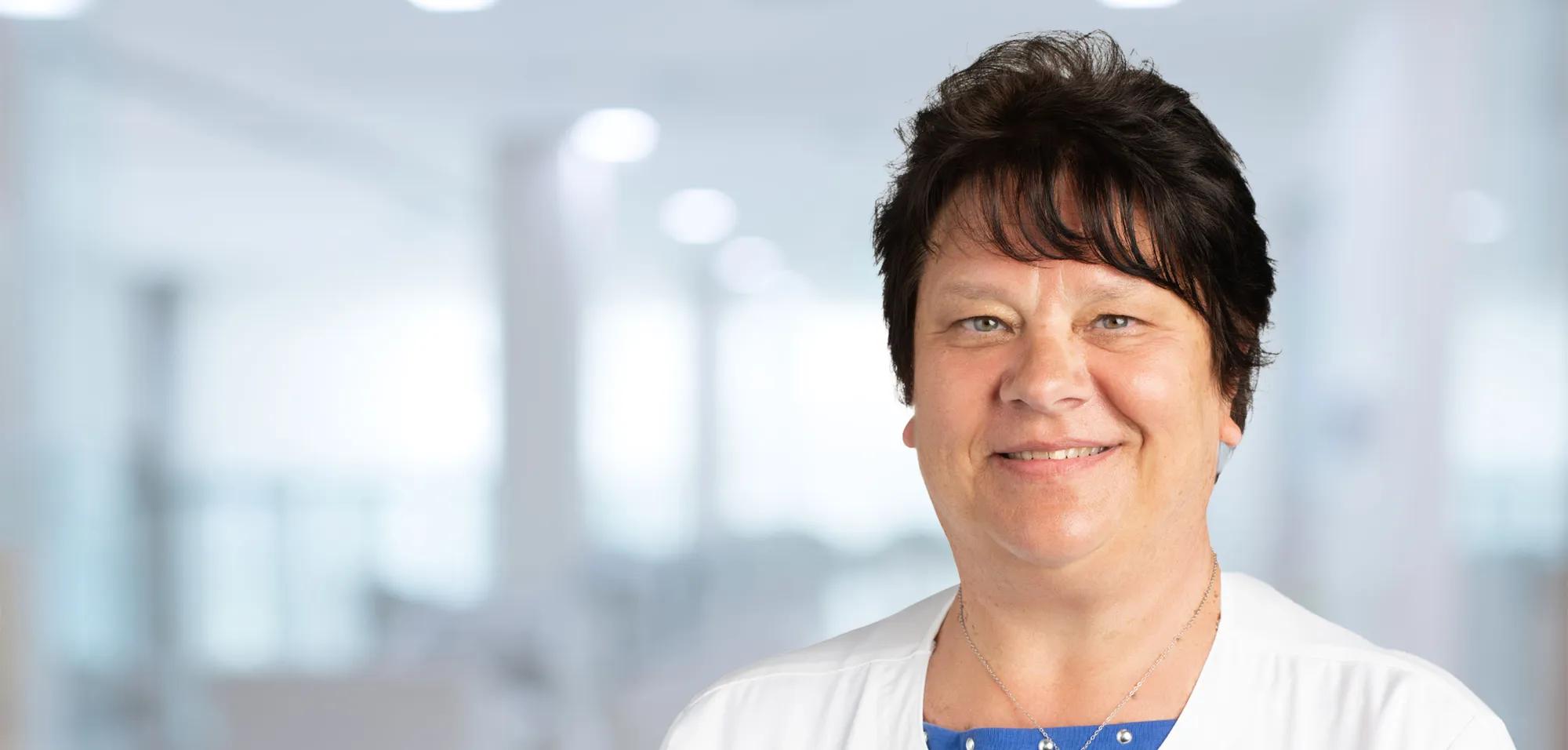
Caring for Patients with Chronic Lung Disease
Four to six percent of Americans live with some form of chronic lung disease, and it remains one of the leading causes of death and illness in the country. In this episode of Nurse Essentials, Debbie Matejka-Orlosky, LPN, in the ambulatory respiratory office at Cleveland Clinic Fairview Hospital, discusses the role nurses play in caring for patients with asthma, chronic obstructive pulmonary disease, interstitial lung disease and other pulmonary conditions.
Advertisement
Cleveland Clinic is a non-profit academic medical center. Advertising on our site helps support our mission. We do not endorse non-Cleveland Clinic products or services. Policy
Recent Episodes
Back to School: Is it Time to Pursue Another Nursing Degree?
Lisa Baszynski, DNP, RN, NE-BC, Associate Chief Nursing Officer (ACNO) for nursing education and professional development at Cleveland Clini…
De-escalation Strategies to Prevent Workplace Violence
Healthcare workers are four to five times more likely to experience workplace violence injuries than workers in private industry, according…
Experienced Nurses Share Advice for New Grads
According to the National Council of State Boards of Nursing, approximately 227,000 new nurses entered the U.S. workforce last year. As more…
Video content: This video is available to watch online.
View video online (https://cdnapisec.kaltura.com/p/2207941/sp/220794100/playManifest/entryId/1_oxdsfxp0/flavorId/1_5f3sgelj/format/url/protocol/https/a.mp4)
Transcript
Carol Pehotsky:
Looking at current statistics, four to six percent of Americans live with some form of chronic lung disease, asthma, COPD, interstitial lung disease, and a variety of other issues. It remains one of the leading causes of illness and death in our country. As nurses, no matter where we take care of patients, an emergency setting, an inpatient setting, or the ambulatory setting, we might be taking care of patients for other reasons, but they are presenting to us with other lung disorders as well. How can we as nurses really treat that whole patient, assess what's going on, look for those subtle signs and symptoms no matter where we're caring for that patient that indicate they might need more help or specialized help. I'm joined today by Debbie Orlosky from one of our ambulatory respiratory offices to talk about the importance of caring for the whole patient in pulmonary care.
Advertisement
Cleveland Clinic is a non-profit academic medical center. Advertising on our site helps support our mission. We do not endorse non-Cleveland Clinic products or services. Policy
Hi, and welcome to Nurse Essentials, a Cleveland Clinic podcast where we discuss all things nursing, from patient care to advancing your career, to navigating tough on-the-job issues. We're so glad you're here. I'm your host, Carol Pehotsky, Associate Chief Nursing Officer of Surgical Services Nursing. Welcome back everyone. If you've been listening along to all other episodes, you'll notice that a couple weeks ago we had a great episode with Alex Jordan about lung cancer and really meeting those patients where they are, and some of the really fantastic therapies that are coming up. But certainly, we know that many more things can happen with our lungs beyond lung cancer, and obviously one of our most vital organs, and we take breathing for granted until it becomes obstructed. I have asthma and thankfully it's well controlled, but in the moments when it isn't controlled, it is very anxious, it's very provoking.
For those of you who live on the Eastern Seaboard this summer in 2026 with the wildfires, certainly lots of people who didn't have lung disorders had an experience where suddenly breathing isn't the way it feels normally. And that cannot just be a challenge, but the mental and physical toll it takes on you to just take a breath is something that we as nurses always need to be thinking about. With that in mind, it's my great pleasure to introduce you all to Debbie Orlosky. Debbie is a licensed practical nurse with us in the ambulatory respiratory office in our west side Fairview location but serving patients all over Northeast Ohio. She is well recommended to us by her leadership. Welcome to the show. We're so glad to have you.
Advertisement
So first tell us a little bit about your journey, if you don't mind, why you decided to become a nurse and what your role has been like throughout the years.
Debra Matejka-Orlosky:
Sure. Thank you again. I've been a nurse for almost 44 years.
Carol Pehotsky:
Wow.
Debra Matejka-Orlosky:
I started out in hospital settings, but for the last 20 years I've been with Cleveland Clinic. The last 10 years I have been in pulmonary and prior to that, 10 years in Ob/Gyn.
Carol Pehotsky:
Wow. You've served a whole host of patients. Correct. What was that transition like?
Debra Matejka-Orlosky:
It was fairly easy. I'm comfortable in the ambulatory setting.
Carol Pehotsky:
Tell us a little bit about your ambulatory area, the types of patients you serve and the team that you work with please.
Debra Matejka-Orlosky:
Sure. I'm located at Fairview Hospital. We are a very busy pulmonary office on the west side. There are about 20 respiratory providers in our office. We were located at the Mohl Center, but that is being rebuilt so we are in a tentative little office and we're making it work. We have two secretaries, check-in people, and then there's a medical assistant, myself, and then the providers.
Carol Pehotsky:
Okay, fantastic. And so, 20 providers, you're seeing tons of patients.
Debra Matejka-Orlosky:
We see roughly 30 to 40 a day.
Carol Pehotsky:
The full gamut of respiratory issues. What sort of patients are you treating?
Debra Matejka-Orlosky:
It could go from asthma or even something simpler than that. Not that simple, but a hospital follow-up for pneumonia. So we could see hospital follow-ups all the way to ILD, which is interstitial lung disease and more complicated respiratory issues like that. Bronchiectasis.
Carol Pehotsky:
The full gamut.
Debra Matejka-Orlosky:
Issues like that, correct.
Carol Pehotsky:
So obviously managing any chronic condition is challenging. What do you think makes lung disease even more challenging to manage?
Debra Matejka-Orlosky:
I think because patients are living longer, we have more resources available, although many patients aren't always aware of the resources that are available. There's still a lot of risk factors involved, smoking, vaping, air pollution, and allergens. There are medications that are available to treat these issues. Although I'm finding more and more that there are issues with obtaining medications with insurance. We work with patients very closely with that also.
Carol Pehotsky:
That's wonderful. From your perspective, all of those things in mind, why do nurses play such a central role in helping patients manage these diseases?
Debra Matejka-Orlosky:
Because I think we are an extension of the provider. When patients call, again, ambulatory speaking, when they call the office, we know the patient. I know the patient. I could tell almost immediately by their voice what's going on, if anything is going on. Do they need to be seen now? Is it something that the provider could address over the phone? Just being able to assess your patients daily as they call.
Advertisement
Carol Pehotsky:
So, you're seeing 30 to 40 patients a day, and you're talking to them on the phone.
Debra Matejka-Orlosky:
It's a busy day.
Carol Pehotsky:
Your point is so perfect that being able to just, sometimes it is over the phone, you're not able to see them and see if they're struggling to breathe. So how are you able to maintain that database of who normally sounds like this, who sounds like they're labored, how do you get to know them?
Debra Matejka-Orlosky:
You just have little cues written that you remember certain things about patients.
Carol Pehotsky:
And you've probably developed fantastic relationships with them over the years.
Debra Matejka-Orlosky:
I have. There are many patients who when they call, they only want to talk to me, and I sometimes have to go over with them. “I'm not the only one here. Anyone here could help you. Don't be afraid to leave a message. Ask that the message be given to me.” Again, when you establish a rapport with a patient and they feel comfortable with you and they know that when they ask you to do something or when they have a concern, it's going to be addressed, that makes a big difference, especially with people who are experiencing respiratory issues or concerns.
Carol Pehotsky:
In this day and age of electronic, we have Epic here, MyChart communications, et cetera. Do you find that patients are more likely to call you?
Advertisement
Debra Matejka-Orlosky:
One of the things that I tell patients, especially new patients when they're leaving, is that the best way to contact any Cleveland Clinic provider is through MyChart. Even if it's just sending a message that says, “Please call me,” because sometimes concerns can't be communicated fully in an Epic message. I say, “Call me, I'll call you,” and we'll go from there.
Carol Pehotsky:
We've talked about the subtle cues that you can pick up on somebody just talking to you over the phone. What other signs or symptoms in your experience might tell you this person is struggling and might need advanced care?
Debra Matejka-Orlosky:
It's knowing your patients. When you're talking to them, do they have shortness of breath? Have they had a fever? Have they had any change in condition? We also talk frequently about pulse ox. Most respiratory patients have pulse oximeters at home. If they're using oxygen, how much are they using? Have they had to increase their oxygen use?
Carol Pehotsky:
People can deteriorate pretty quickly.
Debra Matejka-Orlosky:
Correct. If someone says they're usually on two liters but have turned it up to six liters, that's a hard stop. We need to get them in to see the doctor because simply turning it up is not the answer.
Carol Pehotsky:
You probably have some newly diagnosed patients. How do you support them?
Advertisement
Debra Matejka-Orlosky:
New patients are usually referred by primary care. The first thing they have is pulmonary function testing, which can be scary. Our respiratory therapists spend time with patients and explain everything. After testing they see the provider, and then I'm introduced as their point of contact. I encourage them to sign up for MyChart and explain how to contact us.
Carol Pehotsky:
How can nurses best support proper use of inhalers and medications?
Debra Matejka-Orlosky:
There are many resources available. Respiratory therapists are excellent at inhaler education. We also have the Better Breathers Club. Providers often pull up instructional information on the computer, and I encourage patients to review those resources at home. Pharmacists are another excellent resource.
Carol Pehotsky:
What barriers do patients encounter when getting treatment?
Debra Matejka-Orlosky:
Insurance issues are getting worse every day. If a prescription costs $500, I ask the patient to get their formulary, which lists covered medications. We can review alternatives or pursue a prior authorization. If needed, the provider looks for the most cost-effective option.
Carol Pehotsky:
What about getting access to home oxygen therapy?
Debra Matejka-Orlosky:
The provider writes an order, and the patient chooses a durable medical equipment company. I remind them to verify the company is covered by insurance. Once selected, I send the order and the company coordinates home delivery.
Carol Pehotsky:
What can we do to support patients transitioning to home oxygen?
Debra Matejka-Orlosky:
It's a big transition, but ultimately patients feel better because they have what they need. Sometimes they are hesitant to wear oxygen in public. I encourage them to look around and realize they are not the only person using oxygen. Encouragement and reassurance go a long way.
Carol Pehotsky:
How do you work with patients who continue smoking or vaping?
Debra Matejka-Orlosky:
Our providers discuss smoking cessation in depth. The key is that patients have to want to quit. They often pick a target quit date and work from there. There are medications and many resources available to help.
Carol Pehotsky:
How do you keep the whole team on the same page?
Debra Matejka-Orlosky:
I have great communication with the providers. I've been with this group for almost 10 years. They know me and I know them, and that trust makes a big difference in patient care.
Carol Pehotsky:
What role do you play in pulmonary rehab?
Debra Matejka-Orlosky:
The provider discusses the need for pulmonary rehab. I review the information, explain how to contact rehab, and encourage patients to call me if they run into any issues.
Carol Pehotsky:
What advice would you give inpatient nurses caring for patients with lung disease?
Debra Matejka-Orlosky:
Communication with the provider is key. Make sure patients understand that a pulmonologist is there to help them and that the pulmonology office is a valuable resource after discharge.
Carol Pehotsky:
What barriers are your patients struggling with most?
Debra Matejka-Orlosky:
The biggest barrier is financial. We hear it every day. We usually find a solution, but it takes time, and that's frustrating for both patients and caregivers.
Carol Pehotsky:
How do conversations go when family members smoke around patients?
Debra Matejka-Orlosky:
It's all about education. In our office, education is a big key.
Carol Pehotsky:
You've shared a lot of really helpful information. Before I let you go, what do you do to relax?
Debra Matejka-Orlosky:
My greatest joy is with my grandchildren. I have two grandchildren, a seven-year-old and a five-year-old.
Carol Pehotsky:
Wonderful. Finally, our organization's values are Serve With Heart, Succeed as One Team, and Shape the Future. Which resonates with you most?
Debra Matejka-Orlosky:
Serve With Heart. That's what I do every day. If you choose Serve With Heart, the rest fall into place and it all becomes one goal.
Carol Pehotsky:
Beautifully said. Thank you so much for joining me today.
Debra Matejka-Orlosky:
Thank you.
Carol Pehotsky:
As always, thanks so much for joining us for today's discussion. Don't miss out. Subscribe to hear new episodes wherever you get your podcasts. And remember, we want to hear from you. Do you have ideas for future podcasts or want to share your stories? Email us at nurseessentials@ccf.org. To learn more about nursing at Cleveland Clinic, please check us out at clevelandclinic.org/nursing. Until next time, take care of yourselves and take care of each other. The information in this podcast is for educational and entertainment purposes only and does not constitute medical or legal advice. Consult your local state boards of nursing for any specific practice questions.
Recent Episodes
Back to School: Is it Time to Pursue Another Nursing Degree?
Lisa Baszynski, DNP, RN, NE-BC, Associate Chief Nursing Officer (ACNO) for nursing education and professional development at Cleveland Clini…
De-escalation Strategies to Prevent Workplace Violence
Healthcare workers are four to five times more likely to experience workplace violence injuries than workers in private industry, according…
Experienced Nurses Share Advice for New Grads
According to the National Council of State Boards of Nursing, approximately 227,000 new nurses entered the U.S. workforce last year. As more…
Never miss a moment - subscribe now.
Listen to the Health Essentials Podcast on your favorite streaming platform.
Other Podcasts You May Love
MedEd Thread
MedEd Thread explores the latest innovations in medical education and amplifies the tremendous work…
Health Essentials
Tune in for practical health advice from Cleveland Clinic experts. What's really the healthiest diet…
Beyond Leadership
Hosts Jim Pae and Elizabeth Pugel escort you through a network of thought leaders, sharing world-cla…
Studies in Empathy
Join Cleveland Clinic Patient Experience leaders and a group of guests with a wide range of experien…