



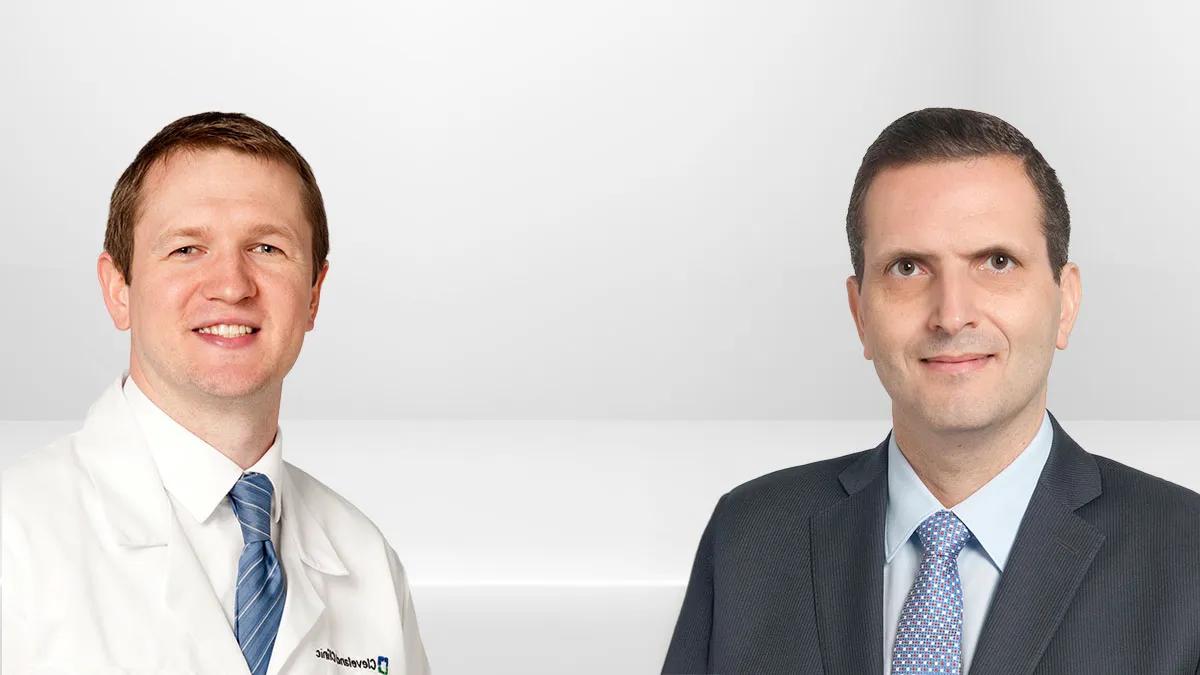
Choosing the Right Treatment for Blocked Coronary Arteries
Faisal Bakaeen, MD, and Grant Reed, MD, explain what blocked coronary arteries mean and the risk factors that can lead to coronary artery disease. They discuss how treatment decisions are made, especially when stents or bypass surgery may be recommended.
Schedule an appointment at Cleveland Clinic by calling 844.868.4339.
Advertisement
Cleveland Clinic is a non-profit academic medical center. Advertising on our site helps support our mission. We do not endorse non-Cleveland Clinic products or services. Policy
Recent Episodes
New Approaches to Treating Aortic Arch Disease
Eric Roselli, MD, and Patrick Vargo, MD, discuss aortic arch aneurysms and dissections, and explain why early diagnosis and ongoing monitori…
Encore: AFib After an Ablation
This is an encore episode of "AFib After an Ablation: What to Know", originally published in June 2025. Experiencing persistent or recurrin…
Understanding High-Risk Aortic Valve Endocarditis
Milind Desai, MD, and Per Wierup, MD, discuss high-risk aortic valve endocarditis, a serious infection that can affect heart valves and lead…
Video content: This video is available to watch online.
View video online (https://cdnapisec.kaltura.com/p/2207941/sp/220794100/playManifest/entryId/1_7qnlnzmz/flavorId/1_5f3sgelj/format/url/protocol/https/a.mp4)
Transcript
Announcer:
Welcome to Love Your Heart, brought to you by Cleveland Clinic's Sydell and Arnold Miller Family Heart, Vascular & Thoracic Institute. This podcast will explore disease prevention, testing, medical and surgical treatments, new innovations and more. Enjoy.
Advertisement
Cleveland Clinic is a non-profit academic medical center. Advertising on our site helps support our mission. We do not endorse non-Cleveland Clinic products or services. Policy
Dr. Faisal Bakaeen:
Welcome to Love Your Heart. I'm Faisal Bakaeen, Surgical Director of the Coronary Center.
Dr. Grant Reed:
I'm Grant Reed. I'm an interventional cardiologist here in the Department of Cardiovascular Medicine.
Dr. Faisal Bakaeen:
Today we're going to be discussing coronary artery disease, and perhaps we'll start from a cardiologist's perspective. I'll turn it over to Dr. Reed.
Dr. Grant Reed:
Great. Wonderful. What we'd like to do is answer some common questions about coronary artery disease that we get asked during our patient visits. We'll start with, what does it mean to have coronary artery disease? What does it mean to have blocked coronary arteries?
Well, coronary artery disease is caused by cholesterol plaque, which builds up in the coronary arteries. The medical term for that is atherosclerosis. That is caused by a diet that is high in cholesterol and fats. Typically, this accumulates gradually over the years, and it's more common in patients who have a family history of this.
There are certain risk factors for this, including those that we mentioned: diet, lack of exercise, high blood pressure, a strong family history, and diabetes is another major risk factor. The other risk factors, which we're starting to appreciate more, that includes obesity, and again lack of exercise, but also lack of sleep, having exposure to smoke and having an unhealthy lifestyle in general.
Advertisement
Dr. Faisal Bakaeen:
Smoking, I guess, is a risk factor that’s not so prominent nowadays. But at least in some countries, it still is a major risk factor.
Dr. Grant Reed:
We've made some major progress, and I get asked often by patients, "What if I just use nicotine products or I vape?" There's actually still a strong association between vaping and progression of coronary disease. The best way to avoid coronary disease is to not do that stuff entirely.
Dr. Faisal Bakaeen:
Right. Prevention is key, I guess.
Dr. Grant Reed:
Prevention is key. When patients do have coronary disease, they'll ask, "Well, what does that mean for me? And what are the symptoms that you might experience?" Well, most patients with coronary artery disease may not have symptoms at all. It may be discovered incidentally due to either a CAT scan which is done, a stress test, or even a heart catheterization done for another reason.
But the symptoms of coronary artery disease that you need to pay attention to are chest discomfort or pressure. Oftentimes we say chest pain, but many patients say, "I don't have chest pain, but I have pressure," so any discomfort in the chest. Fatigue, loss of energy or exercise tolerance, shortness of breath. Importantly, patients can experience any mix of these symptoms or even none at all. Diabetes is a risk for having atypical symptoms. Females often have symptoms which are different.
So, patients will oftentimes say, "Oh, I have an abnormal stress test, but I feel fine." But when they exercise, you may see that their EKG (electrocardiogram) is abnormal or their exercise tolerance isn't very good. Those are also risk factors and symptoms that patients may not appreciate.
Dr. Faisal Bakaeen:
Yeah. Sometimes they say, "Well, Doc, I don't have any symptoms." But I notice that they, like you mentioned, they compensate. I say, "Hey, for example, you told me you used to go up five flights of stairs. Now you get short of breath when you go up two flights of stairs. Or maybe you're going up five flights of stairs, but you go slower." So they try and adapt when, in fact, they're experiencing symptoms.
Dr. Grant Reed:
Exactly. The important thing is to pay attention to how you're feeling. Many patients will attribute their symptoms to just getting older. They'll say, "Oh, Doc, I'm 70 now, so I should start to slow down." The important thing is that you maintain a good quality of life. Coronary artery disease is unfortunately quite common, and it is an addressable risk factor for heart attack, for death, and ultimately for your quality of life. If you are feeling any of those symptoms, tell your doctor. The next steps may be doing what we call a functional study, such as a stress test, doing a CT scan or an MRI, or potentially doing a heart catheterization.
Advertisement
Once coronary artery disease is diagnosed, we often do certain things to help prevent it from progressing, and that's what lifestyle modification is. The number one treatment for coronary artery disease is lifestyle modification and control of risk factors and medications. What we do, and we're very excited about, is surgery and procedures, interventions to fix coronary artery disease, but that's really what you do if medicines and lifestyle modifications don't work, right?
So typically, when I counsel patients, I'll say that really nothing we do can reverse coronary artery disease. Although, there are some studies that show very aggressive modification of your diet and having a very low LDL cholesterol may allow for plaque regression on ultrasound-based studies of the coronary arteries. The truth of the matter is that once the plaque is there, it is unlikely to regress despite even the most aggressive efforts. Our goal is to stabilize, to help control symptoms with medicines. Then, if that does not work, to do either a bypass surgery or stents.
Dr. Faisal Bakaeen:
So, I have coronary artery disease in my family, and we've always been told, and I believe that prevention, prevention, prevention is the most important thing, by lifestyle modifications, healthy diet, lower the risk factors, treat your diabetes, don't smoke. Then, once you're diagnosed, based on testing that you have coronary artery disease, then you do secondary prevention, and that is to stabilize the plaques. As you mentioned anecdotally, imaging-wise, you may be able to cause some regression. But, in reality, the best case scenario, I think in general, is to stabilize it, which is a good thing. But if it's progressive, if it's something that's causing more symptoms, it's becoming more severe, then we move to the invasive interventions. You're the cardiologist. You perform stenting. I'm the surgeon. I perform the surgery. Perhaps we'll start with the less invasive approach first: stenting. Do you want to share some ideas about stenting?
Advertisement
Dr. Grant Reed:
Yeah, absolutely. I think that's a perfect segue.
If you do need treatment of the coronary arteries, the two options are stents or bypass surgery. Stents are less invasive. Typically, the approach that we take is either by going through the radial artery, which is the wrist approach, or from the femoral artery, which is the groin. Through that access point, we put a small catheter that then goes up to the coronary arteries. We image the arteries with the small amount of contrast dye in the arteries to determine where the blockages are. Then at that point, we can pivot towards either medical management of the blockages, which is usually our first approach, to doing stents if the blockages are focal or it appears amenable to stenting, or to bypass surgery if there's more extensive blockage or if certain risk factors would suggest that bypass is better, which we'll talk more about.
So stents are small metal scaffolds, which we deploy with a balloon, which generally expands the artery. Then the stent will stand permanently to keep the artery open. There's a small amount of drug which is on the stent. We call them drug-eluting stents, which is how we've done stents really for many, many years. The drug-eluting stents, the small drug coating allows for the stents to heal in a controlled fashion. That drug coating is an important part of the stent design. Those stents that didn't have a drug coating early on, they narrowed down quicker. But now that we have the drug-eluting stents, the outcomes have been much better. The stents don't narrow down nearly as much, and outcomes have been excellent with modern drug-eluting stents.
Advertisement
So, where stents are really good is in patients who have maybe more focal areas to treat, that maybe does not involve what we call bifurcation, where there's a side branch which comes off right at the area that you need to treat with a stent in those patients who have more complex coronary disease in multiple spots. Now you can treat that with stents, but when you decide to do numerous stents, or if it's the main artery, or in a diabetic individual, those are situations where bypass surgery may have an advantage in terms of durability and even survival.
Dr. Faisal Bakaeen:
Yeah. I mean, we treat coronary artery disease incrementally. The beautiful thing about stenting is that you go in the morning, and a few hours later, you can go home with virtually little or no restrictions. You have to stay on your medications, including blood thinners, to optimize outcomes.
So you say, "Well, why doesn't everybody get a stent?" Well, a stent is ideal if you're having an acute heart attack and acute blockage, because the stent would immediately open it there and then, and supply the blood to the areas of the heart that are deprived. Also, like Dr. Reed mentioned, when it's focal disease, when it's lower burden of a disease. But when the disease is complex, diffuse, involving complex anatomies, branch points, that's when they call upon the surgeons, me as one of them, to consider coronary artery bypass grafting.
Again, here we think as a team with our cardiology colleagues, we think, "Hey, we've tried medical therapy. Stenting was considered, and now we're escalating to CABG (coronary artery bypass grafting)," because this patient has diffused disease, or the stents have not worked, or they weren't durable, or they have diabetes and other risk factors with aggressive disease that would benefit from surgery, or they're very young and you want a durable solution.
The reason the surgery is durable is because we use an artery called the internal mammary artery, and that artery has an excellent patency. If you leave the operating room with a mammary artery to bypass the most important vessel, which is LAD (left anterior descending), with an open graft, the chances are this graft will stay open many, many years, if not a lifetime. We use other arteries as well to maximize the durability of surgery.
However, surgery is invasive. It involves, traditionally, splitting the sternum in half, and going on the heart-lung machine, although we could do it without the heart-lung machine depending on the anatomy and the distribution of the disease.
We also have options in doing minimally invasive bypass surgery. We could do robotic-assisted heart surgery, where we harvest internal mammary artery, the vessel that I talked about, that's protective, using the robot, and then we make a small incision on the left side, and do one or more bypasses. Or the extremely less-invasive ... I'm using two contradictory terms. The most least-invasive approach is a totally endoscopic CABG, or a TECAB (totally endoscopic coronary artery bypass), using the robot, with just keyholes to do bypasses. This is typically reserved for patients with less extensive disease. However, with experience, we're offering these options to more and more patients.
With this approach, many patients can leave the hospital within two to three days, if not earlier. With the traditional approach, it's typically around five days. With the traditional approach, there are more restrictions, obviously. You don't want to be heavy lifting, bench pressing or golfing right away. We typically say you’ve got to wait six to eight weeks before you do those strenuous activities.
However, even with the traditional sternotomy approach, we want the patients to go back to the activities of daily living pretty much right away, like walking. If they can tolerate, they can jog pretty soon after their surgery. But when we do it minimally invasively or totally through the robot, then those restrictions become minimal, and they approach the stent, but they're not as simple in terms of recovery as the stents.
In other words, Dr. Reed and I and other members of the heart team sit together, assess the patient, their age, their risk factors, their anatomies, and then pick the treatment that's optimal for that patient.
Dr. Grant Reed:
Exactly. This is one of the wonderful parts about being at Cleveland Clinic, the multidisciplinary team approach. As a physician, I really enjoy it, because we get to be friends and close colleagues with our surgeons. As interventional cardiologists, we work as one team.
It's very important that we all view this as not competing approaches, but complementary approaches. There may be situations where a patient is able to get a bypass surgery done with an internal mammary to the LAD, but then maybe better suited for a stent to one of the smaller or more distal branches.
Dr. Faisal Bakaeen:
That's called a hybrid approach.
Dr. Grant Reed:
We do a hybrid approach, absolutely. Now, with our contemporary therapies, and drug-eluting stents being so good, and the durability improving, and now with potentially stent-free strategies developing, we can do these hybrid approaches. The only way of making that decision is to have a close collaboration and a plan in place between the surgeons and the interventional cardiologists.
It's really an enjoyable part of our practice, being able to personalize treatment, individualize it for every single patient, and not have a one-size-fits-all approach to every person.
Dr. Faisal Bakaeen:
I 100% agree. It's your choice. Your preference is taken into consideration in that formula when we pick the therapy for a specific patient. I usually say they don't pay me extra to do surgery and they don't pay you extra to do the stent. That's the beautiful thing about a team approach in a setting such as Cleveland Clinic.
Dr. Grant Reed:
Absolutely. We encourage you to reach out, and anything we can do to help you in your heart health journey, we're more than happy to. We have a wonderful team here full of great colleagues and friends, and we'd love to take care of you.
Announcer:
Thank you for listening to Love Your Heart. We hope you enjoyed the podcast. For more information or to schedule an appointment at Cleveland Clinic, please call 844.868.4339. That's 844.868.4339. We welcome your comments and feedback. Please contact us at heart@ccf.org. Like what you heard? Subscribe wherever you get your podcasts, or listen at clevelandclinic.org/loveyourheartpodcast.
Recent Episodes
New Approaches to Treating Aortic Arch Disease
Eric Roselli, MD, and Patrick Vargo, MD, discuss aortic arch aneurysms and dissections, and explain why early diagnosis and ongoing monitori…
Encore: AFib After an Ablation
This is an encore episode of "AFib After an Ablation: What to Know", originally published in June 2025. Experiencing persistent or recurrin…
Understanding High-Risk Aortic Valve Endocarditis
Milind Desai, MD, and Per Wierup, MD, discuss high-risk aortic valve endocarditis, a serious infection that can affect heart valves and lead…
Never miss a moment - subscribe now.
Listen to the Health Essentials Podcast on your favorite streaming platform.
Other Podcasts You May Love
Beyond Leadership
Hosts Jim Pae and Elizabeth Pugel escort you through a network of thought leaders, sharing world-cla…
Beyond the Pages: CCJM Podcast
Beyond the Pages: CCJM Podcast takes the listener more in-depth into Cleveland Clinic Journal of Med…
Butts & Guts
A Cleveland Clinic podcast exploring your digestive and surgical health from end to end. You’ll lear…
Cancer Advances
A Cleveland Clinic podcast for medical professionals exploring the latest innovative research and cl…