



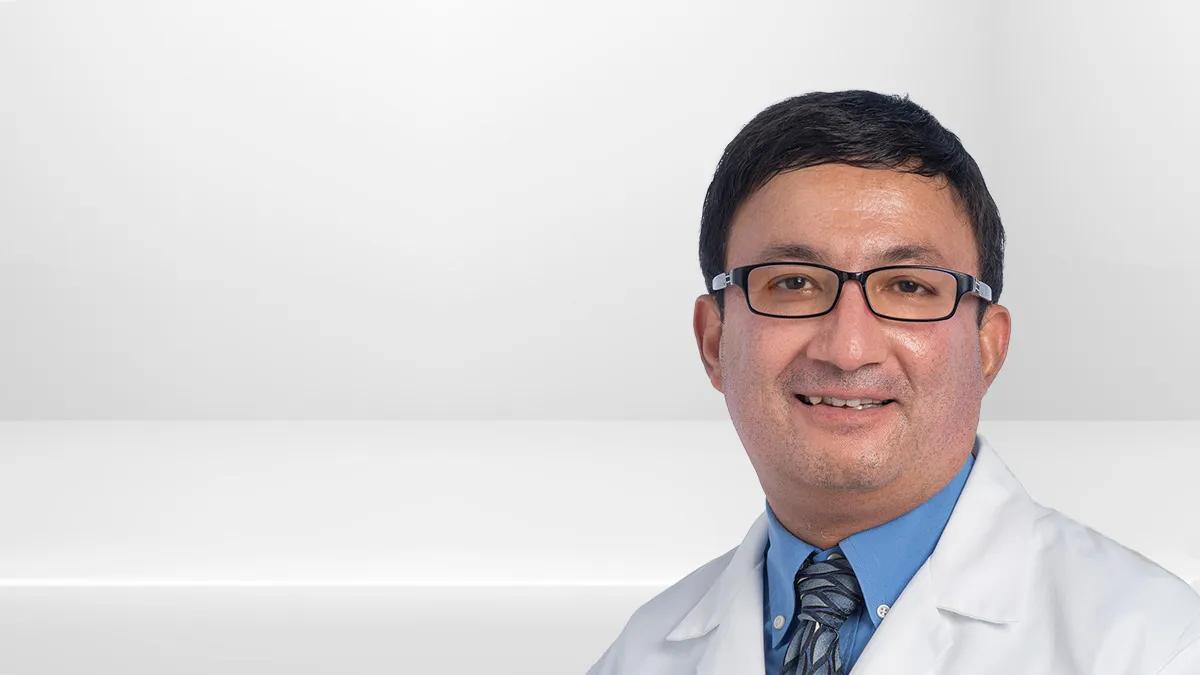
CAR T and Bispecific Therapies in AL Amyloidosis
Hematologist and myeloma specialist Shahzad Raza, MD, joins the Cancer Advances podcast to discuss emerging cellular and immune therapies for AL amyloidosis. Listen as Dr. Raza reviews early data on CAR T-cell therapy and bispecific antibodies, their potential to induce deep hematologic responses and how these approaches may improve organ function and long-term outcomes for patients with this rare plasma cell disorder.
Advertisement
Cleveland Clinic is a non-profit academic medical center. Advertising on our site helps support our mission. We do not endorse non-Cleveland Clinic products or services. Policy
Recent Episodes
Are We Missing Patients? Expanding Germline Genetic Testing in Oncology
As recommendations for germline genetic testing continue to expand, many eligible patients remain untested. In this episode of Cancer Advanc…
Partnering with Classical Hematology: Optimizing Referrals, Diagnostics and Patient Care
Bethany Samuelson Bannow, MD, Director of Classical Hematology at Cleveland Clinic, joins the Cancer Advances podcast to discuss how stronge…
Personalizing Pediatric Cancer Care: The Promise of Precision Oncology
As molecular profiling advances, precision oncology is reshaping cancer care for children, adolescents and young adults. In this episode of…
Video content: This video is available to watch online.
View video online (https://cdnapisec.kaltura.com/p/2207941/sp/220794100/playManifest/entryId/1_88ouvn7y/flavorId/1_5f3sgelj/format/url/protocol/https/a.mp4)
Transcript
Dale Shepard, MD, PhD:
Cancer Advances, a Cleveland Clinic podcast for medical professionals, exploring the latest innovative research and clinical advances in the field of oncology. Thank you for joining us for another episode of Cancer Advances. I'm your host, Dr. Dale Shepard, a medical oncologist and co-director of the Sarcoma Program at Cleveland Clinic.
Advertisement
Cleveland Clinic is a non-profit academic medical center. Advertising on our site helps support our mission. We do not endorse non-Cleveland Clinic products or services. Policy
Today, I'm happy to be joined by Dr. Shahzad Raza, a hematologist focusing on multiple myeloma here at Cleveland Clinic. This is his fourth appearance on our podcast. His previous episode, Insights from the RedirecTT-1 Study: A Potential Game-Changer for Relapse/Refractory Myeloma in Patients with EMD, is still available for you to listen to. Today, he's here to talk about innovations in AL amyloidosis, including CAR T and bispecific therapy. So welcome back.
Shahzad Raza, MD:
Thank you, Dale, for having me here.
Dale Shepard, MD, PhD:
So, remind us again what you do here at Cleveland Clinic.
Shahzad Raza, MD:
I'm a hematologist-oncologist. My area of focus is plasma cell disorders, which include multiple myeloma, light chain amyloidosis, and anything that has to do with the clonal plasma cells. I do stem cell transplants. I do CAR T-cell therapy. I am actively involved in the clinical trial. Many of the clinical trials, I'm the principal investigator or the co-investigators. Some of them are really cutting-edge studies that we've been doing at Cleveland Clinic.
Dale Shepard, MD, PhD:
Yeah. You guys have a lot of interesting things, hence your fourth time here. So, we're going to talk about AL amyloidosis treatments. So, a lot of people might be listening in, different backgrounds. What exactly is that?
Advertisement
Shahzad Raza, MD:
Well, first of all, I mean, it's a very good question. You're asking me about what AL amyloidosis actually is. I think we struggle with the definition for light chain amyloidosis. In simple words, it's the plasma cell clone which actually makes sticky light chains, and these sticky light chain deposits in the heart, deposits in the kidney, liver, and any other organs.
The clone can be very small, but the impact of the clone can be very detrimental. People can have advanced heart failure. People can have advanced kidney disease. So that's why it's really challenging to treat, first to diagnose these cases, and then to treat them with the right therapy. That has been a struggle for many, many years.
Dale Shepard, MD, PhD:
Now, here at Cleveland Clinic, we see a lot of amyloidosis, but for perspective, how rare is this?
Shahzad Raza, MD:
Well, I would say that it's very, very, very rare in the community setting, but not in the Cleveland Clinic setting. You have to think about this diagnosis. And many times, these diagnoses are actually made by the patients, not by the physicians. That's why American Society of Hematology actually just recently published the guidelines for these patients how to diagnose, and we at the Cleveland Clinic were actively participated in developing those guidelines.
Those are very helpful for any physician who has been seeing some cases where there is a suspicion for amyloidosis, how to work it up and how to diagnose these cases. So, it's challenging. But if you have a tertiary care hospital where you have expertise in the cardiac failure management, kidney failure management, I think we think a lot, and many of these patients we successfully identify, those who really have amyloidosis or not, because we have technology and the tools to work around and make the diagnosis as soon as possible.
Dale Shepard, MD, PhD:
When we think about people and their treatment, you mentioned organ dysfunction could be a big problem. Comorbidity is a big problem. These have typically been treated more like multiple myeloma?
Shahzad Raza, MD:
We can interpret the data from the multiple myeloma, but first, we need to know if somebody has an unexplained heart failure. We make the diagnosis. We do the biopsy of the heart or biopsy from other organ, confirm this patient has a light chain amyloidosis. The next step comes up. Okay. How are you going to treat them?
So typically, multiple myeloma management and treatments can be very intense. In light chain amyloidosis, we usually go very palliative way and slow and steady, and some treatments are better tolerated in amyloidosis. For example, there are 14 FDA-approved multiple myeloma drugs, and there's only one FDA-approved regimen in light chain amyloidosis. It's because of the rarity and knowing the diagnosis.
Advertisement
So, our treatment is daratumumab, which is an anti-CD38 monoclonal antibody; bortezomib, which is the proteasome inhibitor; and then Cytoxan and dexamethasone. We typically use this regimen, which is based on the ANDROMEDA trial. This is our standard trial, a standard study-based regimen that we used, and they are FDA-approved. So, we use it for six months and then maintain them for two years. That's how we treat the first line for multiple myeloma.
And approximately, I would say 60% of the patients, we can get them into remission with these regimens. How long the remission last? The future will tell us, but we have a five-year mature data, but we are concerned about those 40% which we do not have the tools what to do with these patients, because there is no other FDA-approved drugs.
And back to your question, that's how we take the drugs from multiple myeloma and use it here in light chain amyloidosis, because we have nothing to offer other than something that targets the plasma cells. So, this is how we treat them, but those 40% are very challenging. And then within 60% of the patients, those who are now starting to fail beyond five years, there is always a question, how are we going to treat them?
Advertisement
Dale Shepard, MD, PhD:
So, as we look at new things, how have CAR T therapies, how have bispecifics started moving their way into amyloidosis?
Shahzad Raza, MD:
That's an excellent question, and I'll do my best to give you a current insight so that we know exactly where we stand with that. So, the CAR Ts and the bispecific has shown excellent responses in multiple myeloma. But again, we need to know multiple myelomas are more bulky disease, heavily burdened plasma cell disease. Light chain amyloidosis are not like that.
So, we had this study here with NXC-201 CAR T study. We were actively participated in that study. The criteria for enrollment is those who have a suboptimal response to first-line treatment. These patients got the CAR T-cell therapy, and that's the first ever in human CAR T-cell therapy. So, the published data, what we know exactly, we are not really seeing much toxicities. We are mostly seeing these are very tolerable agents, and the durability of the responses are lasting more than a year. Many patients are in complete remission.
So, these are steps we were not used to see in the past. Why there is a complete remission? Why we are seeing that unprecedented responses? I think the biology of the disease is the same that you are targeting the plasma cell clone, but the behavior is the major challenge that we have, the organ dysfunction. These drugs are really well-tolerated, especially in cases like heart failure or in the kidney failure diseases, but we have to be a little innovative though how we actually manage these cases.
Advertisement
For example, that we know about some of the toxicities for the CAR T. Three years ago, the patients' perception was very different that, "Oh, CAR T means I can have CRS. I can have this issue, these toxicities." But with the period of time, we also learned a lot how we manage these cases. Some of these patients get prophylactic medications. So those side effects do not happen.
Surprisingly, the data in amyloidosis is quite encouraging. Even in the CAR T-cell data, the cytokine release syndromes are very predictive, like predictable, and we are not seeing more neurological toxicities the way we used to see with other drugs, other bispecific things, but we have to keep in mind the data is small. The small cohort didn't see much toxicities in these cohorts.
I think the major challenge is somebody who has an advanced heart failure, somebody who has an advanced kidney issues. How are they going to manage? Our experiences in multiple myeloma is quite encouraging. Even in these patients, they have been doing very well. We recently published the data, bispecifics in end-stage renal disease on dialysis. Now, these patients are not in any clinical trials, and we figured it out. These are very feasible drugs, and the prospective published data on the bispecifics is also very encouraging.
So, both are coming in in AL amyloidosis, and I think there is a hope that we can get the deep responses, deep remissions for these patients, and that is back to the approach and innovations, like, "Why we need to go that aggressive?" It is only because if you achieve the deep responses, that leads to improvement in an organ function. Otherwise, if we have suboptimal responses, these patients continue to struggle, and they will never have a good outcome from these therapies.
Dale Shepard, MD, PhD:
Do you think it's appreciated? So, you're talking about toxicities. You're talking about organ dysfunction. You're talking about tolerance, which sounds good, whereas oftentimes, I think people might look at these things like CAR Ts and bispecifics and go, "Wow, those are really toxic." Do you think that there may be a perception that people with amyloidosis with the organ dysfunctions are not good candidates, and so there are sort of patient selection issues that are unfounded?
Shahzad Raza, MD:
I agree with that. I think there are two ways. So, one is somebody has a very advanced heart failure that he cannot even walk. People will think twice, "Is it worth treating the patient? Can we reverse the organ functions? Can we improve the patient's quality of life?" Some are too far out where the treatments may not matter. I'm going to go back to give you one historical data that tells us how we improve them.
So why the heart failure is happened? Why the kidney failure is happened? It's because of amyloidosis. So, it makes sense to treat the underlying clone, underlying impact. If you go back to ANDROMEDA study, the very first time we got approval for daratumumab, Cytoxan, Velcade, and dexamethasone-based regimen, the comparator arm was only Velcade, Cytoxan, and dexamethasone.
Even if you give them daratumumab later, the responses were not the same. So, it did tell us that early drop in the light chain, the deeper responses in the light chain as early as possible, that's very important. So, if we drop aggressively these light chains, which these therapies are capable of doing that, you are also looking at a long-term positive outcome. Now, perception is true, but at the same time, I think meeting with an expert physician is very important, because they can direct the right way or managing that.
A lot of things we do not know. Maybe these patients do not need lifelong bispecifics. They just need for a short period of time and stop it and see how they do, because these therapies can knock down the light chains. But unfortunately, none of these therapies are approved yet. They are still in the clinical setting. So, we really have to wait for a longer data to come to us, and so that we can evaluate that in a bigger population, it is worth considering it.
Dale Shepard, MD, PhD:
And then are these CAR Ts, the bispecifics, are these being studied in people who have failed first-line, or are they being studied first-line back to the point of earlier intervention maintains function?
Shahzad Raza, MD:
I think both ways. So, I can give you some data that what we had in Cleveland Clinic. So, we participated in a study where we enroll patients who have a relapsed light chain amyloidosis, but the relapse definition was the difference between the light chain is more than 50. Before that, we were also enrolling patients when the difference is only more than 20. So it's early relapse cases that we were enrolling them.
Now, we have a clinical trial, because this study is closed, and it's going to be presented at American Society of Hematology for overall data, see how it looks like it. But 23 patients' data that was presented early this year was very impressive, and I think it's something that may come up into the patients, like we use CAR T-cell therapy for these patients.
We have another clinical trial. We're using the bispecifics right now, which is working with Dana-Farber, Cleveland Clinic group, and some other institutions to use it in patients with relapsed light chain amyloidosis. So that's another study that we have now opened. So that could be good for the patients who first-line treatment doesn't work. They should be evaluated for bispecific therapy under the clinical trial.
Now, the third thing is we also have a study which is the Cleveland Clinic-initiated study. My colleague Sandra Mazzoni actually started that study. It's not started yet, but we are hoping that we can start some point in this year, this study, which is basically using the bispecific up front and comparing it with standard of care, which is the Dara-CyBorD one that I talked to you, and this is the bispecific things are on a limited duration of time.
Sorry, I'll take it back, but this is just a single-arm bispecific as a first-line treatment. But in parallel, we are also starting the study where we are using the CAR T-cell therapy, the same study which shows great response in relapsed disease, and comparing them with the daratumumab, Cytoxan, Velcade, and dex. Sometimes the patient just want one-time treatment and done. I think this will be an excellent option for the patient who just want one time and see how that goes.
So far, durability of the response is quite amazing with these agents. So I do feel that there is a lot going on with the CAR T-cell therapy in the newly diagnosed setting, bispecific settings, and also in the relapsed setting. And back to your question, I think they are coming in. It's just a matter of time when will be just commercially available these drugs. And the earlier we adopt these technologies, it's going to benefit the patients. At least preliminary data is quite encouraging and quite exciting that the patients who get these therapy can get long-term remissions.
Dale Shepard, MD, PhD:
So, as we move these into earlier lines, again, these are patients that inherently have organ dysfunction. Are you guys looking not only at efficacy from the standpoint of disease control, but also return of organ function?
Shahzad Raza, MD:
All the time, and I think that's the key. I think the principle is how we improve the organ dysfunction, and the one thing we learned in light chain amyloidosis is suppressing the light chains is the way to go. This is what years of experiences and studies have shown. The more deeper we have a response, the better is the chances that we can get the organ responses.
Now, there is a point where there is no return. It exists, but again, there is a theoretical threshold. We say cardiac biomarker 8,500 or above. It's very hard to reverse their organ functions. But in our settings, what we see that we use the same way, we suppress the light chain, get them into remission, and then sustain the remission. And then if we get a good cardiac care, there is a possibility we can actually come down, improve their light chains.
What I can tell you from my own practice experiences is, amyloidosis is known to cause sudden deaths, that you start treatment in month and two months, patients are passed away. I'm seeing, at least in my practice, this pattern is going down significantly. Maybe our first line, whatever we have now, dara, Cytoxan, Velcade, and dex, it's also pretty effective, and we are dropping the light chain. So some improvement, we are already seeing that in our clinical practices, but I think the next in line, these CAR therapies or bispecific therapy, they are the potential game changers in the future.
Dale Shepard, MD, PhD:
And then I guess just for perspective, when we talk about response rates and progression-free survival, what are we looking at in terms of response?
Shahzad Raza, MD:
That's a good question. So, I think the one is always the objective response rates. We also look at VGPR, very good partial response, like you have dropped the light chains 90%, complete remissions. And more recently, the studies are focusing on MRD negativity. I can tell you, the CAR T, we saw 95% complete responses within a month. I mean, we never heard about these things.
Dale Shepard, MD, PhD:
I mean, as a sarcoma guy, I'm intensely jealous.
Shahzad Raza, MD:
Right? Well, I mean, this is what we are seeing it now. I'm very impressed the way we are seeing that. And now, we are going for another benchmark, which is the minimal residual disease. So we are now trying to get MRD negativity, means absolutely no evidence of clone, no evidence of the residual disease, and this is potentially evolving. And not only the bispecifics alone, who knows, but in the myeloma, we are seeing bispecifics with some other drugs in combination and seeing better outcome compared to just one drug, and we will see those results in the future in multiple myeloma space.
Maybe that will be the future too. How are we going to incorporate them? And then next in line, we have trispecific antibodies, those monoclonal antibodies. I think they're very potential game changer, and I can tell you that plasma cells clones, we really struggle to get rid of these clones, even though the size of the clone is very small, only 5%, 7%. But they are difficult to eradicate, because they produce such sticky light chains.
So having these therapies and using them early, it provides the organ reversibility, improve the quality of life, and our metrics remains the same, objective response rates, VGPR, early MRD negativity, and then we look at the progression-free survival, like how these patients have been doing. And then I think for amyloid, more important is overall survival, and the only reason is because advanced disease patients do not survive longer, but now we are seeing completely reverse data.
We are seeing that these patients are surviving longer. Up to stage 3A, we were including these patients in CAR T trials, and some of these studies now bispecifics. They're also taking patients with stage 3B as well. So I think the future will be to see how patients who have very, very advanced heart disease or very advanced renal failure, how we do in those situations.
At least at this point, we can say that the data is quite promising for stage 1 amyloid, stage 2 amyloid, stage 3A, which is also an advanced stage of amyloidosis, but in an early advanced-stage amyloidosis. These are quite encouraging data. So I think we have to see in the future how things go, but I'm very optimistic the way we've been seeing the responses in light chain amyloidosis with bispecifics as well as with the CAR T-cell therapy.
Dale Shepard, MD, PhD:
So, it sounds like good progress to this point, even more things look promising in the future. You mentioned things like the trispecifics. Are there other targets preclinically or early clinical development? Are there other particularly interesting markers or targets that you're looking at?
Shahzad Raza, MD:
Yes. So, 11;14 translocation, which is a unique chromosomal translocation. It's seen quite commonly in light chain amyloidosis, approximately more than 50%, and these light chain amyloidosis patients are very sensitive to biomarker-driven drug. So, I think the venetoclax and drugs which targets BCL-2 inhibitors, they're very effective in knocking down these light chains, and we use it in our practices, these drugs as well, those who have 11;14 translocation, and it's an oral drug.
So that is something, an exciting target. I think the BCMA CAR Ts are coming in in light chain amyloidosis. Bispecifics, especially the anti-BCMA bispecifics, are coming in. But when I say about the trispecific, because trispecific has another marker in addition to BCMA called GPRC5D. So that is something, a potential target that we are going to be exploring it in the future as well for these patients, and I do not know the stem cell transplant will have a space here.
I know as a stem cell transplant doctor, we like to do stem cell transplant, but you can already see that light chain amyloidosis get less and less stem cell transplant, and we do get the referrals. But with these bispecifics, CAR T-cell therapy, and knowing that these patients are very weak, fragile, maybe we're going to move away from stem cell transplant and offering these patients some alternatives like these therapies that we discussed.
Dale Shepard, MD, PhD:
Wow. So, a rare disease that you are definitely making an impact on. Appreciate your insights today. Thank you.
Shahzad Raza, MD:
Thank you, Dale. Thanks a lot. Thank you.
Dale Shepard, MD, PhD:
To make a direct online referral to our Cancer Institute, complete our online cancer patient referral form by visiting clevelandclinic.org/cancerpatientreferrals. You will receive confirmation once the appointment is scheduled.
This concludes this episode of Cancer Advances. For more podcast episodes, visit our website, clevelandclinic.org/canceradvancespodcast. Subscribe on Apple Podcasts, Spotify, or wherever you listen to podcasts.
Thank you for listening. Please join us again soon.
Recent Episodes
Are We Missing Patients? Expanding Germline Genetic Testing in Oncology
As recommendations for germline genetic testing continue to expand, many eligible patients remain untested. In this episode of Cancer Advanc…
Partnering with Classical Hematology: Optimizing Referrals, Diagnostics and Patient Care
Bethany Samuelson Bannow, MD, Director of Classical Hematology at Cleveland Clinic, joins the Cancer Advances podcast to discuss how stronge…
Personalizing Pediatric Cancer Care: The Promise of Precision Oncology
As molecular profiling advances, precision oncology is reshaping cancer care for children, adolescents and young adults. In this episode of…
Other Podcasts You May Love
Beyond Leadership
Hosts Jim Pae and Elizabeth Pugel escort you through a network of thought leaders, sharing world-cla…
Beyond the Pages: CCJM Podcast
Beyond the Pages: CCJM Podcast takes the listener more in-depth into Cleveland Clinic Journal of Med…
Butts & Guts
A Cleveland Clinic podcast exploring your digestive and surgical health from end to end. You’ll lear…
Cardiac Consult
A Cleveland Clinic podcast exploring heart, vascular and thoracic topics of interest to healthcare p…