



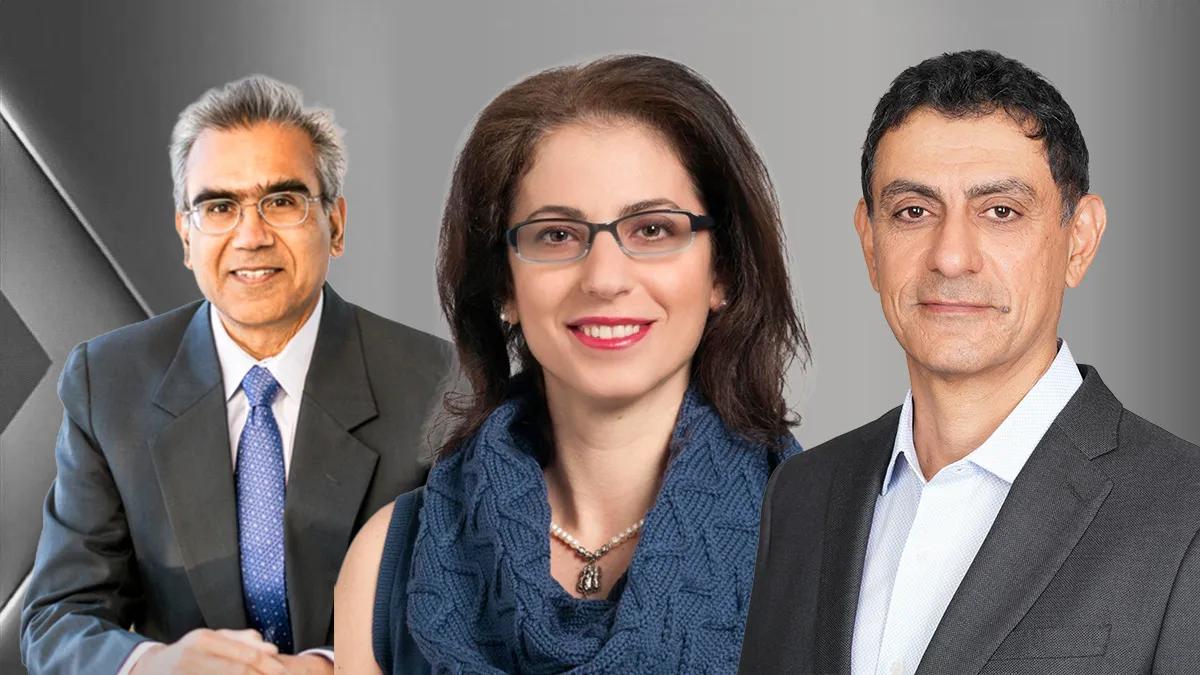
New Leadership Skills: AI and Beyond
This episode explores how artificial intelligence (AI) is reshaping healthcare. The panel examines the practical AI applications across clinical workflows, research, and diagnostics, highlighting real-world such as accelerated trial recruitment and early sepsis detection.
Advertisement
Cleveland Clinic is a non-profit academic medical center. Advertising on our site helps support our mission. We do not endorse non-Cleveland Clinic products or services. Policy
Recent Episodes
Bridging the Gap by Reconnecting Disconnected Workforces
This episode will focus on approaches to fostering culture, connection, and involvement in hybrid and remote work environments. They focus o…
Empowering Leadership Voice
This episode will explore how leaders can strengthen their voice, balance advocacy with active listening, and build psychological safety. Th…
Rethinking Lean: Delivering Value with Purpose
In the episode, Dr. Lisa Yerian, Dr. James Gutierrez, and Dr. Jeffrey Chapman explore how Lean goes beyond cost-cutting to become a purpose-…
Video content: This video is available to watch online.
View video online (https://cdnapisec.kaltura.com/p/2207941/sp/220794100/playManifest/entryId/1_fbmnowjf/flavorId/1_5f3sgelj/format/url/protocol/https/a.mp4)
Transcript
Beyond Leadership Podcast Series
Advertisement
Cleveland Clinic is a non-profit academic medical center. Advertising on our site helps support our mission. We do not endorse non-Cleveland Clinic products or services. Policy
Release Date: August 27, 2026
Expiration Date: August 26, 2029
Estimated Time of Completion: 45 minutes
New Leadership Skills: AI and Beyond
Rohit Chandra, PhD
Lara Jehi, MD
Ben Shahshahani, PhD
Description
Welcome to L.E.A.D., a special series by Beyond Leadership. L.E.A.D. is an innovative, action-oriented framework built on four human-centered behaviors: Listening, Empathizing, Adapting, and Developing. In this series, we explore how top leaders apply these behaviors to build trust, foster collaboration, promote growth, and connect authentically every day.
This episode explores how artificial intelligence (AI) is reshaping healthcare. The panel examines the practical AI applications across clinical workflows, research, and diagnostics, highlighting real-world such as accelerated trial recruitment and early sepsis detection.
Learning Objectives
- Describe ways generative AI is reshaping healthcare operations, clinical workflows, and research.
- Identify key risks and ethical considerations associated with AI adoption in healthcare.
- Summarize leadership factors that support trustworthy AI integration in healthcare.
Target Audience
This program is designed for healthcare professionals interested in advancing their leadership skills.
Advertisement
Accreditation
In support of improving patient care, Cleveland Clinic Center for Continuing Education is jointly accredited by the Accreditation Council for Continuing Medical Education (ACCME), the Accreditation Council for Pharmacy Education (ACPE), the American Nurses Credentialing Center (ANCC), and Interprofessional Continuing Education (IPCE) Credit to provide continuing education for the healthcare team.
Credit Designation
- American Medical Association (AMA)
Cleveland Clinic Center for Continuing Education designates this internet enduring material for a maximum of 0.75 AMA PRA Category 1 Credits™. Physicians should claim only the credit commensurate with the extent of their participation in the activity.
Participants claiming CME credit from this activity may submit the credit hours to the American Osteopathic Association for Category 2 credit.
- American Nurses Credentialing Center (ANCC)
Cleveland Clinic Center for Continuing Education designates this internet enduring material for a maximum of 0.75 ANCC contact hours.
- American Academy of PAs (AAPA)
Cleveland Clinic Center for Continuing Education has been authorized by the American Academy of PAs (AAPA) to award AAPA Category 1 CME credit for activities planned in accordance with AAPA CME Criteria. This activity is designated for 0.75 AAPA Category 1 CME credits. PAs should only claim credit commensurate with the extent of their participation.
- Accreditation Council of Pharmacy Education (ACPE)
Cleveland Clinic Center for Continuing Education designates this knowledge-based activity for a maximum of 0.75 hours. Credit will be provided to NABP CPE Monitor within 60 days after the activity completion. Universal Activity Number List:
- Pharmacist UAN: JA0000192-0000-26-039-H99-P
- Interprofessional Continuing Education (IPCE) Credit
This activity was planned by and for the healthcare team, and learners will receive 0.75 Interprofessional Continuing Education (IPCE) credit for learning and change.
- Certificate of Participation
A certificate of participation will be provided to other health care professionals for requesting credits in accordance with their professional boards and/or associations.
Cleveland Clinic Planning Committee
James Stoller, MD, MS
Co-Activity Director
Chair, Education
Cecile Foshee, PhD
Co-Activity Director
Director, Office of Interprofessional Learning
Sawsan Abdel Razig, MD
Chief Academic Officer, Cleveland Clinic Abu Dhabi
Lindsey Amerine, PharmD
Sr. VP, Chief Pharmacy Officer
Lisa Baszynski, DNP
Executive Director, Associate Chief Nursing Officer
Colleen Carroll, MS
Sr. Director of Leadership and Learning
Matthew Donnelly, MBBS (Hons)
VP, Professional Staff Affairs
Advertisement
Mark Hamilton, MD
Cleveland Clinic London
Joseph Iannotti, MD
Chief of Staff, Cleveland Clinic Florida
Debra Kangisser, PA-C
Office of Interprofessional Learning
Aanchal Kapoor, MD, MEd
Founder and Director of the Medical Intensive Liver Unit
Suchetha Kshettry, MD
Enterprise & Ohio Women’s Professional Staff Association President, (2025-2026)
Christopher Nagel, BA, MA
VP, Leadership and Learning
Silvia Perez Protto, MD
Immediate Women’s Professional Staff Association Past President, (2025)
Ronna Romano, MBA
Office of Interprofessional Learning
Stormy Sweitzer, PhD
Office of Interprofessional Learning
Faculty
Rohit Chandra, PhD
Chief, Digital Officer
Lara Jehi, MD
Chief, Research Information Officer
Ben Shahshahani, PhD
Chief, Artificial Intelligence Officer
Host
Elizabeth Pugel
Sr. Learning Partner
Global Leadership and Learning Institute
Disclosures
The Cleveland Clinic Center for Continuing Education has implemented a policy to comply with the Accreditation Council for Continuing Medical Education Standards for Integrity and Independence. This activity includes non-clinical content only. In accordance with the Standards for Integrity and Independence, identification, mitigation and disclosure of financial relationships does not apply.
Advertisement
CME Disclaimer
The information in this educational activity is provided for general medical education purposes only and is not meant to substitute for the independent medical judgment of a physician relative to diagnostic and treatment options of a specific patient's medical condition. The viewpoints expressed in this CME activity are those of the authors/faculty. They do not represent an endorsement by The Cleveland Clinic Foundation. In no event will The Cleveland Clinic Foundation be liable for any decision made or action taken in reliance upon the information provided through this CME activity.
HOW TO OBTAIN AMA PRA Category 1 Credits™, ANCC, AAPA, ACPE, IPCE Contact Hours, OR CERTIFICATE OF PARTICIPATION:
Go to:
http://cce.ccf.org/ccecme/process?site_code=main&activity_session_code=EKCE02704
to log into myCME and begin the activity evaluation and print your certificate. If you need assistance, contact the CME office at myCME@ccf.org
Copyright © 2026 The Cleveland Clinic Foundation. All Rights Reserved.
Podcast Transcript
Kelly Hancock, DNP, RN, NE-BC, FAAN:
Hello and welcome to Beyond Leadership, a Cleveland Clinic podcast where we explore the many dimensions of leadership. I'm Kelly Hancock, Executive Vice President, Chief Caregiver, and Administrative Officer here at Cleveland Clinic, and I'm thrilled to have you join us. In this podcast series, we'll feature conversations with remarkable thinkers and uncover how their insights and experiences are shaping the future of leadership in healthcare. Now let's turn it over to our host, who will guide us through today's enlightening conversation.
Advertisement
Elizabeth Pugel:
Hello everyone, and welcome to today's episode. I am your host, Elizabeth Pugel, and this is Beyond Leadership. Artificial intelligence is transforming the workplace and healthcare is no exception. With generative AI advancing rapidly, leaders must not only embrace the opportunities but also navigate the risks and ensure their teams are prepared. I am joined today by Dr. Lara Jehi, Chief Research Information Officer, Rohit Chandra, PhD, Executive Vice President and Chief Digital Officer, and Ben Shahshahani, PhD, chief Artificial Intelligence Officer.
Together we'll explore how AI is reshaping the healthcare landscape, when and how it should be used, and what new skills leaders must develop to guide their teams into an AI driven future. The rapid adaption of generative AI is reshaping healthcare from administrative tasks and roles to clinical decisions support systems, but the opportunity comes risk requiring leaders to set vision and guidance. Let's start with the landscape. Rohit coming to you for this first question today. How do you see AI transforming healthcare today?
Rohit Chandra, PhD:
So, what I'm very encouraged by is that we're starting to see the impact of AI in both clinical and non-clinical settings already. So, you can imagine in non-clinical settings, we are using AI and predictive analytics for just back-office automation and optimization, which is helping us do things cheaper, better, faster. We're starting to take an initial step, even in a near clinical setting, is what I'll call it, and that's with the advent of an AI scribe, which can automatically transcribe a physician-patient conversation into high quality clinical notes, and that significantly reduces the documentation burden for providers. I'm hoping that both of these examples are just the tip of the iceberg, but both of these benefits are being realized today, and I hope that there's plenty, plenty more to come.
Elizabeth Pugel:
Fantastic. What a great way to start off our podcast today. Ben, can you share an example where AI added real value to patient care or operations?
Ben Shahshahani, PhD:
Sure. I mean, there's actually quite a few examples that I can point to. A good example is what Rohit actually mentioned in the productivity for caregivers, for our doctors. So, we implemented ambient scribe, it's a technology that is used in outpatient settings. So, where an app is listening in the background to the conversation between the doctor and the patient, and then it transcribes that, and then it automatically turns that into clinical notes. So that's something that has impact on the patient experience because during the time of that conversation, during the visit, doctors no longer need to spend their time trying to take notes, staring at their monitor. They spend the time having a conversation with the patient, and therefore the patient outcome and the experience is better. It also helps the caregiver, the doctors, in terms of doing nonclinical administrative and documentation, which is a major cause of burnout among the physicians. So, we rolled this technology out enterprise wise and we are getting really good encouraging feedback from our patients and from our clinicians. And we are seeing the impact actually in our operations as well. In terms of actual amount of time saved doing the documentation, which opens up that time for doing more clinical work.
Elizabeth Pugel:
How do you measure the value?
Ben Shahshahani, PhD:
Yeah, I mean there are multiple ways of measuring the value. One is pure ROI. So, for instance, we may take a look to see how much time is spent in doing the documentation before and after. And for instance, overall, we see upward of 25% an average reduction in time doing the documentation. Better documentation sometimes also has other side effects. So, so for instance, improved in terms of the billing, and all those.
Then there is the measure of adoption. In other words, the intensity and frequency of use. Are doctors who use this technology, do they continue to use that? How often do they use that? And that shows whether or not technology is actually implemented in a way that the actual use it and the users find it useful and come back and use it again.
And then the third is subjective. We ask about the experience; we ask whether or not they're recommended to others and the preference of the users. So, we monitor all of those metrics to assist the performance and the outcome.
Rohit Chandra, PhD:
Let me add one comment to what Ben just alluded to. So, if you're a primary care doctor, you are spending anywhere between one to three hours a day in documentation. And that historically has led to significant burnout. And the scribe that we are all very excited about has been almost magical. We've literally heard from providers who are planning to retire but have chosen not to retire just because the scribe has reduced the documentation burden so much that it has brought the joy back to caregiving. So really excited about that.
Elizabeth Pugel:
Fantastic. Thank you so much for sharing. So, Lara, what are the most promising ways generative AI is currently being applied in healthcare?
Lara Jehi, MD, MS:
There are multiple ways applications, I will speak about the applications and research for generative AI. These are in a way parallel to the examples that we heard from Rohit and Ben, where there is one application realm, which is in the delivery of the job itself, and then another application space, which is in facilitating the infrastructure for that operation. In research, we have similar applications where on one side we use generative AI to better do research. Classical examples are in drug discovery, for example, where these AI algorithms are helping us better model how certain chemical compounds will work in the human body, or what types of chemical structures can help us predict how a disease is going to progress. In those fields generative AI has been transformative.
Then on the operational side of research, there are also applications for generative AI that's helping us execute more efficiently. A classical example there would be accelerating how we identify patients for clinical trials, where we are accomplishing that at exponentially faster rates, 80 times faster, 200 times faster, and taking the manual effort of coordinators reviewing charts to find patients and putting it in the algorithm space where they are spending their time seeing those patients that the AI has identified.
Elizabeth Pugel:
Ben, what risks do leaders need to watch closely as they adapt these technologies?
Ben Shahshahani, PhD:
So, there are, I can think of three or four different categories of risk. One is about safety, AI systems hallucinate, and when they hallucinate, they can also be very confident. So, understanding what the impact of an error can be is something that should be top of mind. Particularly for cases where there is clinical decisioning or patient facing applications.
Then you have the risk of privacy and data leakage. So, you have to understand that if you are using an AI system, whether or not that system is safe, is it kept compliant? For instance, should you put patient information or confidential information in it or not? Then there is the risk of bias and ethical considerations. So, AI systems are trained on data. These data, the data that went into the training might have particular biases. And so, the decisions that comes out of those might carry those biases. So, you have to be careful about what use cases this AI system is being applied to, who is going to look at it and what decisions are going to be made for it. So those are typical risks that are associated with the use of generative AI.
Elizabeth Pugel:
Rohit how do you frame AI not just as a tech tool, but as part of a broader leadership vision for the future?
Rohit Chandra, PhD:
So, the way we approach it is that we're at the confluence of two different forces at work. Healthcare faces some of the biggest challenges in terms of its availability and its affordability for the population at large. And yet at the same time we have emerging technologies like AI and generative AI that are often amazing in terms of their capabilities. So, our posture is how do we harness these technologies for healthcare transformation? We have to do it very thoughtfully, very carefully with safety and trust at the core. But I think that generative AI has the potential over time to transform many, if not most aspects of healthcare. Whether it's the patient experience, whether it is the nursing experience, or a caregiver experience, or a provider experience, as well as back-office tasks. I think that over time as we harness the technology properly and bring it to bear, we should be able to make healthcare cheaper, safer, more affordable, and more scalable.
Elizabeth Pugel:
So, AI brings enormous opportunity, but it also raises concerns. Many people fear being displaced or worry about misuse. Let's talk about how leaders can help teams embrace AI responsibly.
The integration of AI is not just about adapting new tools. It's a fundamental skill in how we work. This transformation requires leaders to play a central role in addressing fears and building a culture where people feel equipped and confident to work alongside AI. Lara how do we foster a positive collaborative environment while preparing teams for an AI enabled workplace?
Lara Jehi, MD, MS:
It’s critical to prepare teams and demystify AI. That to me is the first step, is help them understand what it is. It's not enough to keep repeating to them. AI is not here to take your job. At some point they may stop believing that statement. If they don't see in reality what that actually means. And one approach is to move AI from a presentation of it being a competitor to the human, to a place where it's actually a supporter of the human. So instead of spending time telling them the workforce that AI is not here to replace you, engage them, the workforce, in educational efforts or training programs that can help them see how AI can help them. Engage them upfront in defining the priorities that they want, problems that they can solve now that they need help with. And then presenting AI as a possible solution.
So, I think engagement of the workforce at all steps from problem definition to identifying a solution, to designing a workflow, to developing milestones, and checkpoints. All of that can help with getting them more involved in the process and eventually them adopting it better because it's not scary for them anymore.
Elizabeth Pugel:
So, let's start with one of the most common concerns, the fear of job displacement. Beyond just saying AI won't take your job. What are some concrete strategies that you have seen leaders use to address fears of job loss and build a sense of security and purpose in an AI enabled future? Ben?
Ben Shahshahani, PhD:
So, I think there are only very few jobs that are single task jobs and any job that you think about mostly consists of doing multiple tasks and typically AI may solve some of those tasks. And those are again, typically the tasks that people don't actually want to do. They're more mechanical. In the case that we talked about earlier, documentation for instance is not a task that doctors like to do. That's not what they went to school for, right? So, when you phrase it that way and you say that your jobs are going to change, the definition of what you do is going to change because of AI, probably for most people, if not everyone, it's not going to eliminate everything that you do. You have to learn how to work with AI, how to think with AI and focus basically on those areas where using this technology can make your job more pleasant. Almost like having an assistant or an intern, you are still responsible for the outcome. So, you can use this powerful assistant and they go and do everything that you tell them. You have to set the context for them, you have to say what the goal is, you have to review their result of their work 'cause you're accountable for that. But you have that at your disposal and now you can focus on the things that is higher value, that the things that are more enjoyable. And that combination is a win-win scenario.
Lara Jehi, MD, MS:
I totally agree with that and on the research side, the example I mentioned is about clinical trial recruitment and the research coordinators time spent with manual chart review being replaced by AI, when your transparent and you reassure them upfront that we're deploying this tool to help you find those patients faster. But we are doing that not because we want to have less research coordinators on the team, but we want to do that so that the existing research coordinators can now see more patients and can expand the number of trials that the program is running. They are fully on board because they want to see patients, they like to do that part of the job, but they hate sitting in front of a computer to review Epic notes. So, it takes transparency and vision for how this is presented and oftentimes people want to do more of what they signed up for.
Rohit Chandra, PhD:
Can I add maybe one comment? I agree with what Ben and Lara said. So, the part that I would emphasize is change is uncomfortable and it's understandable if people feel a little insecure, but change is also in progress is also the human condition. It will happen. And I think that trying to hold people's hand and doing what we can do as leaders and as organizations to help support people through the change in terms of education and helping charter new future is part of our responsibilities.
The other thing which I think is particularly true in healthcare, more than half the country does not have easy access to affordable healthcare. So, while in other industries there may be a bigger risk of displacement, I think the primary objective of the change and progress and automation that we are trying to drive in healthcare is actually to make it more available to more of the country.
Elizabeth Pugel:
So, staying on the topic of change, Rohit, what are the top one or two skills, technical or human-centric that you believe are most critical for the workforce to master right now to thrive alongside AI?
Rohit Chandra, PhD:
I don't know if I can point necessarily to a skill that will vary from job to job, to job. The quality that I would emphasize is curiosity and exploration. I think that AI is in its early stages. I think that there's more that we don't know than we know. So, I think that both as individuals, as teams and as organizations, we have to give ourselves license to experiment and explore these technologies because we are still learning how to apply them. All of the topics that we've touched on, how to do it safely, how to do it effectively are all questions that we are all working through as an organization, as a society. So, I would actually emphasize the willingness to explore, the willingness to take risks as a more critical meta quality.
Elizabeth Pugel:
Ben, can you walk us through a specific instance where your organization introduced a new AI tool? What were the initial concerns, the training process, and then the ultimate outcome for the team and the business?
Ben Shahshahani, PhD:
Well, the AI tool that we talked about earlier, which was ambient scribe for doctors, that was an example where we rolled out, it worked out well because as I think Lara mentioned earlier, we engaged with the end users early on. In other words, we made sure that the people who would be interacting with these systems are involved in the design of the workflow. These technologies are those that are kind of invisible and they disappear in the workflow. And so that, went to start with, that was the right approach in terms of understanding what the pain point is, which was documentation, understanding how the technology can use it, understanding how to put in the workflow so people would be able to use it in a seamless way. We evaluated it and then with the vendor, with the technology partner that we had, we each rated over making improvements so that it would become something that doctors would find useful.
Elizabeth Pugel:
Once teams are equipped and confident with AI, the next critical step is fostering the judgment to use it wisely. Knowing when to use AI is just as important as knowing when not to. So, let's dive into this distinction. We often hear about the incredible power of AI, but truly responsible integration requires an equally deep understanding of its limits. Leaders have the crucial role of guiding their teams to not only leverage AI for efficiency, but also to recognize when human judgment, empathy and ethical considerations must prevail. How do leaders set clear boundaries for AI use that build trust and ensure safety?
Ben Shahshahani, PhD:
I think setting the right policy and communicating that and also investing in AI literacy for the organization is very crucial. So here at the Cleveland Clinic for instance, we have a governance structure in place. This is a place where we evaluate use cases, we evaluate how AI technology is going to be used in order to solve a problem. And we bring experts from different domains, from research, from cybersecurity, from ethics, from privacy, from data science. And each of them assess the risks that might be associated with the end use of that technology. That's one thing. The other thing is AI literacy doesn't mean you need to understand the technology in depth. Doesn't mean that you need to understand the math or the computer science behind that. But what it means is if we make sure that our employees, your team members know what are the capabilities of AI systems and what are the potential shortcomings, what are the potential pitfalls in terms of hallucination rate, in terms of the privacy issues, in terms of the cybersecurity issues, then they can ask the right questions.
And AI literacy in my mind is the ability to ask the right question. What happens? What is the risk if some, if it makes an error, what happens if I put confidential information about a patient in it? What happens if the bias in the data could influence the results and do something that is unfair. Am I compliant with privacy or regulatory, compliance laws that's in place? What was the cutoff for the training? Those are the kinds of questions that you don't need to have very deep expertise in computer science, but understanding the capabilities and the sort of the pitfalls of technology would let you ask the right questions.
Lara Jehi, MD, MS:
I agree with Ben. The caregiver population that I serve is research. So those are people who are more on the front line of developing AI algorithms and technologies. For them, working in the AI space is their bread and butter. So, it's a bit of a different population from those who are seeing it from afar. In that context, the considerations are a bit different. So, the risk there is that they might use the wrong AI approach, for example, to study a given question and avoiding that risk comes with education. I would say in general there are two important points that could help. I think the first one is explainability, so that comes with the technology that you choose to use and deploy. In general, clinicians and researchers do a much better job of using it safely. If they understand why it's giving them the answer that it's giving them, we are all then a better judge of how trustworthy that is.
We know our patients the best and we know our data the best on the research side. So having models that can be explainable is a good way to make sure that people will use them safely. The second is allowing people a safe space where they understand that there is always a human in the loop with deploying these algorithms. Meaning that the responsibility at the end of the day is on them and they cannot say the AI told me to do it and then I just believe it and go run with it. They, if you don't know as the user, whether it's the clinician or the researcher, what the output should look like, then you will not be able to trust, or you shouldn't trust the output that the generative AI is giving you. You should look at that technology as a way to make your job easier. Whatever you are going to spend 10 hours on is now happening in 10 minutes. But if you don't know what to expect at the end of the 10 minutes or the 10 hours, then you just shouldn't be using that technology.
Rohit Chandra, PhD:
Maybe I'll add one last point. I completely agree with what's been said is I would add transparency. I think that there's an element of trust and I think we build trust through transparency. Yeah, I will make mistakes, and I think that it's a journey that we as a society are on. So, if we are sort of transparent with our patients, where are we using it? How are we using it? Then I think we get licensed to learn as we go along.
Elizabeth Pugel:
Are there some examples where AI should not be used in healthcare decision making?
Lara Jehi, MD, MS:
The current state of affairs is such that I don't think that there is an AI approach that is mature enough or trustworthy enough to take a human out of a decision-making process. We should crawl before we walk, walk before we run, run before we fly, right.? So, in the healthcare space, that would be more on the administrative side of doing things and research. It would be more on the operational, organizing team side of doing things. That is a safe space where AI now is really demonstrating benefit. The closer that we get to a direct patient interaction, like say having a robot independently operate in the operating room, we are not there yet. <laugh>. Those would be the situations where I think we are not ready. I'm not ready to jump in a self-driving car yet, for example, <laugh>, others may be, but I'm not. So, there is that piece to consider here, which is what's the readiness level on whoever is consuming that technology, and we can't assume that what we consider safe and reasonable has that same trust level on the recipient end.
Rohit Chandra, PhD:
I think there's two aspects here. One is social acceptance, which is legitimate, and the other is just can you scientifically prove that something is good enough? I think that to your original question, I would not use AI in closed loop clinical decision making today. I think that at the same time technology’s amazingly good, but I don't think we can yet prove that it is safer than a human. And until we get there, I would not use it.
Elizabeth Pugel:
And Rohit, this is a great transition into the next question here. How do you integrate AI into workflows without compromising the human relationship and care? Can you give us an example of an AI tool that has successfully enhanced a human's role rather than replaced it?
Rohit Chandra, PhD:
I'll give you one example which we've now deployed. This is using AI to predict the onset of sepsis. Sepsis is a bloodstream infection with a very high mortality rate, and a thousand people die in the US every day of sepsis related complications. So, the place where we are using AI is looking at a variety of different biomarkers and vitals to predict the onset of sepsis. There's no simple test for it and we know how to treat it, but the problem is we don't have good detection mechanisms. So that's a place where we are using AI for the detection part. And this way a physician has an early warning that a patient may be at the risk of sepsis and they can then go conduct a bedside exam, and if appropriate intervene. And that is leading to better clinical outcomes, lower mortality rates for us. And I think that those are areas where it's not replacing the providers, but it is really helping them be much more efficient and much more effective at the job.
Ben Shahshahani, PhD:
There are a lot of examples also in radiology. And radiology is one of those areas that adopted AI very early on and it's those are great examples of where AI just enhances the work of radiology. So, for instance it may point to that part of the x-ray that needs more attention. We are using an algorithm here for analysis of the CT scans of the lung where AI kind of processes the CT scan and points you exactly to the, where it thinks that there might be a long nodule present. So, the result of it is not replacing the radiologist, but it's a productivity tool for them. They can be more efficient, and it can be more accurate in the analysis, but very much similar in the same genre of things that Rohit talked about, but more on the kind of imaging side.
Lara Jehi, MD, MS:
In research, there's many examples too. So, there are examples where we are using the AI technology to better screen through hundreds of candidates for a given biological mechanism. And instead of doing that process in the lab with building those compounds and then going through the experiments to find out which 10 work out of the 200 that we were considering with AI, we can do simulations to help us prioritize which ones to actually go through the whole process with. Other examples are in generating documents that are necessary for regulatory purposes to standardize the execution of clinical research where the research team has to develop a protocol for the study. Any research study requires that to make sure that all the team members know what to expect and how to operate. And that typically takes days sometimes of manual labor, just writing documents from scratch.
But with generative AI, if we can provide documents that were used in designing the study, then that generative AI, that large language model, can at least provide the team with a document to start with, which can significantly shave off time for them to be doing all of this work from scratch. In Cleveland Clinic, that is not an inconsequential benefit. We have 3000 clinical trials that are clinical research studies that are going on at any point in time, if all of the documentation associated with them can be moved from it being manual, starting from scratch as it is now, to automated assisted by large language models as we hope it would be. If we figure out how to deploy that technology effectively, then that would be a significant operational savings for the organization.
Elizabeth Pugel:
This has been a great conversation around the balance between human and machine, knowing when to let the machine assist and when the human must decide. This brings us to a critical principle, human and the loop AI. Let's take a few minutes to explore what this concept means for leaders. We've established that AI should be a partner, not a replacement. The most successful organizations are designing what's known as human in the loop AI. Rohit, how do you practically operationalize this principle to create a new type of human machine collaboration?
Rohit Chandra, PhD:
It's an evolving journey. So, if you ask me the same question in a year or two's time, I think my answer is going to be different. But we are very intentional about working backwards from the workflow that we are trying to optimize. I talked about two examples. I talked about using AI for detection of sepsis. We spent three months sitting down with our nursing and provider colleagues to examine what is the workload that they're doing, where should AI fit in, and how should it complement what they do so that it is not just efficient, but also effective and safe. due to the same thing with the AI scribe where it's really a question of how do you bring the technology a little bit to use Ben's phrase, almost invisibly into their workflow so that it is complementing what they do, enhancing what they do as opposed to getting in the way. So, I think that, I like your question. I think it is important to elevate the workflow, the experience that technology can bring and be really intentional about designing it properly.
Lara Jehi, MD, MS:
There's a great example in my clinical role. So, I'm a neurologist and there is an AI application that helps identify narrowing in the blood vessels in the neck or in the brain that are leading to strokes. So, a patient comes into the emergency room, we suspect they may be having a stroke, we are not sure, and we get an imaging study that looks at these blood vessels and the AI in it can quickly find out where, that blockage is with strokes, time is brain. Every minute that is lost before we open up that blood vessel, those brain cells are dying. So the way this workflow was developed, it wasn't just about the technology works, it was about whenever it identifies that there is a concern there, it automatically sends messages and pages that go to the clinicians, the radiologist, the interventional stroke team that is supposed to open up this blockage and get the patient in the operating table. The first person that it goes to is the human, the radiologist who is supposed to verify the finding. So that is a perfect place for a human to be in that loop because their presence will ensure a timely interpretation of the AI output and trigger the subsequent management and treatment steps that need to happen quickly.
Elizabeth Pugel:
Ben, how do you ensure that the use of AI, which is often data-driven, doesn't diminish the human skills we value most such as empathy, creativity, and critical thinking?
Ben Shahshahani, PhD:
I think that's a great question, and I think there was actually recently a study that showed that people who use AI and rely on it and not think about evaluating and validating its results eventually may start to lose the ability to do the work that they used to do. I think there are different strategies that you could employ.
One of the things, one, and an example that comes to my mind is something that one of our doctors here, Dr. Neil Mehta, who spends a lot of time in medical education, started to do for his classes. So what he did was he decided to get ahead of the game and he prepares as part of the curriculum of the class patient cases, I think these are based on the New England Journal medicine or some of the standard cases, and he passes them to an AI system and the homework assignment for the students is to evaluate the AI's output and write their interpretation of, was it right, was it wrong? What it miss?
That kind of thinking, figuring out how do you expose, how do you teach, bring that AI literacy to your workforce, to your team members, to your employees? So, they understand that AI is not perfect and they are responsible and accountable for the final output of the work, and therefore they need to ask the right questions. They need to ask what's the risk? Are the citations that are given by the AI, is that actually true or not? Check those things and even ask it to reevaluate itself. They are techniques emerging in prompt engineering that I think people who want to use AI should try to understand and utilize that to make sure that AI has enough context, it has a clear goal, it has some examples, and it knows what the output should be. Once you give that, then you still need to reevaluate that and maybe ask it to iterate with it in order to get it to do the job better and better.
It's very much like a new junior employee. The example that I give people when they come to us sometimes different teams and they want to have an AI system built for them for whatever use case. The way that we start is think that you have an intern or a new employee, a junior employee, and that person is coming in and you're onboarding them. What are you gonna do? You're going to set some context for them, you're gonna tell them what they're expected, what they're supposed to do. If you're a good manager, maybe you give 'em an example, maybe you sit down with them, right? And then say, do this, tell them what to prepare, what the output should be. But you don't just delegate, right? As a manager and intern supervisor, you look at the assignments that they did, they look at the output, you criticize them, give them the feedback to do it better and better and better. That's the way to interact with AI system currently, at least.
Lara Jehi, MD, MS:
The example we keep talking about with the AI scribe and empathy, I would say as a clinician, a patient would much more enjoy me looking at their face during the visit and as they're talking to me, that would be a more empathetic approach to that visit than me turning my back and typing in front of the computer. So that technology can actually help us become more empathetic in how we provide care. Now, it's a complex question though, particularly in the mental health space, for example, where there is now chatbots that patients can use for therapy, mostly in the teenage years, young adults, people are finding it that the AI, these chatbots are more empathic then people. They find it easier now to talk particularly about such sensitive topics.to a phone or to a device where they don't have to deal then with how do they react then to how the other person is looking at them or the judgment that could be perceived, that it's coming. So, it's a difficult area and, like Rohit said, we are learning as a society what any of this means. I just gave you two examples that are the complete extreme opposites. Like a situation where the AI is helping the human appear more empathetic, and then a situation where the technology is making the human be appearing as less empathetic and the technology is the same, really, it's just the way it's being used and the context that is leading, to these divergent views.
Elizabeth Pugel:
Looking ahead, Rohit, if you had to give one single piece of advice to a leader who is just beginning their journey of integrating AI, what is the most important thing they can do to build a culture of confidence and engagement with their team?
Rohit Chandra, PhD:
I'll touch on two things. One is I think we are in the early stages. So, I think being intentional about where to apply technology, I think is important because there's so many opportunities and healthcare being deliberate and intentional about where you think you can actually apply it and make a difference. I think going in with that sort of bringing that domain expertise and thinking to bear is important. And at the same time, you have to be willing to explore and experiment. I think the curiosity factor is important. I think that some things will work, some things will be more effective than we think, and some things will surprise us. And for a leader, I would look to say that bring that curiosity and that intentionality to bear and that is how transformation will happen.
Elizabeth Pugel:
We've covered opportunities, fears, boundaries, and the role of human oversight. Let's close today by looking at what leadership skills are needed to guide us into this AI driven future. Today we unpack the most critical aspects of leading with AI, from taking away fears and setting clear boundaries to embracing human in the loop collaboration, the journey ahead will test our leadership skills, but as we heard today, the path is clear. It requires vision, intentional communication, and a new kind of proactive stewardship. Lara, what is the most important new skill must develop to thrive in an AI driven workplace?
Lara Jehi, MD, MS:
It's important that the leader is educated on AI and comfortable with AI themselves. If, if I am leading a group, I cannot with a straight face, tell them, you must be comfortable, with this technology or identify its ideal applications in the area that I am leading unless I am familiar with that technology. So, I would start by learning as a leader no matter what I do. Have that curiosity, have that interest in jumping in, diving in. There is no point in being afraid of something that you cannot change. There is no point in being anxious about something that you have no control over. And at this point, AI integration, not just in healthcare, but in our life in general, is a fact. It is coming. So, we should not be, there is no point in fighting it. There is no point in resisting what it means to us. So, start by then embracing it. <laugh>, we, we cannot stop it. Let's join it, and then we can understand it, and then we can define how to use it to our advantage.
A leader who has that comfort level and that vision will be a source of strength to their team members who will be confident then going to their leader with their questions, their concerns, and they will then spend their energy creating instead of spending it worrying.
Elizabeth Pugel:
Ben, if our listeners could take one concrete action tomorrow, a single step to start preparing their teams for AI, what would it be? What's the best first move to build that confidence and engagement?
Ben Shahshahani, PhD:
So, I was at one of our summits that our radiology team had, and they had a hands-on workshop on AI, and I thought that it was an excellent way to introduce a team into AI in a fun way, in a collaborative environment. And the gist of it was not really going again, in terms of the technology and math and computer science and all of that, how do you use AI? How do you prompt something to do?
I think every team, every leader can do that within their own team. Think about some application, particularly something that might be important for your team. It might be finding information from your documents or your PowerPoints. It could be crafting a, a draft of a proposal or whatever it is, and then setting up simple workshops.
It could be as simple as getting your favorite AI system or chatbot to work. How do you prompt that? And once you experiment with it, you can learn its capabilities. You could ask it to be, to have different personalities and then it would act differently. You can ask it to be verbose, or you could ask it to be very discreet and short in the response. You could change its tone, it could be formal, you could ask it to be friendly and chatty.
You try all of these things and gradually people get more comfortable with it. I would then ask him to maybe use it, use that system next week and come back and share your results and encourage finding and reporting errors and mistakes? And sort of create that psychologically safe environment for people to try and even if they did something wrong, they actually share that and make that a fun environment. I think that goes a long way. Anyways, the experiment that I saw was, was really great and sort of made me think[about] how can we institutionalize that approach and use that template across all of our groups here?
Elizabeth Pugel:
And we'll end with Rohit. What is one concrete action tomorrow that leaders can start doing to prepare their teams for AI?
Rohit Chandra, PhD:
I think that the quality that they have to shed is not be afraid. I think that change can cause us to be uncomfortable, can cause us to be afraid. And I would say that dive right in. I think that I would encourage people to, many of these technologies are directly accessible to all of us regardless of our work function. So, I think engaging with these technologies and understanding their potential is an essential ingredient. And the comfort that I would give them is, yeah, in such strange way, has actually leveled the playing field because it is accessible to all of us and there's no shortcut other than trying it. And that's how you build some comfort. That's how you can build confidence. That's how you can lead your teams. That's how you can try different things and see what works and what doesn't.
Elizabeth Pugel:
Thank you to each of you for taking the time to share your expertise with our listeners.
This concludes another episode of Beyond Leadership. You can find additional podcast episodes on our website, clevelandclinic.org/beyondleadership, or subscribe to the podcast on iTunes, Google Play, Spotify, or wherever you get your podcasts.
Recent Episodes
Bridging the Gap by Reconnecting Disconnected Workforces
This episode will focus on approaches to fostering culture, connection, and involvement in hybrid and remote work environments. They focus o…
Empowering Leadership Voice
This episode will explore how leaders can strengthen their voice, balance advocacy with active listening, and build psychological safety. Th…
Rethinking Lean: Delivering Value with Purpose
In the episode, Dr. Lisa Yerian, Dr. James Gutierrez, and Dr. Jeffrey Chapman explore how Lean goes beyond cost-cutting to become a purpose-…
Never miss a moment - subscribe now.
Listen to the Health Essentials Podcast on your favorite streaming platform.
Other Podcasts You May Love

Beyond the Pages: CCJM Podcast
Beyond the Pages: CCJM Podcast takes the listener more in-depth into Cleveland Clinic Journal of Med…
Butts & Guts
A Cleveland Clinic podcast exploring your digestive and surgical health from end to end. You’ll lear…
Cancer Advances
A Cleveland Clinic podcast for medical professionals exploring the latest innovative research and cl…
Cardiac Consult
A Cleveland Clinic podcast exploring heart, vascular and thoracic topics of interest to healthcare p…