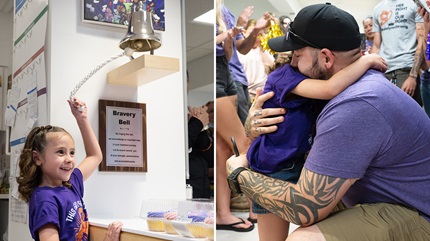
John Petri never imagined that a regular workout would change his life. While exercising at the gym, he suddenly felt something he had never experienced before—a burning sensation spreading across his entire chest.
“It was a feeling that came over my chest,” John recalls. “It was throughout my entire chest, and it was something I’d never felt before.”
Concerned, John sought care at Cleveland Clinic Weston Hospital, where advanced testing revealed a serious and potentially fatal diagnosis: a major tear in his aorta, the main blood vessel carrying blood from the heart to the rest of the body.
“I told them I had never had a heart condition before,” John says.
According to Malcolm McDonald, MD, cardiologist, sudden tears in the aorta—known as aortic dissections—can occur without warning. “The aorta is the single largest and highest pressure vessel in the body,” Dr. McDonald explains. “A sudden tear can very easily be a fatal event. Frequently, patients with this disease process have no symptoms at all.”
To fully understand the severity of John’s condition, the care team used advanced CT based 3D imaging to create a detailed model of his heart and aorta. “This technology allows us to understand the full extent of the problem and carefully plan the surgical approach,” Dr. McDonald says. John’s tear began at the base of the aorta—the critical vessel leaving the heart that supplies blood to the brain and the rest of the body. He also had a leaking valve and a progressively enlarging aorta.
“When we looked at the totality of the situation,” says Antonio Polanco, MD, cardiothoracic surgeon, “we knew that with a leaking valve, a very enlarging aorta, and a chronic dissection, John was a ticking time bomb.”
Surgery was the only option. John ultimately underwent a surgical aortic graft repair, a complex and highly specialized procedure designed not only to improve his quality of life, but to save it.
“They told me it was a serious operation,” John says. “I’d be under for quite some time on a heart lung machine.”
Because John’s dissection involved the arch of the aorta, where the arteries supplying blood to the brain originate, the procedure required extraordinary planning and teamwork. During the surgery, doctors needed to temporarily drain blood from John’s body while still ensuring continuous oxygen rich blood flow to his brain.
Working side by side, Dr. Polanco and Otto Montero, MD, vascular surgeon, designed a highly coordinated approach to protect John’s brain while repairing the damaged aortic arch. “This required carefully orchestrated, sequential steps during surgery to achieve the best possible outcome,” Dr. Montero explains.
The result exceeded expectations.
Today, John is grateful for the expertise, advanced technology, and collaborative care that gave him a second chance at life—proof that world class heart and vascular care can make all the difference when it matters most.
Patient Stories
Routine Health Assessment Reveals Abnormal Heart Rhythm Hidden for Years
Sep 23, 2026
After Early Ovarian Cancer Diagnosis, Woman Finds Relief From Chemotherapy-Related Nerve Pain
Sep 18, 2026