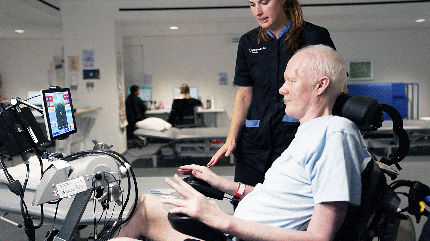
When David Lyon noticed occasional blood in his stool, it didn’t immediately alarm him. A healthy, athletic 26-year-old from Erie, Pennsylvania, he brushed it off as something minor.
That changed in June 2021, when he developed sharp abdominal pain so severe it prevented him from standing up straight. David went to the doctor, and a diagnostic colonoscopy quickly revealed the unexpected cause of his symptoms: stage 4 colorectal cancer that had spread to his liver and several lymph nodes near his heart.
David had no significant family history of colorectal cancer, which made the diagnosis even more surprising. “Cancer was the farthest thing from my mind,” recalls David, now 31. “I thought maybe something else was wrong—but never cancer.”
According to Cleveland Clinic gastrointestinal oncologist Bassam Estfan, MD, who has treated David since shortly after his diagnosis, that response is typical among younger patients facing colorectal cancer. “For someone as young as David, with so much life still ahead of him, it can be a profound shock for patients and their families,” says Dr. Estfan. “Young-onset cancer may come as a surprise, but younger patients are usually able to tolerate more aggressive treatment, which can expand their options.”

David went through extensive treatment for his cancer before being eligible for a liver transplant. (Courtesy: David Lyon)
Studies show rates for people under the age of 50—particularly for breast, colorectal and other gastrointestinal cancers—have risen by nearly 80% since 1990 in the U.S. and other industrialized nations. Researchers continue to investigate the reasons behind the trend, with many pointing to environmental factors such as diet, obesity and increasingly sedentary lifestyles.
As colorectal cancer increasingly affects younger adults and has become the leading cause of cancer death in this age group in the U.S., Cleveland Clinic established its Center for Young Onset Colorectal Cancer. Part of Cleveland Clinic’s Young People with Cancer Program, the center brings together a multidisciplinary team to deliver comprehensive, individualized care tailored to patients’ lives, addressing not only treatment but also school, work, fertility planning and relationships.
Encouraged by his employer at the time, David visited the center with the steady support of his mother, Lorrie Smith. He soon chose to have the Cleveland Clinic team oversee his care, including Dr. Estfan, colon and rectal surgeon Scott Steele, MD, and liver transplant surgeon Cristiano Quintini, MD.

David with his family at Cleveland Clinic, prior to undergoing a liver transplant. (Courtesy: David Lyon)
David recalls, “Everybody who worked with me was amazing. And right away, they had a plan for me.”
According to Dr. Estfan, the plan began with aggressive chemotherapy, aimed at shrinking the cancer before surgery and determining whether targeted radiation to the liver could be an option. Because David’s liver was extensively affected, he would not be eligible for a liver transplant until the disease was managed.
“When you’re facing an aggressive cancer like this, close collaboration among surgeons, medical oncologists, transplant specialists, interventional radiologists and others is critical to determining the best possible course of care,” says Dr. Estfan.
Eager to confront the cancer head on, David began chemotherapy 10 days after his diagnosis, receiving treatment close to home in Erie. Over the next three years, he endured dozens of six-to-eight-hour sessions, with breaks only when other treatments were required.

David ringing the bell signifying the end of his cancer treatment. (Courtesy: David Lyon)
Those additional treatments included surgery to remove the tumor in his colon, a second operation to remove cancerous lymph nodes near his heart and targeted radiation to his liver. Each step was made possible by chemotherapy, which successfully reduced the cancer enough to allow doctors to proceed.
Despite the physical toll of chemotherapy and radiation, David was determined to keep moving forward. He continued playing hockey for the Swamp Donkeys in an Erie adult league, missing just one game during treatment, aside from time spent recovering from surgery.
“I think what helped me the most was staying active,” says David, who also credits the support of his girlfriend, Krissy Cole, whom he met after his diagnosis. “Cancer doesn’t define who you are. I knew there was a chance things could end badly, but I didn’t dwell on that. I was 26, and I wanted to keep living my life.”
After his second cancer removal surgery, which required temporarily deflating a lung to reach cancerous lymph nodes near his heart, David underwent radioembolization to stop the disease from spreading further in his liver. The procedure delivers tiny beads containing a radioactive substance called Yttrium- 90 directly into the liver’s blood vessels. Its success made David eligible to be placed on the liver transplant list.

David with one of the doctors on his care team, liver transplant surgeon Alejandro Pita, MD. (Courtesy: David Lyon)
In August 2024, he underwent a successful liver transplant at Cleveland Clinic, made possible by the generosity of an organ donor and their family. David remains deeply grateful for the gift that gave him a second chance at life.
His recovery was remarkably fast. By December, he was back on the ice skating, and by January 2025, he had returned to playing hockey for the Swamp Donkeys, even scoring the game winning goal in his first game back.

In January 2025, David was back playing hockey for the Swamp Donkeys. (Courtesy: David Lyon)
David currently shows no evidence of cancer. In addition to his job designing commercial HVAC systems and continuing to play hockey, he spends much of his free time as a video game content creator. He donates a significant portion of the proceeds from his work to several charities, a commitment he sees as both personal and purposeful. “It’s my way of giving back,” he says.
That desire to help others has also fueled David’s willingness to share his health journey. “I hope I can help ease the minds of young adults,” he says. “Getting checked out isn’t a chore. It’s something you owe yourself. Listening to your body and getting checked early can change everything.”
Related Institutes: Digestive Disease & Surgery Institute , Cleveland Clinic Cancer CenterPatient Stories
After Early Ovarian Cancer Diagnosis, Woman Finds Relief From Chemotherapy-Related Nerve Pain
Sep 18, 2026
Adelynn Strong: Family's Promise Carries Girl Through Leukemia Treatment
Sep 15, 2026