During his career, Tom Bruckman helped raise awareness about prostate cancer and the importance of early detection. Through national education efforts, he worked to bring conversations about prostate health into the public eye and encourage men to make informed decisions about their care.
Decades later, those advances became personal.
"My message to my brothers, my sons and everyone else is there has been tremendous progress in prostate cancer detection and treatment over the last 25 to 30 years," says Tom, 75. "There are more options available today than there once were, and understanding those options can make a real difference."
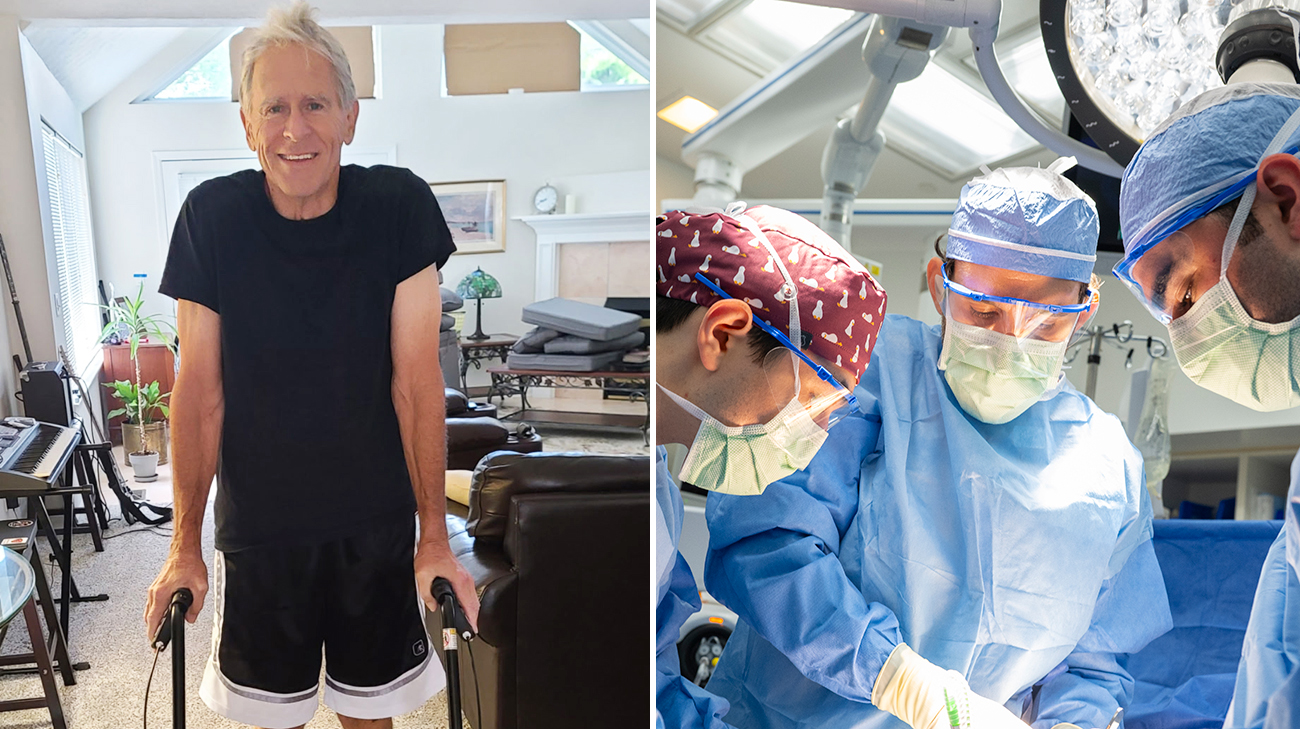
When Tom was diagnosed with localized prostate cancer in 2025, he worked with Cleveland Clinic urologic oncologist Zeyad Schwen, MD, and urologist Bradley Gill, MD, to determine the best treatment approach. He ultimately chose to undergo a single-port, robot-assisted radical prostatectomy, performed by Dr. Schwen.
Because the cancer had spread beyond the prostate and into the nerves that supply erectile function, the surgery also included a novel nerve reconstruction technique. The procedure uses specially processed donor nerve tissue that supports regeneration of the patient's remaining nerve tissue with hopes for improved recovery of erectile function.
Tom, who lost an uncle to prostate cancer and has other family members who have been treated for the disease, did not hesitate when his physicians discussed the option. While the technique remains investigational in urologic surgery, the same nerve graft used in the procedure is approved by the U.S. Food and Drug Administration and has been used to repair sensory and motor nerve injuries after trauma and to help restore sensation following mastectomy and breast reconstruction.
"I was among the first group of men to receive the cavernosal nerve allograft," Tom says.
A Cleveland, Ohio, native now living in Dallas, Texas, Tom returns to Cleveland regularly to visit his children and grandchildren and for follow-up appointments with his care team.

Tom comes back to Cleveland, Ohio, to spend time with his family and for continued follow-up appointments. (Courtesy: Tom Bruckman)
According to Dr. Schwen, who leads the Prostate Cancer Research Working Group at Cleveland Clinic and specializes in minimally invasive robotic surgery for prostate cancer, Tom was an ideal candidate for the nerve allograft procedure.
"Before surgery, imaging and biopsy results showed Tom had an aggressive prostate cancer that had extended beyond the prostate into the erection nerves that would need to be removed," Dr. Schwen says. "The nerve graft offered the potential for a faster and more complete functional recovery to improve his quality of life. It serves as a scaffold that may help the nerves reconnect and regenerate over time."
Tom's path to treatment began years earlier. Throughout much of his adult life, he underwent routine prostate cancer screening, including regular prostate-specific antigen (PSA) blood tests.
In 2021, he began experiencing symptoms associated with an enlarged prostate, and his PSA levels started to rise. To help relieve those symptoms, Dr. Gill performed a transurethral resection of the prostate (TURP), a procedure that removes a portion of the prostate. No cancer was detected at the time.
But Tom continued to closely monitor his prostate health. In 2025, after his PSA levels continued to increase, a biopsy revealed prostate cancer that had spread beyond the prostate into nearby tissue, including a nerve involved in continence and erectile function. Additional testing, including genetic evaluation, helped guide the treatment plan that ultimately included both robot-assisted surgery and the investigational nerve reconstruction procedure.
Tom was encouraged by his recovery.
"Despite it being a complicated surgery, I recovered much faster than I expected," he says. "Three months after surgery, I was where Dr. Schwen thought I might be after nine or 10 months."
Recently, Tom and his companion, Arlene, celebrated that progress with a two-week trip to Italy.
Looking back, Dr. Schwen credits Tom's long-standing commitment to prostate cancer screening and his willingness to act when symptoms emerged.
Cleveland Clinic conducts an annual MENtion It campaign to raise awareness of prostate cancer and other health issues specific to men. The campaign encourages men to speak openly about their health and stay proactive with screenings, which can help identify serious conditions before symptoms become more advanced.
"Many men are reluctant to talk about prostate health, which can delay diagnosis and treatment," Dr. Schwen says. "Tom stayed on top of his screenings, paid attention when things changed and sought care early. His experience is a good reminder that routine screening can play an important role in detecting prostate cancer when treatment options may be most effective."
Related Institutes: Cleveland Clinic Cancer Center, Glickman Urological & Kidney InstitutePatient Stories
Novel Nerve Graft Procedure Offers Hope For Functional Recovery After Prostate Cancer Surgery
Sep 27, 2026
Routine Health Assessment Reveals Abnormal Heart Rhythm Hidden for Years
Sep 23, 2026