



An intra-aortic balloon pump (IABP) is a device that helps your heart when it’s struggling to pump. A balloon deflates when your heart pumps blood out and inflates when your heart rests between beats. You may need an IABP to treat cardiogenic shock, or before or after cardiac surgery. Most people only need the device for a short time.
Advertisement
Cleveland Clinic is a non-profit academic medical center. Advertising on our site helps support our mission. We do not endorse non-Cleveland Clinic products or services. Policy
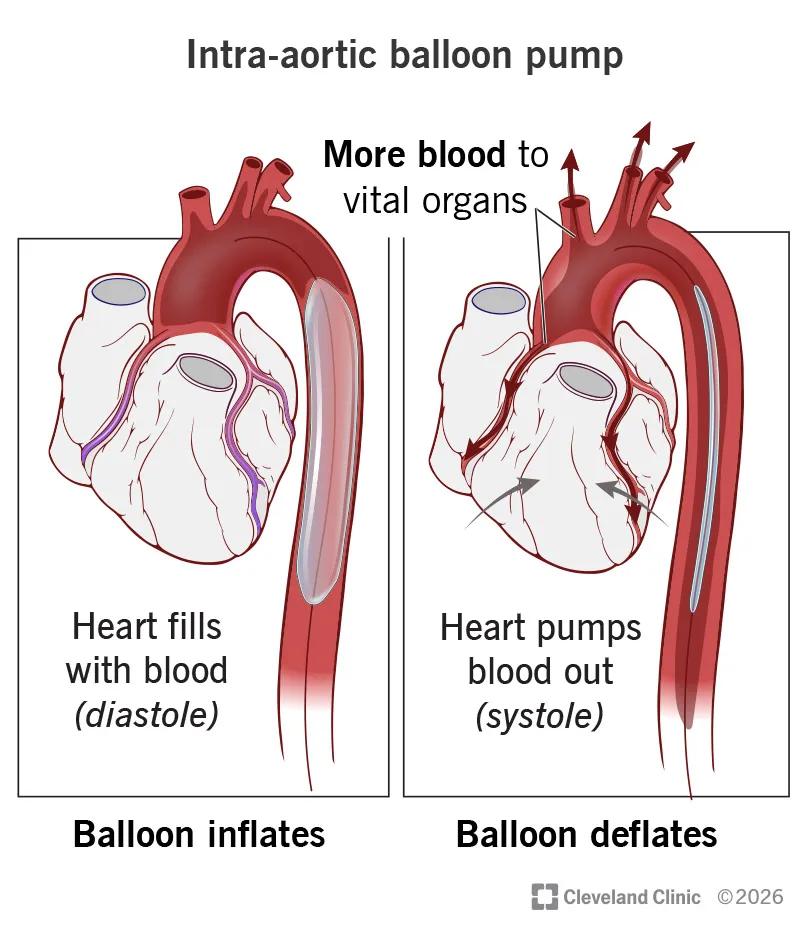
Image content: This image is available to view online.
View image online (https://assets.clevelandclinic.org/transform/1a1834da-8a65-41b9-bd82-5c1426859d1b/intra-aortic-balloon-pump)
An intra-aortic balloon pump (IABP) is a widely used device that helps the heart pump more blood. It does this by making it easier for the cardiac muscles to open the aortic valve and eject blood. It’s used in people with cardiac-related shock or severe coronary artery disease. Healthcare providers commonly place this device only in the intensive care unit.
Advertisement
Cleveland Clinic is a non-profit academic medical center. Advertising on our site helps support our mission. We do not endorse non-Cleveland Clinic products or services. Policy
An IABP has a tube (catheter) with a balloon at one end that goes inside your body. At the other end, outside your body, the catheter connects to a console with a gas line for helium. The console tells the pump when to deflate and inflate.
Typically, when your heart contracts, it sends blood out to the rest of your body. When your heart relaxes, it fills with blood. An intra-aortic balloon pump deflates when your heart pumps blood out, and then inflates with helium when your heart relaxes.
An IABP stays in place for only a few days. Healthcare providers typically use the device when you’re in the hospital after surgery or a cardiac event. Some people may need an IABP before or after cardiac procedures like angioplasty or bypass surgery for a blocked artery. You may also have one while you wait for a long-term device.
You may need an IABP to treat cardiogenic shock. This means your heart isn’t pumping enough blood to meet your body’s demand for it. This type of shock may develop because of:
It’s unsafe to get an IABP if you have:
Advertisement
Your risks depend on multiple factors, including your age and overall health. In general, the risks of an intra-aortic balloon pump may include:
If you’re already in cardiac surgery when your healthcare provider places the IABP, you’ll be asleep for the procedure. Otherwise, your provider may give you numbing medicine (local anesthesia) to reduce the chance of pain during the procedure.
During an intra-aortic balloon pump placement, your healthcare provider:
You may feel some chest pain during IABP placement. This pain should go away within a few minutes. More commonly, the device will help improve chest pain if you receive the IABP for severe coronary artery disease that doesn’t respond to medical management.
You’ll stay in bed with your head slightly elevated while the IABP is in place. The catheter will stay in your leg. You’ll need to keep your leg straight to prevent the balloon from moving out of position.
Usually, providers will give you a blood thinner called heparin after placing an intra-aortic balloon pump. Heparin helps prevent blood clots from forming.
You’ll likely have a chest X-ray each day to make sure the IABP is still in the correct place.
Most people stay on an IABP for a few days, or until they have a procedure in the cath lab or a surgery. It depends on why you received the device. Your healthcare provider may temporarily stop the balloon pump after a few days to see how you respond. If your heart pumps well on its own, your provider may remove the balloon pump. You’ll need at least two hours of bed rest after the IABP is out.
In severe cases, you may need to keep using the IABP until another option is available, like a left ventricular assist device or a donor heart for a transplant.
Advertisement
If you’re in the hospital, your care team will be watching for any problems that develop.
Let your team know if you have any signs of infection or complications after a cardiac procedure, including:
An IABP usually only stays in place for a few days. But your healthcare provider may keep it in place for up to 30 days, or sometimes longer.
When your heart isn’t able to supply your body with the blood it needs, nothing else seems to matter. An intra-aortic balloon pump (IABP) can help get more blood to your cells, tissues and organs. It’s a short-term solution that can get you to a longer-term remedy. Your care team can answer any questions you might have about what an IABP can and can’t do.
Advertisement



Sign up for our Health Essentials emails for expert guidance on nutrition, fitness, sleep, skin care and more.
Learn more about the Health Library and our editorial process.
Cleveland Clinic’s health articles are based on evidence-backed information and review by medical professionals to ensure accuracy, reliability and up-to-date clinical standards.
Cleveland Clinic’s health articles are based on evidence-backed information and review by medical professionals to ensure accuracy, reliability and up-to-date clinical standards.
When your heart needs some help, the cardiology experts at Cleveland Clinic are here for you. We diagnose and treat the full spectrum of cardiovascular diseases.
