



Parry-Romberg syndrome is a rare condition that causes slow thinning of skin and tissue on one side of your face. It may also affect your nerves, eyes or jaw. While there’s no cure, medications and reconstructive treatments may help manage symptoms and improve facial function.
Advertisement
Cleveland Clinic is a non-profit academic medical center. Advertising on our site helps support our mission. We do not endorse non-Cleveland Clinic products or services. Policy
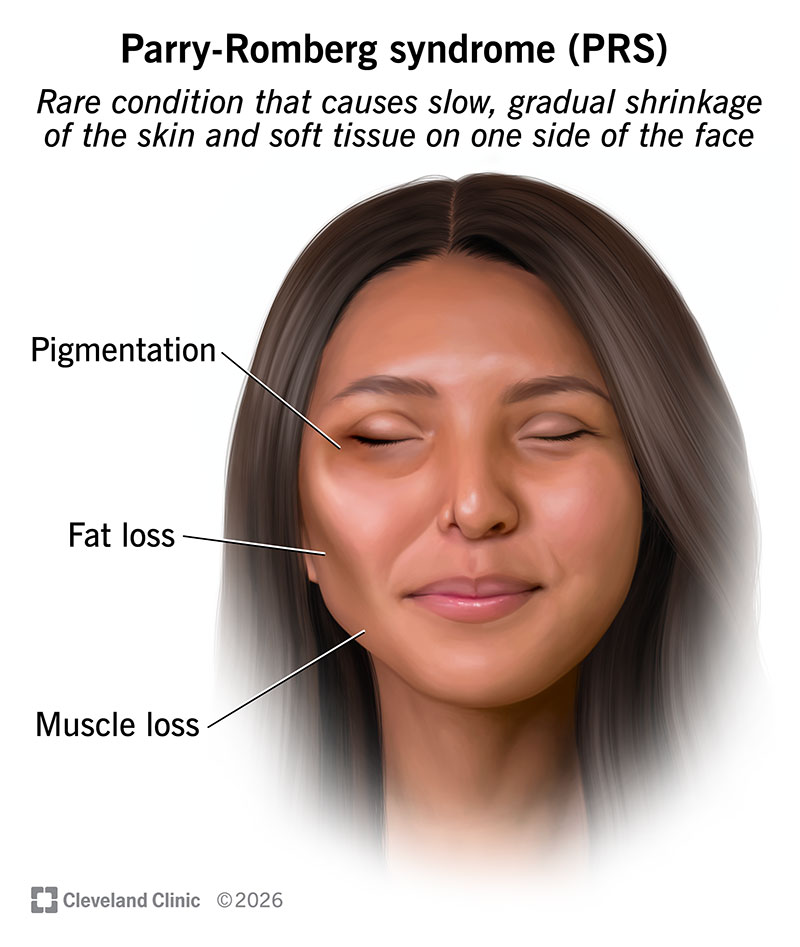
Image content: This image is available to view online.
View image online (https://my.clevelandclinic.org/-/scassets/images/org/health/articles/parry-romberg-syndrome)
Parry-Romberg syndrome (PRS) is a rare condition that affects your facial skin, fat, muscles and sometimes bone. It causes slow, gradual shrinkage (atrophy) of your skin and soft tissue on one side of your face. It usually starts in childhood or the teen years. It’s more common in females than males.
Advertisement
Cleveland Clinic is a non-profit academic medical center. Advertising on our site helps support our mission. We do not endorse non-Cleveland Clinic products or services. Policy
Symptoms often begin with changes in your skin color. Over time, your face may lose fat and look thinner on one side. You might also develop seizures, migraines or jaw problems.
You may hear your provider call PRS:
They all refer to the same condition.
Treatment manages symptoms. Your provider can help you understand your options and what to expect.
PRS can affect your face, eyes and mouth. Symptoms vary from person to person and may include:
Eye symptoms may include:
Symptoms that affect your mouth may include:
Healthcare providers don’t know the exact cause, but there are several theories about why people may get this disease. Possible causes include:
Advertisement
Of these causes, the most widely supported theory is that PRS may be an autoimmune disorder. An autoimmune disorder happens when your immune system mistakenly attacks healthy tissue. PRS often overlaps with a condition called linear scleroderma. Linear scleroderma is an autoimmune disease that affects the skin.
Providers sometimes diagnose this condition in people who also have autoimmune conditions like:
Researchers continue to study PRS to better understand why it develops.
PRS may lead to complications over time. These could include:
Severe complications are rare, but they may include:
A healthcare provider will diagnose PRS mainly by examining your face and reviewing your medical history.
During the exam, your provider will look for slow, progressive thinning on one side of your face. They’ll also ask about other symptoms, like headaches, facial pain or problems with vision.
They may order imaging tests, like an MRI or CT scan of your head, to check your brain, bones and blood vessels. These tests help your provider see how much tissue the condition affects and look for complications. An eye doctor may also check your vision and eye health.
There isn’t a specific lab test for PRS, but your provider may order blood tests to look for autoimmune conditions. In rare cases, they may perform a skin biopsy to rule out similar conditions.
Providers may also describe PRS as mild, moderate or severe. These describe how much the condition affects your tissue and bone.
There isn’t a cure for PRS, but treatment may help slow the disease and manage symptoms in the early, progressive phase. After this phase, when the disease is no longer active, the goal of treatment is to improve the appearance and function of the affected tissues.
Your provider will tailor treatment to your symptoms, the stage and your personal goals.
Advertisement
If PRS is progressing, your care team will focus on calming your immune system with one of the following medications:
There are also symptom-related treatments available, like:
Once the condition is stable (for at least one to two years), you might choose to have cosmetic treatments to improve your facial symmetry (evenness) and function. These treatments may even include surgery. Options may include:
You should see a healthcare provider if you notice:
Advertisement
Early care may help your provider monitor the condition and start treatment if needed.
PRS usually progresses slowly over several years. Changes may continue for two to 20 years. Then, it often reaches a stable or inactive phase. It typically doesn’t continue getting worse forever, although rare cases can reactivate later in life.
PRS often begins when your body and identity are still developing. Your appearance can feel especially important. Going through visible facial changes during these years may feel confusing, frustrating or emotionally overwhelming. Many people find counseling or peer support helpful as they adjust.
Over time, you can expect some degree of permanent facial asymmetry (unevenness). The severity varies from person to person. People who develop PRS at a younger age or who have deeper tissue involvement may notice more visible changes. Reconstructive surgery might improve appearance, but it will often require more than one procedure, and results can vary.
This condition doesn’t usually affect life expectancy. It’s chronic, which means it can last for many years, but it’s not typically fatal. Most people with PRS live a normal lifespan.
Parry-Romberg syndrome (PRS) may feel like a lot to take in. Often because it starts during the years when your appearance can especially feel important. Noticing gradual changes in your body can affect more than your physical health — it can affect your emotional well-being, too.
Advertisement
While there isn’t a cure right now, there are ways to manage PRS. If you notice new symptoms or changes that worry you, trust your gut and reach out to a healthcare provider. Early care can make a meaningful difference. And if the emotional weight feels heavy, counseling or peer support can be just as important as medical treatment.



Sign up for our Health Essentials emails for expert guidance on nutrition, fitness, sleep, skin care and more.
Learn more about the Health Library and our editorial process.
Cleveland Clinic’s health articles are based on evidence-backed information and review by medical professionals to ensure accuracy, reliability and up-to-date clinical standards.
Cleveland Clinic’s health articles are based on evidence-backed information and review by medical professionals to ensure accuracy, reliability and up-to-date clinical standards.
Cleveland Clinic’s primary care providers offer lifelong medical care. From sinus infections and high blood pressure to preventive screening, we’re here for you.
