



An acute kidney injury (AKI) is when your kidneys suddenly stop working as well as they should. This causes waste products to build up in your blood. A separate condition usually causes an AKI, including conditions that affect blood flow or your ability to pee. Treating an AKI involves treating its cause. A severe AKI may require dialysis.
Advertisement
Cleveland Clinic is a non-profit academic medical center. Advertising on our site helps support our mission. We do not endorse non-Cleveland Clinic products or services. Policy
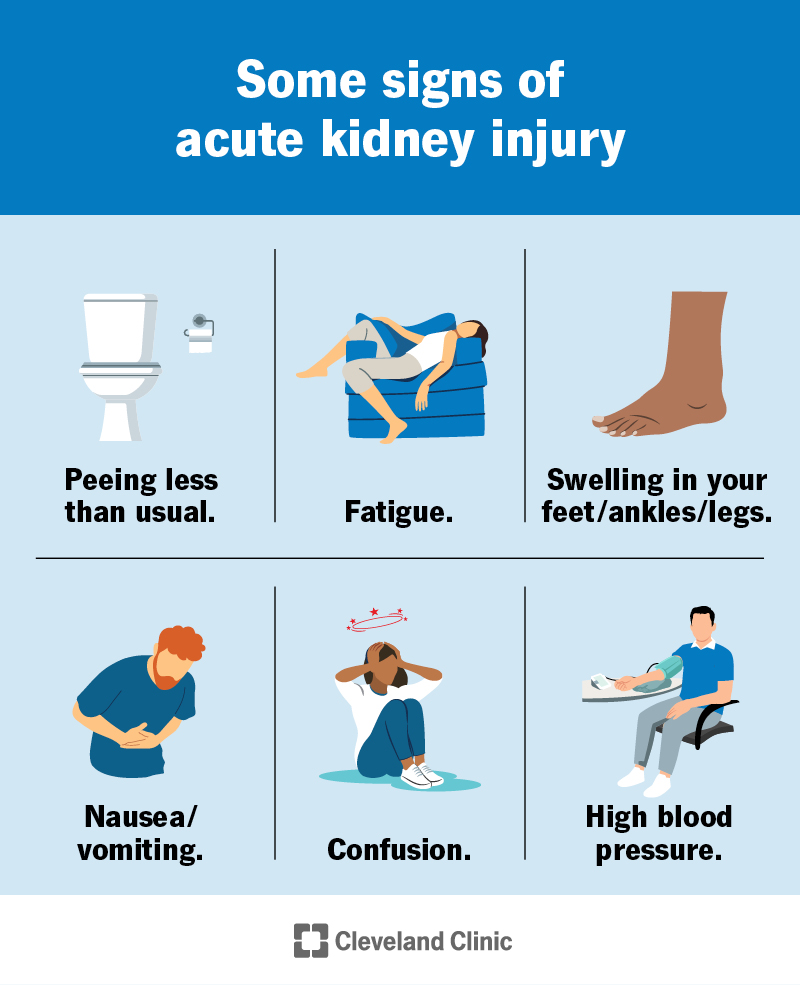
Image content: This image is available to view online.
View image online (https://my.clevelandclinic.org/-/scassets/images/org/health/articles/acute-kidney-injury)
An acute kidney injury (AKI) is when your kidneys abruptly decrease function and stop removing waste products from your blood. “Acute” means it develops suddenly — it can happen over a few hours or over the course of a week. It usually develops as a result of another serious condition.
Advertisement
Cleveland Clinic is a non-profit academic medical center. Advertising on our site helps support our mission. We do not endorse non-Cleveland Clinic products or services. Policy
An AKI can be mild or severe. Mild cases may not cause permanent damage. But a severe AKI may be fatal without treatment.
Other names for acute kidney injury include:
“Renal” is another word for kidney.
Acute kidney injury symptoms may vary according to the cause and severity of your kidney damage. In mild cases, you may not have any symptoms. If you do have symptoms, they may include:
There are many different possible causes of an acute kidney injury. These may include:
Conditions that may reduce blood flow to your kidneys include:
Conditions that affect your kidneys and may cause damage include:
Advertisement
Common urinary obstructions that may cause obstructions include:
Sometimes medications or other substances may contribute to a kidney injury. But they may not be the main cause. Your risk of AKI increases if you have reduced blood flow to your kidneys, kidney damage or a urinary obstruction and use some of the following medications or substances:
You’re at a greater risk of developing an acute kidney injury if you:
A healthcare provider will:
If they suspect an acute kidney injury, they’ll recommend tests to help confirm their diagnosis.
A healthcare provider may recommend different types of tests to diagnose an acute kidney injury, including:
In rare cases, a provider may recommend a kidney biopsy.
Acute kidney injury treatment depends on the underlying cause and its severity. Depending on the cause, a healthcare provider may recommend:
If a lot of waste products build up in your blood, you may need temporary dialysis. As soon as your kidneys recover, you can usually stop dialysis.
Advertisement
With a proper diagnosis of the cause and prompt treatment, the damage is often reversible. It depends on the underlying cause of your acute kidney injury, the severity of kidney damage and your overall health. A healthcare provider can give you a better idea of what to expect.
With appropriate treatment, a mild AKI may heal within a few days. Severe cases may take at least two to three weeks or even longer. But if you had kidney problems before an AKI, your kidneys may not fully heal.
You’ll likely feel tired or weak after treatment for an acute kidney injury. Your body is unique, and your recovery time may be different from others. It may take you up to a few weeks before you start to feel better. A healthcare provider will give you a better idea of what to expect.
It’s a good idea to schedule regular or annual appointments with your healthcare provider after an acute kidney injury, even if you make a full recovery. They’ll perform standard tests to make sure your kidneys are functioning as expected. They’ll also let you know what symptoms to be aware of to help prevent another AKI in the future.
Go to the emergency room if you have several of the following symptoms:
Advertisement
With proper diagnosis and treatment, the outlook (prognosis) for an acute kidney injury is good. Your outlook is usually better if a condition that reduces blood flow to your kidneys causes an AKI. That’s because those conditions are usually treatable. The outlook is worse if an AKI relates to or occurs alongside organ failure.
It depends on the severity of your acute kidney injury and its cause. In general, your life expectancy is better if you have a mild AKI and get proper treatment quickly. But your life expectancy may be lower if you have an AKI alongside other serious health conditions, such as organ failure. A healthcare provider can best let you know what you may expect.
You can help prevent an acute kidney injury by scheduling annual physical exams with a primary care physician. They’ll monitor your overall health and any conditions that may put you at risk of an AKI.
You can also help prevent an AKI by:
Advertisement
It can be a shock to hear that something is affecting your kidneys. But it’s important that you give yourself some time to process and learn about your acute kidney injury (AKI), including what you can do to preserve kidney function. Knowing what caused your AKI, the severity and your treatment options can help calm your mind. Healthcare providers understand what you’re feeling. They’re available to answer any of your questions.



Sign up for our Health Essentials emails for expert guidance on nutrition, fitness, sleep, skin care and more.
Learn more about the Health Library and our editorial process.
Cleveland Clinic’s health articles are based on evidence-backed information and review by medical professionals to ensure accuracy, reliability and up-to-date clinical standards.
Cleveland Clinic’s health articles are based on evidence-backed information and review by medical professionals to ensure accuracy, reliability and up-to-date clinical standards.
If you have a condition that’s affecting your kidneys, you want experts by your side. At Cleveland Clinic, we’ll work with you to craft a personalized treatment plan.
