



Your right ventricular outflow tract (RVOT) is a pathway for blood to leave your heart and go to your lungs. Your RVOT connects to the pulmonary valve, which opens to let blood move to your pulmonary artery. When blood reaches your lungs, it picks up oxygen.
Advertisement
Cleveland Clinic is a non-profit academic medical center. Advertising on our site helps support our mission. We do not endorse non-Cleveland Clinic products or services. Policy
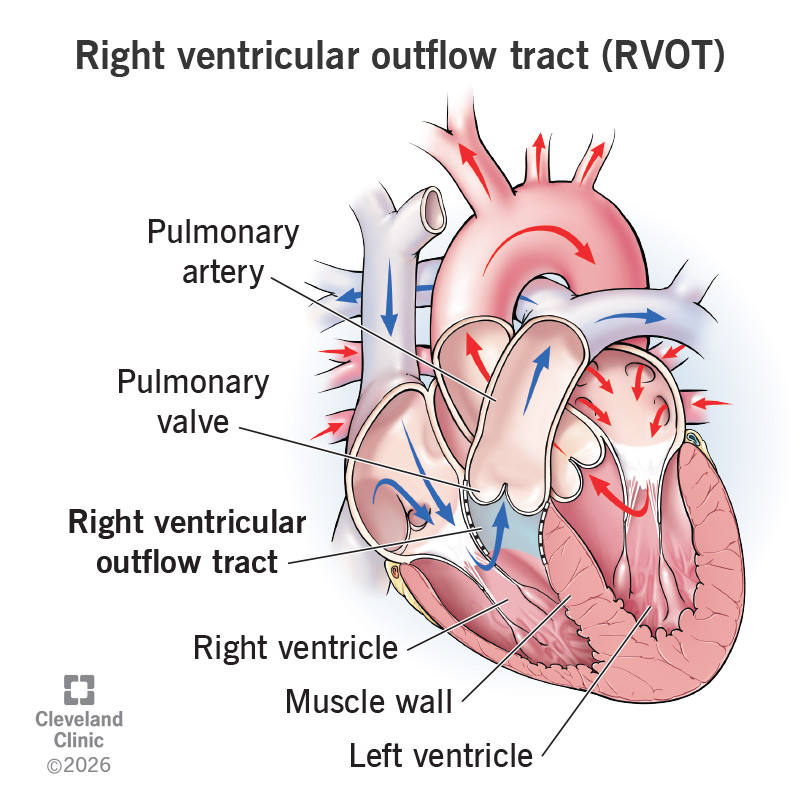
Image content: This image is available to view online.
View image online (https://my.clevelandclinic.org/-/scassets/images/org/health/articles/right-ventricular-outflow-tract-RVOT)
The right ventricular outflow tract (RVOT) is a part of the right ventricle in your heart. This heart chamber handles blood that comes back to your heart from other parts of your body. Your RVOT has a funnel shape and gets narrower as it gets closer to its connection with your main pulmonary artery.
Advertisement
Cleveland Clinic is a non-profit academic medical center. Advertising on our site helps support our mission. We do not endorse non-Cleveland Clinic products or services. Policy
The RVOT directs blood with low oxygen levels to your pulmonary artery. After blood leaves your heart’s right ventricle, it goes through your pulmonary valve and into the pulmonary arteries. These arteries take blood to your lungs to pick up oxygen.
Your right ventricular outflow tract supports your pulmonary valve’s leaflets. These leaflets attach to RVOT muscle. The leaflets open and close to let blood flow from your right ventricle to your pulmonary artery.
The RVOT is in your heart’s right ventricle. It starts at the bottom of the chamber and leads up into your pulmonary valve. A wall of muscle sets the right ventricular outflow tract apart from the left ventricle of your heart.
Part of the right ventricular outflow tract has a tube shape. Some describe it as a muscular sleeve. The walls of your RVOT are smooth, which helps blood move faster.
The whole RVOT is less than 30 millimeters (about 1 inch) wide and under 40 millimeters (about 1.5 inches) high. This is roughly the size of a 9-volt battery.
Conditions that affect your heart muscle and RVOT include:
Advertisement
Conditions you have at birth can affect your heart’s right ventricle. Often, a problem causes muscle in your right ventricle to enlarge from working too hard. Problems in this chamber also affect its outflow tract (RVOT). These conditions include:
A surgeon may need to reconstruct your RVOT after repairs due to certain heart issues present at birth. These include ToF, pulmonary atresia and DORV. They can cause problems that lead to the need for a new pulmonary valve later in life. This affects your RVOT because the pulmonary valve connects to it.
When your RVOT isn’t working well, you may have these symptoms:
You can help your heart work at its best by following these tips:
People don’t talk much about the heart’s right ventricle, let alone its outflow tract. But your RVOT is the pathway for blood to get to your lungs and pick up oxygen. That job matters, because every part of your body needs oxygen. If you have a condition that affects your RVOT, ask your healthcare provider what you need to know about it.
Advertisement



Sign up for our Health Essentials emails for expert guidance on nutrition, fitness, sleep, skin care and more.
Learn more about the Health Library and our editorial process.
Cleveland Clinic’s health articles are based on evidence-backed information and review by medical professionals to ensure accuracy, reliability and up-to-date clinical standards.
Cleveland Clinic’s health articles are based on evidence-backed information and review by medical professionals to ensure accuracy, reliability and up-to-date clinical standards.
When your heart needs some help, the cardiology experts at Cleveland Clinic are here for you. We diagnose and treat the full spectrum of cardiovascular diseases.
