



Spasticity is a symptom and characteristic of certain neurological conditions. It causes certain muscles to contract all at once. It ranges in severity and can affect movement and speech. There are several treatment options for spasticity, including physical therapy, medication and botulinum toxin injections.
Advertisement
Cleveland Clinic is a non-profit academic medical center. Advertising on our site helps support our mission. We do not endorse non-Cleveland Clinic products or services. Policy
Spasticity is a disruption in muscle movement patterns that causes certain muscles to contract all at once when you try to move or even at rest. The muscles remain contracted and resist being stretched. It interferes with movement and can also affect your speech and gait (walk).
Advertisement
Cleveland Clinic is a non-profit academic medical center. Advertising on our site helps support our mission. We do not endorse non-Cleveland Clinic products or services. Policy
Spasticity can vary greatly in how it affects someone — it may be as mild as the feeling of tightness of your muscles or may be so severe that it causes painful, uncontrollable stiffness and spasms of your extremities.
Spasticity can involve the following:
Muscle movements are normally controlled by a complex system that allows some of your muscles to contract (tighten) while others relax. Damage to nerves in your central nervous system (brain and spinal cord) can disrupt this pattern. As a result, many muscles may contract all at once (sometimes called co-contraction), which makes it difficult to perform voluntary movement.
Advertisement
Muscle rigidity and muscle spasticity are both hypertonic states (a state of abnormally high muscle tone), but they’re different.
Rigidity is most commonly associated with basal ganglia injuries, and it’s often seen with Parkinson’s disease. The basal ganglia is a group of structures linked to the thalamus in the base of your brain that are involved with coordination of movement.
Rigidity, unlike spasticity, affects all muscles surrounding a particular joint equally. In addition, with spasticity, more rapid movement triggers a stronger involuntary contraction or “catch” of the affected muscles. With rigidity, the increased muscle tone remains constant throughout the range of movement of the affected joint.
Complications of spasticity can vary. In a severe state, spasticity can interfere with daily function and cause extreme pain. It can also make it more difficult to perform hygiene tasks and basic care. This, in turn, can increase the risk of developing pressure injuries (bedsores), which can lead to infection and sepsis.
Left untreated, moderate to severe spasticity can also lead to:
Spasticity is usually caused by damage to nerve pathways within your brain or spinal cord that control movement and stretch reflexes.
Spasticity may occur due to several conditions, including:
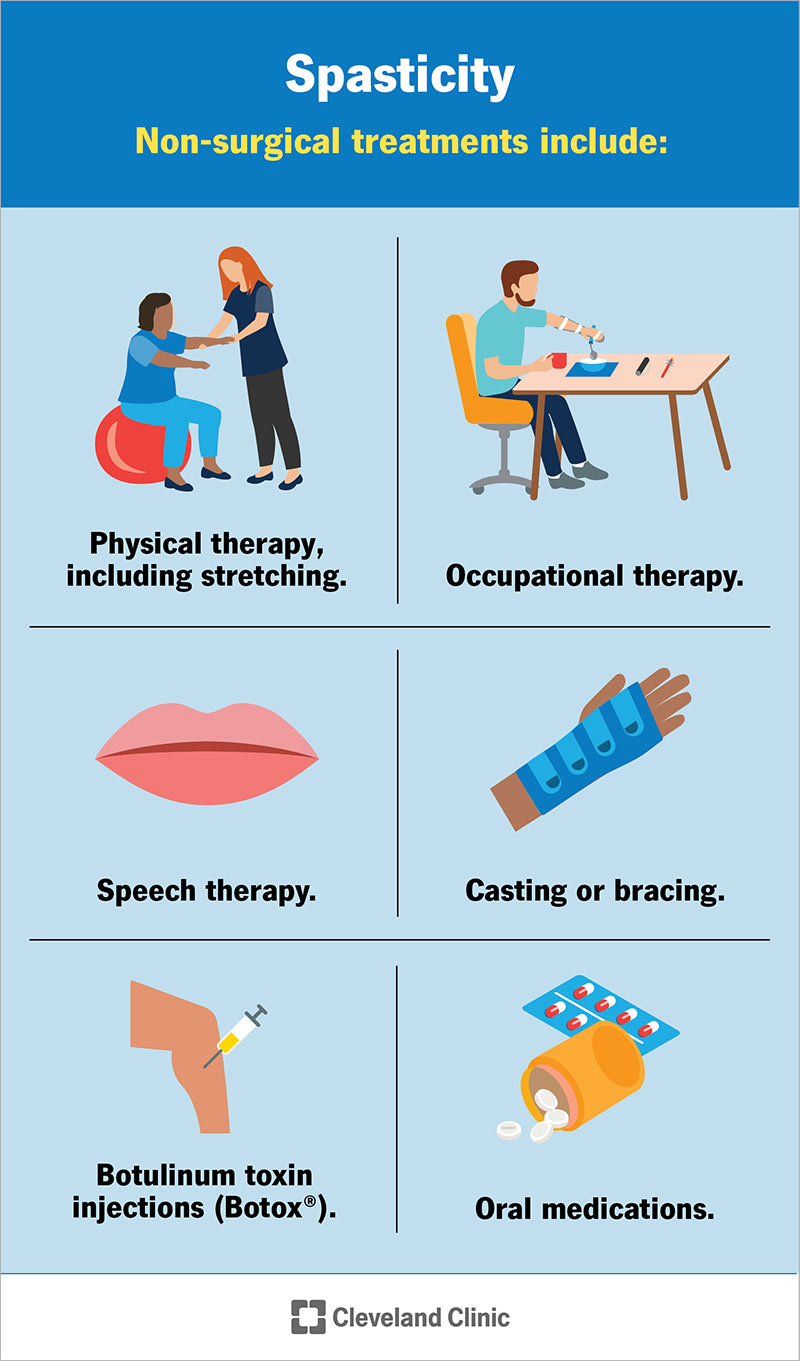
Image content: This image is available to view online.
View image online (https://my.clevelandclinic.org/-/scassets/images/org/health/articles/14346-spasticity)
There are several treatment options for spasticity. People who have spasticity usually undergo more than one treatment at a time. Though there’s no cure for spasticity, these treatments can help alleviate symptoms and improve quality of life.
The most effective way to treat spasticity is with a team of healthcare professionals with different specialties. Members of this team may include one or more of the following:
Nonsurgical treatments for spasticity include:
Advertisement
Healthcare providers typically prescribe oral medications in combination with other therapies. They usually only prescribe medications if your spasticity disrupts daily functioning or sleep. Common medications for spasticity include:
Oral medications for spasticity are often effective but may cause side effects such as drowsiness and weakness.
Local injections of botulinum toxin (Botox®) or phenol into spastic muscles can be very effective for treating spasticity. These shots can selectively reduce tone in muscles causing the most tightness or spasm.
During botulinum toxin injections, your provider injects the toxin into carefully selected sites in your muscle, causing spastic muscles to relax. This may improve comfort, positioning and function. The effects usually take seven to 10 days to become noticeable, and typically last around three months.
This therapy is usually a consideration when spasticity needs to be relieved in only a few muscle groups. It can be used in addition to other treatments for spasticity.
Healthcare providers typically only recommend surgical treatments for spasticity in severe cases. These types of treatment include:
Advertisement
It’s important to seek medical care if you experience spasticity for the first time with no known cause, since spasticity may be a sign of damage to your brain or spinal cord.
Advertisement
If you’ve been diagnosed with spasticity, see your healthcare provider if the spasticity is worsening and/or becoming more frequent or if it’s interfering with everyday tasks.
Spasticity is a common symptom and feature of several neurological conditions. The severity of spasticity can range from a minor inconvenience to a significant disruption of your day-to-day life. The good news is that there are several treatment options for spasticity. Together, you’ll work with your healthcare team to determine the best treatment plan for you.



Sign up for our Health Essentials emails for expert guidance on nutrition, fitness, sleep, skin care and more.
Learn more about the Health Library and our editorial process.
Cleveland Clinic’s health articles are based on evidence-backed information and review by medical professionals to ensure accuracy, reliability and up-to-date clinical standards.
Cleveland Clinic’s health articles are based on evidence-backed information and review by medical professionals to ensure accuracy, reliability and up-to-date clinical standards.
Spasticity causes your muscles to contract all at once, making daily tasks painful. Cleveland Clinic experts can help relieve the pain and get your muscles moving.
