



A central venous catheter is a tube a healthcare provider inserts into a vein in your chest, neck or arm. It leads to your superior vena cava, a big vein that sends blood into your heart. This device helps you receive treatments like chemo, antibiotics and blood transfusions for emergency or long-term care. PICC lines and ports are specific types.
Advertisement
Cleveland Clinic is a non-profit academic medical center. Advertising on our site helps support our mission. We do not endorse non-Cleveland Clinic products or services. Policy
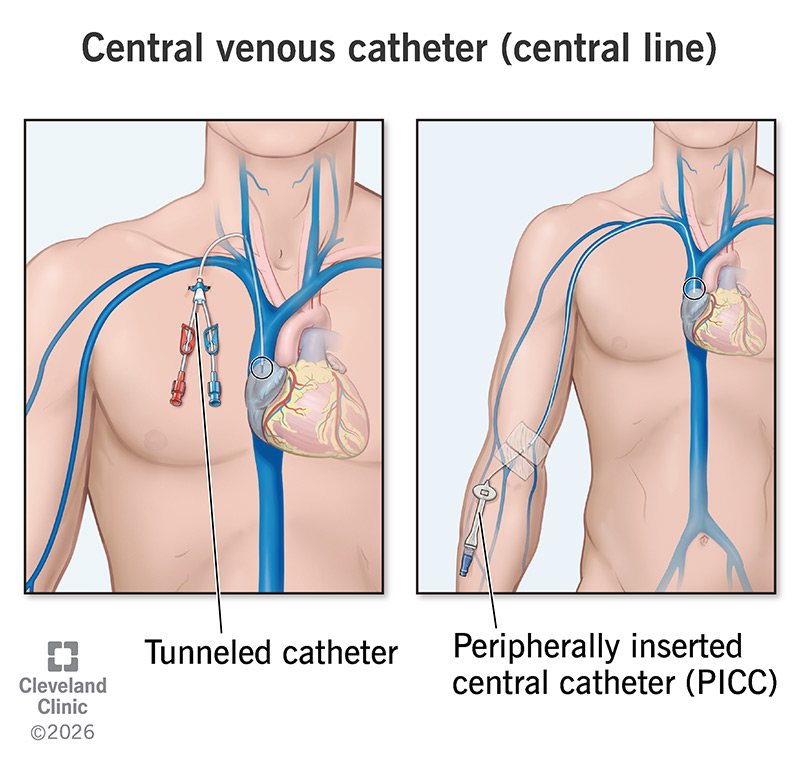
Image content: This image is available to view online.
View image online (https://my.clevelandclinic.org/-/scassets/images/org/health/articles/23927-central-venous-catheter)
A central venous catheter, also called a CVC or central line, is a long, flexible, plastic tube that sends medicines and other treatments into a large vein in the middle of your chest. It’s a type of intravenous (IV) line. But unlike peripheral IVs, which can only stay in place for a few days, a central line can remain for weeks, months or even years. Your healthcare provider places the central line during a minor procedure.
Advertisement
Cleveland Clinic is a non-profit academic medical center. Advertising on our site helps support our mission. We do not endorse non-Cleveland Clinic products or services. Policy
You may need a central line for:
Central lines are very common. Each year, healthcare providers around the world insert about 27 million of them.
Central venous catheters come in many forms. These include:
Advertisement
Healthcare providers also describe central lines by how many channels (lumens) it has. Each lumen is a thin tube that connects to the main tube in your vein. You might hear these called single, double or triple lumen catheters. With more than one lumen, your provider can give you multiple medications at the same time.
There’s not much you need to do to prepare for CVC placement. Your healthcare provider will review your health history and medications list to make sure a central line is appropriate and safe for you. They may also do blood tests and imaging tests to get information that helps with the procedure — like how well your blood clots, and the location of your veins.
Your provider will let you know if you need to fast (avoid all foods and drinks except water) before your procedure.
The exact details depend on the type of CVC you’re getting. In general, a healthcare provider will:
Central line placement usually takes about one hour. You can go home the same day unless you need to stay at the hospital for other reasons.
A central line has many advantages over a peripheral IV, including:
Possible CVC complications include:
Advertisement
Your healthcare provider will tell you when you can return home. They’ll also explain:
CVC removal is usually simpler and faster than placement. But you should never remove the catheter on your own. Only a healthcare provider can do this. For a PICC line, your provider will gently pull on the end of the catheter to remove it from your vein. For a port, a provider will make a small cut in your skin to remove the device.
Call your provider immediately if you have signs or symptoms of a central line infection. These include:
Also, call your provider right away if:
Your provider will tell you how often you need to come in so they can check on your central line.
Common access points for central line placement include your:
Advertisement
Rarely, healthcare providers use the femoral vein if no other insertion sites are available. But they avoid this, if possible, due to increased infection risk.
Your central line is like a lifeline. It gives you the treatments you need for as long as you need them. Still, it might take some getting used to — especially if you can see the catheter dangling from your skin.
If looking at the catheter makes you feel scared or anxious, try to replace those thoughts with a positive reminder. Tell yourself, “I am strong,” or “I am doing what I can to care for my body.” And remember that you’re not alone. Your healthcare provider will guide you through treatment and help you understand what comes next.
Advertisement



Sign up for our Health Essentials emails for expert guidance on nutrition, fitness, sleep, skin care and more.
Learn more about the Health Library and our editorial process.
Cleveland Clinic’s health articles are based on evidence-backed information and review by medical professionals to ensure accuracy, reliability and up-to-date clinical standards.
Cleveland Clinic’s health articles are based on evidence-backed information and review by medical professionals to ensure accuracy, reliability and up-to-date clinical standards.
Cleveland Clinic’s primary care providers offer lifelong medical care. From sinus infections and high blood pressure to preventive screening, we’re here for you.
