West Nile is a virus that spreads through mosquito bites. Most people infected with West Nile virus don’t have symptoms. About 1 in 5 people have symptoms like fever, rash and muscle aches. Rarely, West Nile can cause serious brain and spinal cord inflammation (encephalitis and meningitis).
Advertisement
Cleveland Clinic is a non-profit academic medical center. Advertising on our site helps support our mission. We do not endorse non-Cleveland Clinic products or services. Policy
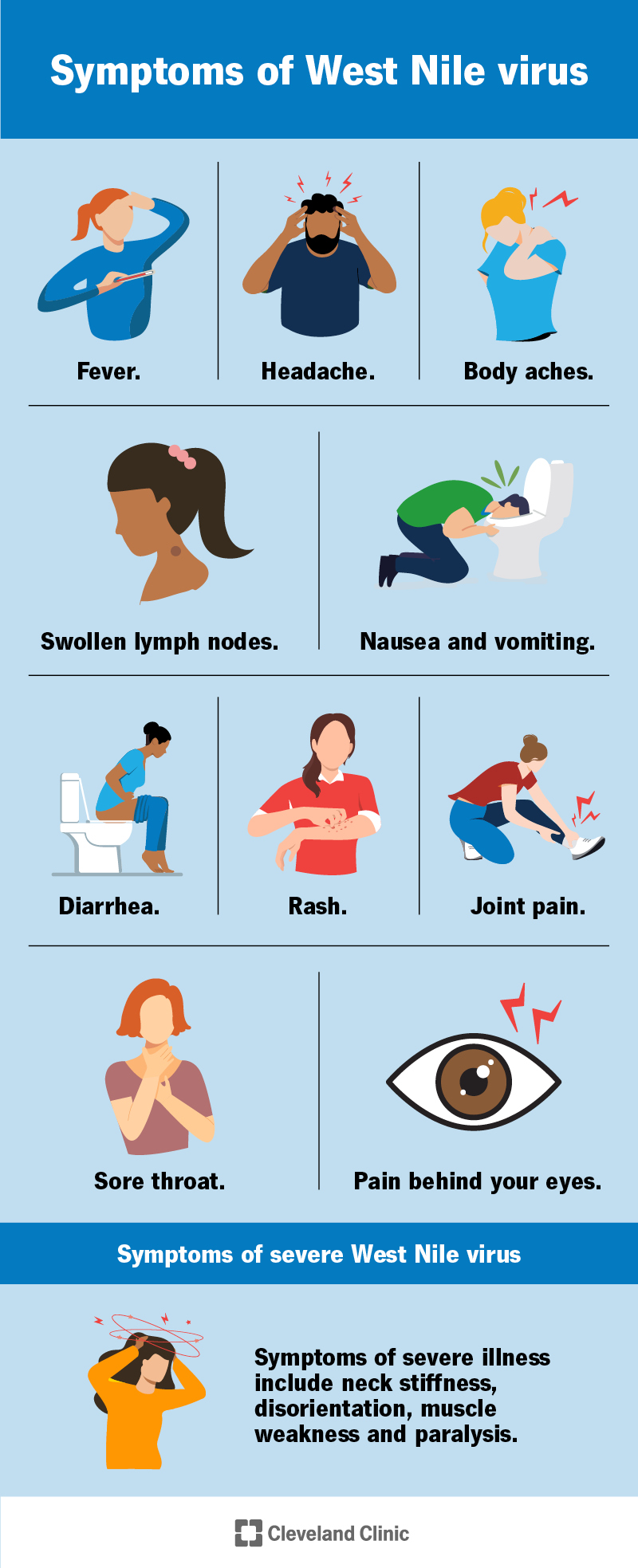
Image content: This image is available to view online.
View image online (https://my.clevelandclinic.org/-/scassets/images/org/health/articles/west-nile-virus)
West Nile is a virus that spreads through mosquito bites. Most people who get infected don’t have symptoms. But about 1 in 5 people have a fever, headache, body aches and other flu-like symptoms (sometimes called West Nile fever). Rarely, West Nile virus infects your nervous system and causes serious brain or spinal cord inflammation (encephalitis or meningitis).
Advertisement
Cleveland Clinic is a non-profit academic medical center. Advertising on our site helps support our mission. We do not endorse non-Cleveland Clinic products or services. Policy
West Nile is named after the West Nile district of Uganda, where it was first identified.
West Nile virus is found in many parts of the world, including North America, Europe, Africa, the Middle East, Australia and Asia. It’s the most common mosquito-transmitted virus in the U.S., with cases reported in 49 states. There have been over 51,000 symptomatic cases in the U.S. since the first cases in the country in 1999.
Symptoms of West Nile fever include:
Symptoms of more serious West Nile infections include:
West Nile is an arbovirus, or a virus you get from an arthropod (arthropods are a large group that includes insects). It’s an RNA virus in the genus Flavivirus. Similar viruses cause dengue fever, yellow fever and Zika.
Infected mosquitos transmit West Nile virus. They usually get the virus by biting an infected bird (there’s no evidence humans get it directly from birds). The virus multiplies inside the mosquito, and it’s transmitted to you (or another animal) when it bites you. The incubation period — how long before you have symptoms — is usually two to six days after getting bitten (but can be up to 14 days).
Advertisement
In a very few cases, West Nile virus has spread:
West Nile isn’t contagious. You can’t get it from another person who has it.
Mosquitos can bite anyone. But certain people are at a higher risk of getting severely ill if they get West Nile. You might be at a higher risk if you:
Less than 1% (about 1 in 150) of people infected with West Nile will get severe symptoms. The most common complication is swelling in part of your nervous system (your brain and spinal cord), including encephalitis and meningitis.
Long-term effects of a severe West Nile infection could include:
A provider can test your blood or cerebrospinal fluid (CSF) to look for antibodies or other signs of a West Nile virus infection. They usually only do these tests if you’re seriously ill. If you have signs of brain inflammation, they’ll get images of your brain with a CT scan (computed tomography scan) or MRI (magnetic resonance imaging).
There aren’t any antiviral medications that treat West Nile virus. You can treat mild symptoms at home with over-the-counter (OTC) medications like you’d take for a cold or flu.
If you have serious neurological symptoms, providers will monitor you at a hospital. They might treat your symptoms or try to reduce brain swelling with:
Yes, in most people, their immune systems eventually fight off West Nile virus. Flu-like symptoms usually go away on their own. But if you have a weakened immune system, it may be difficult to get rid of the viral infection. Nervous system damage from severe West Nile infections can be permanent, even after the virus goes away.
Mild symptoms of West Nile usually fully resolve in a few weeks. Sometimes, fatigue and muscle weakness can linger for months. After a nervous system infection, you may have long-lasting or permanent memory loss, hearing loss, balance or gait issues, and other neurological conditions.
West Nile is fatal in about 1 out of 10 people with nervous system infections (or about 1 in 1,500 people with West Nile).
Advertisement
There isn’t a vaccine to prevent West Nile virus. The best way to reduce your risk is to protect yourself from mosquito bites. Ways to do this include:
If you think you could have West Nile virus, talk to a healthcare provider. They can let you know:
Advertisement
Go to the emergency room if you have symptoms of severe illness, including:
It might be helpful to ask your healthcare provider:
Most of the time, mosquitos are just an obnoxious nuisance. But they sometimes carry viruses that can make you sick. Fortunately, 80% of people who have West Nile never develop symptoms. And most people’s risk of getting seriously ill is very low.
If you might be around mosquitos, you can take steps to protect yourself from their bites. If you do get bitten, see a healthcare provider if you develop symptoms of West Nile. They can help you understand what serious symptoms to look out for and answer any questions you have.
Advertisement



Sign up for our Health Essentials emails for expert guidance on nutrition, fitness, sleep, skin care and more.
Learn more about the Health Library and our editorial process.
Cleveland Clinic’s health articles are based on evidence-backed information and review by medical professionals to ensure accuracy, reliability and up-to-date clinical standards.
Cleveland Clinic’s health articles are based on evidence-backed information and review by medical professionals to ensure accuracy, reliability and up-to-date clinical standards.
Need care fast? Cleveland Clinic’s Express Care and Urgent Care locations treat everything from sprains to sinus infections — no appointment needed.