



Testicles, or testes, are part of the male reproductive system. They make sperm and hormones. They’re in your scrotum, outside of your body. If you have any pain or notice any changes to your testicles, reach out to your healthcare provider.
Advertisement
Cleveland Clinic is a non-profit academic medical center. Advertising on our site helps support our mission. We do not endorse non-Cleveland Clinic products or services. Policy
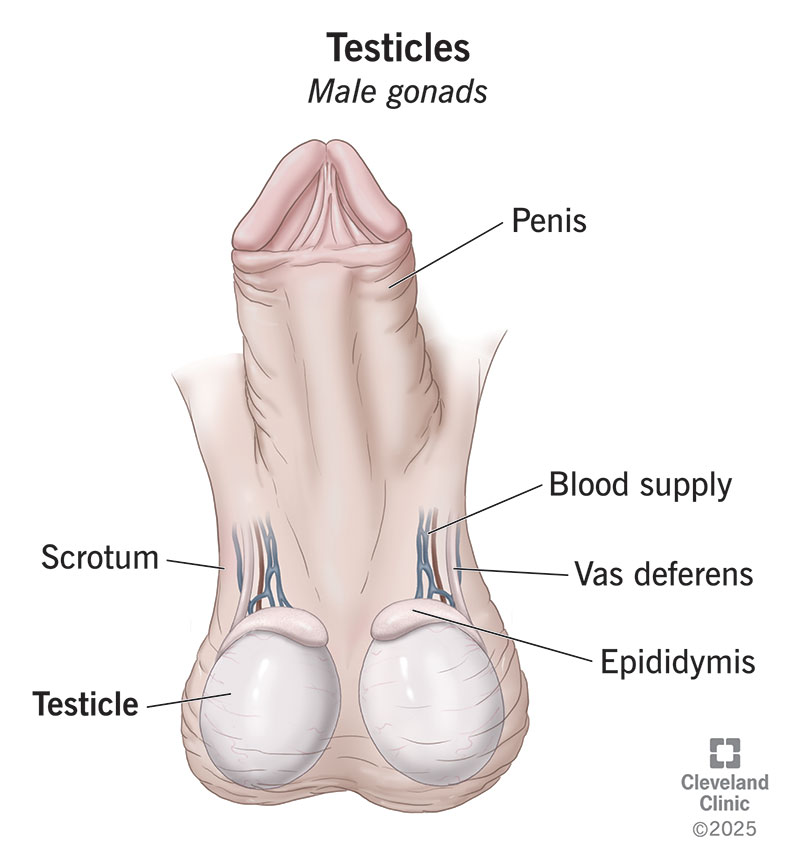
Image content: This image is available to view online.
View image online (https://my.clevelandclinic.org/-/scassets/Images/org/health/articles/23964-testicles.jpg)
Testicles are male sex organs that are usually in the thick pouch of skin under your penis (scrotum). As part of the male reproductive system, they make sperm and hormones. Most males have two testicles (TES-ti-kuhlz).
Advertisement
Cleveland Clinic is a non-profit academic medical center. Advertising on our site helps support our mission. We do not endorse non-Cleveland Clinic products or services. Policy
There are many different words for testicles. Healthcare providers may use the terms testes (singular “testis”) or gonads. But there are many slang terms for testicles, too. These include balls, cojones and nuts.
Your testicles make two important products. After puberty, they make sperm. Sperm are male reproductive cells. They also make testosterone. Testosterone is a hormone that helps cause many changes during puberty, including:
Your testes make hormones like testosterone in the Leydig cells (interstitial cells). Testes also make:
Your testicles are about 5 degrees Fahrenheit (3 degrees Celsius) lower than the rest of your body. This cooler temperature is better for making sperm (spermatogenesis). In each testicle, spermatogenesis happens in seminiferous tubules. Hormones (like testosterone and follicle-stimulating hormone) stimulate cells in your testicles to develop into sperm.
Advertisement
Your testicles are in a pouch of skin (scrotum) underneath your penis, between your legs. Most males have one testicle to the right and one to the left in the scrotum.
The parts of the testicle include:
You can’t see your testicles because they’re inside your scrotum. But you can see their outlines. You can also feel them. Some describe them as feeling like large olives, small eggs or walnuts.
There’s no exact size for testicles. They’re smaller at birth. They usually stay around the same size until around 8 years old. Then, they start to grow until they reach their adult size during puberty. An adult testicle may range from half an inch (15 mL) to 1.5 inches (35 mL) or more — the size of a bird egg to the size of a small chicken egg.
It’s normal for one of your testicles to be a little bigger than the other. One may hang a little lower, too.
Trauma is one of the most common conditions that can affect your testicles. There are no muscles or bones around your testicles to protect them. So, they’re vulnerable to injuries during falls, accidents or roughhousing.
Other conditions that can affect your testicles include:
Advertisement
Schedule an appointment with your healthcare provider if you have:
Testicular self-exams are a great way to learn how your testicles usually look and feel. It’s good practice to check your testicles once a month. If you notice any changes, schedule an appointment with your healthcare provider. It’s also a good idea to have your healthcare provider perform a physical exam of your testicles once a year.
You can also help protect your testicles by:
Advertisement
During ejaculation, sperm travel from your testicles to your epididymis. Your epididymis swells a little bit. Sperm then move through your vas deferens and then to your prostate. In your prostate, sperm mix with fluids to create semen. Your vas deferens then squeezes the semen toward the base of your penis. Muscles at the base of your penis contract and force semen out during ejaculation.
Yes, one testicle can produce enough sperm to get your partner pregnant. If healthcare providers must remove both testicles because of cancer or an injury, you may be able to bank your sperm. Sperm banking freezes your sperm so you can use it later to have biological children.
Your testicles are an important part of your body. They make sperm and hormones. You should familiarize yourself with how they look and feel when they’re healthy. Things like pain, lumps, scrotum discoloration, blood in your semen and trouble getting your partner pregnant can point to problems with your testicles. If you notice any changes, call a healthcare provider.
Advertisement



Sign up for our Health Essentials emails for expert guidance on nutrition, fitness, sleep, skin care and more.
Learn more about the Health Library and our editorial process.
Cleveland Clinic’s health articles are based on evidence-backed information and review by medical professionals to ensure accuracy, reliability and up-to-date clinical standards.
Cleveland Clinic’s health articles are based on evidence-backed information and review by medical professionals to ensure accuracy, reliability and up-to-date clinical standards.
Cleveland Clinic’s primary care providers offer lifelong medical care. From sinus infections and high blood pressure to preventive screening, we’re here for you.
