



Lung cancer happens when harmful cells in your lungs grow unchecked. This can damage your lungs and spread to other parts of your body. Symptoms include persistent cough, shortness of breath and unexplained weight loss. Symptoms often don’t appear until later stages. Smoking increases your risk. Screening is recommended if you’re at high risk.
Advertisement
Cleveland Clinic is a non-profit academic medical center. Advertising on our site helps support our mission. We do not endorse non-Cleveland Clinic products or services. Policy
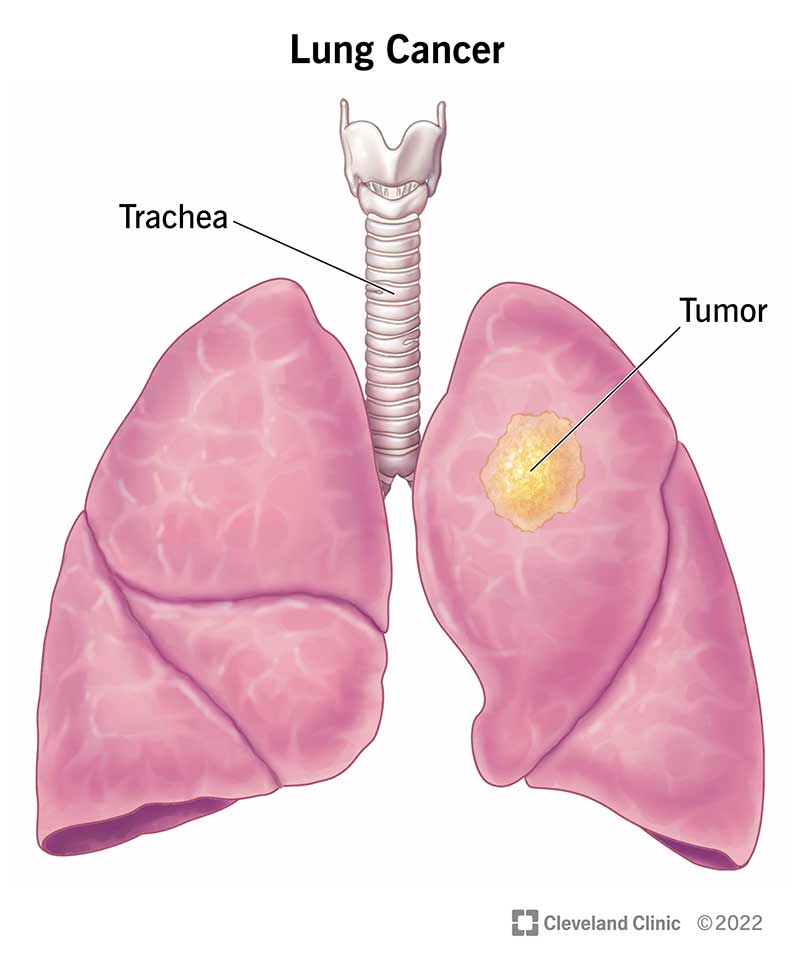
Image content: This image is available to view online.
View image online (https://my.clevelandclinic.org/-/scassets/images/org/health/articles/4375-lung-cancer)
Lung cancer is a disease that happens when cells in your lung tissue grow out of control and make tumors. Lung cancer starts in your airways or the small air sacs of your lungs (alveoli). It can damage your lungs and spread to other parts of your body (metastatic lung cancer). This can eventually lead to your organs not working properly.
Advertisement
Cleveland Clinic is a non-profit academic medical center. Advertising on our site helps support our mission. We do not endorse non-Cleveland Clinic products or services. Policy
Lung cancer usually doesn’t cause symptoms until it’s in an advanced stage. That’s why it’s important to get screened if you’re at higher risk. The most common symptoms are new or worsening cough, coughing up blood, shortness of breath, chest pain, hoarseness and unexplained weight loss.
Lung cancer is the third most common cancer in the U.S. It’s the No. 1 cause of cancer-related deaths in the U.S. and worldwide. Smoking is the main risk factor for developing lung cancer. It’s never too late to quit smoking, and quitting reduces your risk. Other risk factors include second-hand smoke, radon exposure and air pollution.
Types of lung cancer include:
Other types of cancer can start in or around your lungs, including lymphomas (cancer in your lymph nodes), sarcomas (cancer in your bones or soft tissue) and pleural mesothelioma (cancer in the lining of your lungs). These are treated differently and providers don’t usually call them lung cancer.
Advertisement
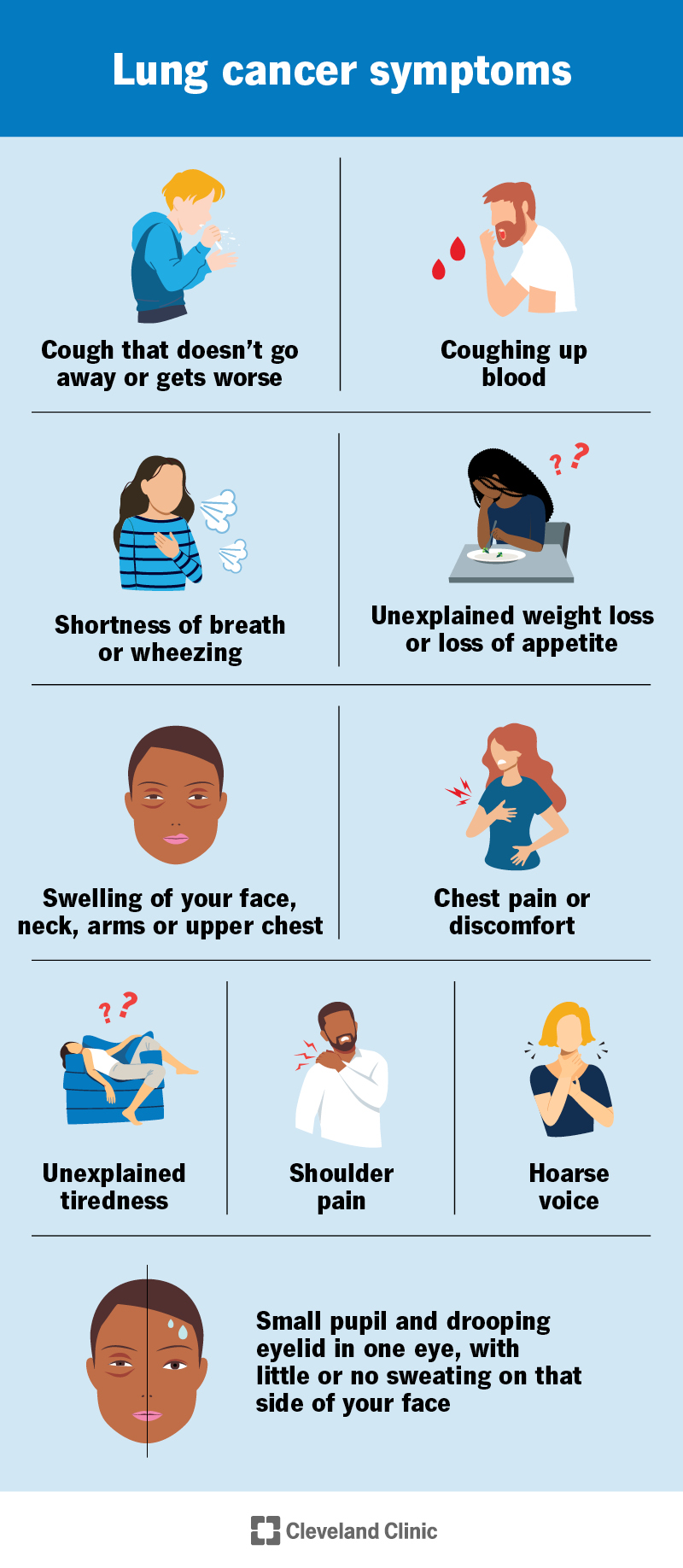
Image content: This image is available to view online.
View image online (https://my.clevelandclinic.org/-/scassets/images/org/health/articles/lung-cancer-symptoms)
Symptoms could include:
You won’t experience every symptom. Many symptoms of lung cancer can be caused by less serious illnesses, too. Only a healthcare provider can tell you for sure what’s causing these symptoms.
Lung cancer often doesn’t cause symptoms in early stages. A cough or pneumonia that keeps coming back after treatment can sometimes be an early sign of lung cancer. Check with your provider if you have concerning symptoms.
Lung cancer happens when cells keep dividing when they shouldn’t. Cell division is a normal process. But all cells have a built-in “off switch” that keeps them from growing unchecked or causes them to die off when necessary. When a cell has divided too many times or has too many changes (mutations), it triggers this off switch.
Cancer cells have changes that remove the off switch. Cells keep multiplying, unchecked, and interfere with your normal cells. Cancer cells can get into your lymph nodes or bloodstream and move to other places in your body, spreading the damage.
Smoking any kind of tobacco product, including cigarettes, cigars or pipes, is the biggest single risk factor for lung cancer. Experts estimate that 80% of lung cancer deaths are smoking-related. Vape liquids contain substances that can harm your lungs, but it’s unclear whether vaping increases your risk for cancer.
Other risk factors include:
Diagnosing lung cancer can be a multistep process. Your provider will start by examining you and asking about your symptoms. They may get blood tests and a chest X-ray. Then, you may have additional tests to rule out or diagnose cancer. These tests could include:
Advertisement
Your provider might let you know the cancer stage when you’re diagnosed. Staging is a shorthand way to know how advanced the cancer is. It’s usually based on the size of the initial tumor, how far or deep into the surrounding tissue it goes, and whether it’s spread to lymph nodes or other organs. This helps your provider determine treatment options and affects the outlook (prognosis).
The general staging for lung cancer is:
Limited vs. extensive stage
For treatment, you might also hear SCLC (small cell lung cancer) described as limited or extensive stage. This is based on whether the area can be treated with a single radiation field.
Advertisement
Treatments for lung cancer are designed to get rid of cancer in your body or slow down its growth. Your treatment will depend on the type of cancer you have, where it is, how far it’s spread and many other factors. In many cases, you’ll have a combination of two or more types of treatments that target cancer in different ways.
Options could include:
Advertisement
Some treatments can relieve symptoms instead of getting rid of the cancer. These include procedures to reduce or remove tumors that are blocking airways or to remove fluid from around your lungs.
See a healthcare provider if you have any symptoms that concern you, especially if they’ve gotten worse over time. A cough that won’t go away or shortness of breath are symptoms you shouldn’t ignore. If you smoke or used to smoke, ask your provider about screening for lung cancer.
What to expect after a lung cancer diagnosis depends on many factors. If caught early, a surgeon may be able to remove the tumor. You’ll need follow-up screenings for several years.
For cancer diagnosed in later stages, treatment can be a process that evolves over time. It may mean doing one type of treatment until it stops being effective, then moving on to another type.
Some types of lung cancer can be considered cured if diagnosed before they spread. But doctors don’t often use the word “cured” to describe cancer. More common terms are “remission” or “no evidence of disease” (NED). If you’re in remission or NED for five years or more, you might be considered cured. There’s always a small chance that cancer cells could come back.
Lung cancer is often diagnosed in later stages, when five-year survival rates are lowest. That’s why it’s important to see a provider for any symptoms and get screened before symptoms start if you’re at higher risk.
Experts aren’t sure why some people develop lung cancer while others don’t. So there’s no way to completely ensure you won’t get it. But some ways to reduce your risk include:
A lung cancer diagnosis can bring a flood of different emotions. Sometimes, the amount of new information can be overwhelming. It’s important to remember that statistics can’t tell you how your treatment will go or what decisions are right for your specific situation. Your healthcare provider is the best resource to know what to expect.
Enlisting the help of trusted loved ones or a support group can help you consider your options and voice your preferences. Cancer treatment is often a process, and taking care of yourself is one of its most critical parts.



Sign up for our Health Essentials emails for expert guidance on nutrition, fitness, sleep, skin care and more.
Learn more about the Health Library and our editorial process.
Cleveland Clinic’s health articles are based on evidence-backed information and review by medical professionals to ensure accuracy, reliability and up-to-date clinical standards.
Cleveland Clinic’s health articles are based on evidence-backed information and review by medical professionals to ensure accuracy, reliability and up-to-date clinical standards.
If you have lung cancer, you might feel alone and afraid. You don’t have to be. Cleveland Clinic is here to help find and treat your cancer at any stage.
