



Alopecia areata is an autoimmune disease that attacks your body’s hair follicles, causing patchy hair loss. Medications and therapies can help your hair regrow, though severe cases may not respond to treatment.
Advertisement
Cleveland Clinic is a non-profit academic medical center. Advertising on our site helps support our mission. We do not endorse non-Cleveland Clinic products or services. Policy
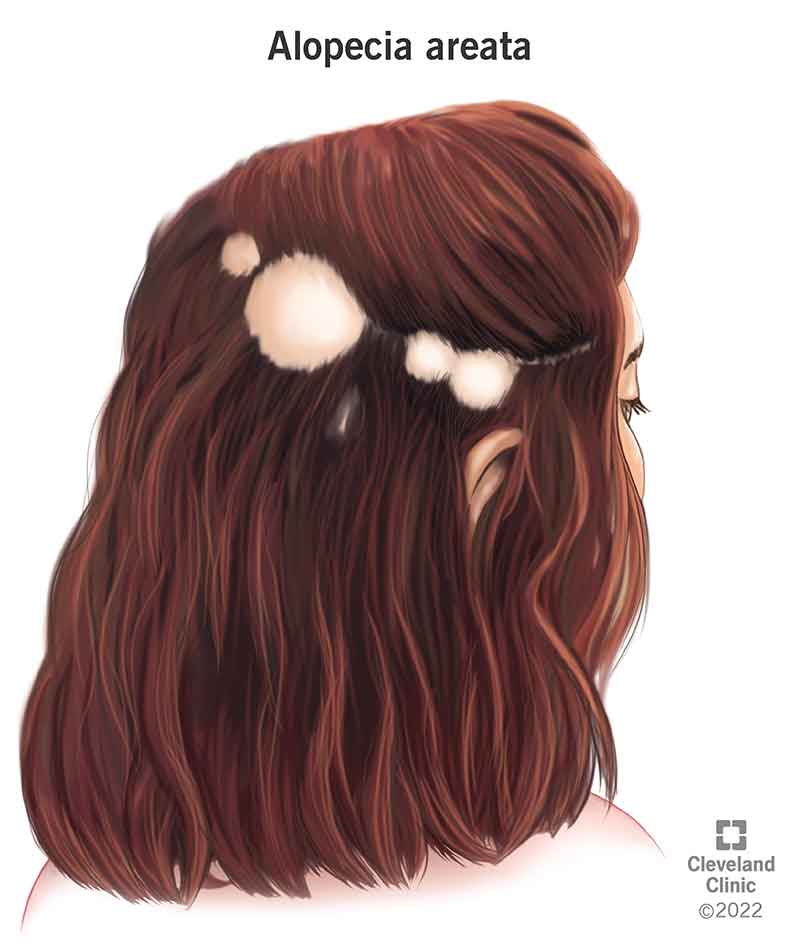
Image content: This image is available to view online.
View image online (https://my.clevelandclinic.org/-/scassets/images/org/health/articles/12423-alopecia-areata)
Alopecia areata is an autoimmune disease that causes patchy hair loss anywhere on your body, but it most commonly affects the hair on the skin that covers your head (scalp). “Alopecia” is a medical term for hair loss or baldness, and “areata” means that it occurs in small, random areas.
Advertisement
Cleveland Clinic is a non-profit academic medical center. Advertising on our site helps support our mission. We do not endorse non-Cleveland Clinic products or services. Policy
There are many different classifications of alopecia areata. The classifications depend on the amount of hair you’ve lost and where you’ve lost it on your body.
Anyone can develop alopecia areata. But your chances of having alopecia areata are greater if:
Alopecia areata is common. Nearly 7 million people in the United States have alopecia areata, and approximately 20% of cases involve children. Of people who have alopecia areata, 5% have alopecia areata totalis, and 1% have alopecia areata universalis.
It’s the second-most common form of hair loss, behind female pattern baldness and male pattern baldness.
Alopecia areata causes your hair to fall out in patches. The patches are usually small and round — about the size of a quarter — but the shape and amount of hair you lose may be bigger or smaller.
Advertisement
Your nails may also develop dents or pits (cupuliform depressions). They may make your nails feel coarse or gritty, like sandpaper.
Alopecia areata doesn’t typically affect your physical health. However, it can affect you psychosocially (how society and social groups affect your thoughts and emotions) and psychologically (how you think about yourself and your behavior). You may experience stress, anxiety and depression.
Common symptoms of alopecia areata include:
Your patches won’t typically have any other symptoms, but in rare cases, they may:
Alopecia areata is an autoimmune disease that causes your immune system to attack your body. Your immune system attacks your hair follicles because it thinks they’re foreign invaders — bacteria, viruses, parasites or fungi — that cause infection, illness and disease.
When this happens, your hair begins to fall out, often in clumps the size and shape of a quarter. The extent of the hair loss varies. In some cases, it’s only in a few spots. In others, the hair loss may be more significant, including total hair loss.
Your genetic makeup (the parts of your cells that determine your physical traits, like eye color, height or hair color) may trigger your body’s autoimmune reaction. Or your genetic makeup combined with a virus or another substance you encounter may trigger the reaction.
No, alopecia areata isn’t contagious. You can’t spread alopecia areata through skin-to-skin contact or airborne particles.
Your healthcare provider can usually diagnose alopecia areata through a physical exam. They’ll ask about your medical history, including when you started noticing hair loss and whether you have a family history of alopecia areata or autoimmune disorders. They may also examine your nails.
If your healthcare provider can’t make a diagnosis after a physical examination of your bald spots, they may:
Advertisement
Video content: This video is available to watch online.
View video online (https://cdnapisec.kaltura.com/p/2207941/sp/220794100/playManifest/entryId/1_tsruhybu/flavorId/1_5f3sgelj/format/url/protocol/https/a.mp4)
Approved treatments for alopecia areata may help you minimize symptoms, but they’re not a permanent solution.
No, alopecia areata doesn’t go away. Medications and other treatments help manage your hair loss, but they won’t cure the disease. Alopecia areata totalis and alopecia areata universalis are more severe and less likely to respond to treatment.
Treatment options include:
Advertisement
Alopecia areata can be unpredictable. In some people, their hair grows back but falls out again later. In others, their hair grows back and never falls out again. Each case of alopecia areata is unique. Even if someone loses all of their hair, there’s a chance that it’ll grow back. Depending on your therapy and its effectiveness, you may see new hair growth between four and 12 weeks after starting.
In mild cases of alopecia areata, you may have flare-ups and times when symptoms go away (remission). Alopecia areata totalis and alopecia areata universalis are more severe, and your body is less likely to respond to treatment options.
There isn’t any way to prevent alopecia areata. Treatments can reduce your symptoms. If you have alopecia areata, it may come and go throughout your life.
There are various cosmetic and protective techniques that people with alopecia areata can use to take care of themselves, including:
Advertisement
Call a healthcare provider as soon as you notice hair loss. After you start treatment, contact your healthcare provider if:
It can be alarming to notice hair loss. Alopecia areata is a common condition that causes hair loss anywhere on your body, but it usually affects your scalp. Everyone loses hair when they shampoo or brush, it’s part of the hair growth process. But if you have alopecia areata, you might notice more hair loss than usual. Or you might not notice until you see patchy baldness. Reach out to your healthcare provider as soon as you notice hair loss, especially if it causes stress, anxiety or depression.



Sign up for our Health Essentials emails for expert guidance on nutrition, fitness, sleep, skin care and more.
Learn more about the Health Library and our editorial process.
Cleveland Clinic’s health articles are based on evidence-backed information and review by medical professionals to ensure accuracy, reliability and up-to-date clinical standards.
Cleveland Clinic’s health articles are based on evidence-backed information and review by medical professionals to ensure accuracy, reliability and up-to-date clinical standards.
Losing your hair can be shocking and overwhelming. At Cleveland Clinic, we’ll find the right treatment to help you feel (and look) like yourself again.
