



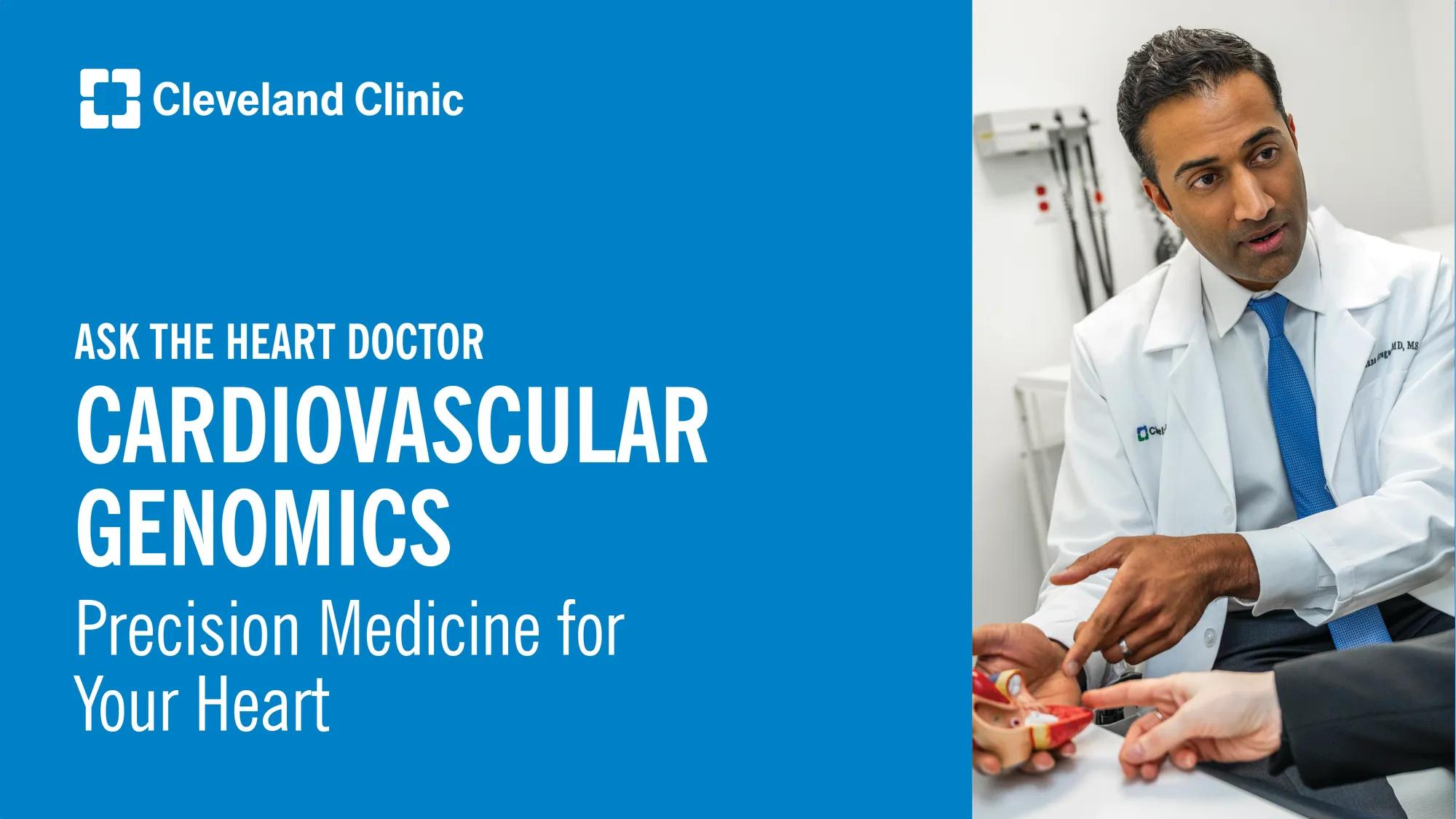
Ask the Heart Doctor | Genomics: Precision Medicine for Your Heart
In this Ask the Heart Doctor discussion, Cleveland Clinic experts explain cardiovascular genomics and how genetic testing can help identify inherited risks for conditions involving the heart muscle, heart rhythm, aorta and cholesterol. They discuss who may benefit from testing, what the process involves, how results can guide monitoring and treatment and why findings may matter for your family members, too.
Schedule an appointment at Cleveland Clinic by calling 844.868.4339.
Meet the panelists:
Krishna Aragam, MD
Wilson Tang, MD
Vidyasagar Kalahasti, MD
Milind Desai, MD, MBA
Advertisement
Cleveland Clinic is a non-profit academic medical center. Advertising on our site helps support our mission. We do not endorse non-Cleveland Clinic products or services. Policy
Recent Episodes
Ask the Heart Doctor | Heart Failure: Surgical Options and Mechanical Support
Heart failure affects millions of people and can range from mild symptoms to advanced disease. In this episode, discuss how heart failure is…
Quick Questions: Mitral Valve Prolapse
Marc Gillinov, MD, explains what mitral valve prolapse is and how it is diagnosed. He also discusses when mitral valve prolapse can lead to…
New Approaches to Treating Aortic Arch Disease
Eric Roselli, MD, and Patrick Vargo, MD, discuss aortic arch aneurysms and dissections, and explain why early diagnosis and ongoing monitori…
Video content: This video is available to watch online.
View video online (https://cdnapisec.kaltura.com/p/2207941/sp/220794100/playManifest/entryId/1_s1r8caf3/flavorId/1_5f3sgelj/format/url/protocol/https/a.mp4)
Transcript
Announcer:
Welcome to Love Your Heart, brought to you by Cleveland Clinic's Sydell and Arnold Miller Family Heart, Vascular & Thoracic Institute. This podcast will explore disease prevention, testing, medical and surgical treatments, new innovations and more. Enjoy.
Advertisement
Cleveland Clinic is a non-profit academic medical center. Advertising on our site helps support our mission. We do not endorse non-Cleveland Clinic products or services. Policy
Dr. Krishna Aragam:
I want to welcome all of you to another session of Ask the Heart Doctor, where we'll talk about inherited DNA changes, how they affect heart health, when it makes sense to pursue genetic testing, and what we do with that information with regards to management of patients.
My name is Krishna Aragam. I'm the section head for our new section of Cardiovascular Genomics and Precision Medicine here at Cleveland Clinic. I'm joined by three of my esteemed colleagues and experts in cardiovascular genomics, as well. I'll let them introduce themselves.
Dr. Wilson Tang:
Hi, my name is Wilson Tang. I'm a heart failure transplant cardiologist here at Cleveland Clinic.
Dr. Vidyasagar Kalahasti:
I'm Sagar Kalahasti. I'm the Director of the Marfan and Other Vascular Connective Tissue Disorders Clinic in the Aorta Center.
Dr. Milind Desai:
Hi, I'm Milind Desai. I'm Vice Chair for HVTI. I direct our HCM Center, and I'm also the medical director of the Aorta Center. It's great to be here.
Dr. Krishna Aragam:
Great. We have a list of questions. I think these are all fairly commonly asked questions, and we'll make our way through all of them and talk in a bit of a round table format. The first question is a broad one, which is quite simply, what is cardiovascular genomics? I'll start with that, which is to say, that broadly speaking, the field, the discipline of cardiovascular genomics involves the study and practice of looking at, again, changes and differences in our DNA and how that affects the development of diseases of the heart and blood vessels.
Advertisement
Oftentimes, the terms genetics and genomics can be used interchangeably. Oftentimes, we'll think about genetics as involving particular individual genes, whereas genomics then encompasses the entire genome and its interplay with other environmental and clinical factors.
So, when we talk about cardiovascular genomics, we're talking about combining and leveraging the information from one's genome and the DNA differences to understand about risks of heart disease, as well as, then, what can be done about those risks.
The next question is then, what particular heart conditions as we know of them today, are most strongly linked to cardiovascular genetics? I will turn to Dr. Tang for maybe some insights on this.
Dr. Wilson Tang:
The majority of heart disease may have a familial component, although there are basically right now four main categories that we actually see. One is actually related to heart and muscle. We call it cardiomyopathy. It could be a thick heart, a thin heart, or a heart that has the right side being abnormal. Those are probably one of the more common diseases that we actually test for genetics.
The other type is a type with rhythm problems, particularly rhythm problems that cause sudden cardiac arrest. Those may or may not actually be related to the heart and muscle disorder, but certainly different types of ion channel disorders we could see.
The other two, obviously Dr. Kalahasti has the expertise on aorta, aortic disease is something that is also very common, Marfan syndrome or other conditions that lead to aortopathies. The last version is really cholesterol. Familial cholesterol diseases are actually quite common and is actually something that we also have a lot of treatment for.
Now, there are other diseases that are also run in families, like atrial fibrillation or some valvular diseases, although that actually doesn't have any commercial panel testing right now. But there are certainly many genes that have been associated with their development.
Dr. Krishna Aragam:
Thanks, Wilson. I might just say that, as mentioned, these are the main areas that we know of today, but as you alluded to, there's a lot more coming down the pike. Part of the reason to be prepared for this now is so that we're set up to do what's coming to us soon in a more ready fashion.
Dr. Wilson Tang:
There are certainly other types of diseases, like congenital heart diseases, that have got very specific variations of their genes that many of them are still under investigation.
Dr. Krishna Aragam:
That's great. One of the things that comes up oftentimes when a patient first comes to us with a concern for a genetic problem or familial condition, is that we're often trying to tease apart how much of that person's history and risk for heart disease is truly genetic, due to shared genetics versus say, shared lifestyle. Sagar, do you want to maybe comment on in general how do we think of heart disease in terms of genetic versus lifestyle components?
Advertisement
Dr. Vidyasagar Kalahasti:
I think we can, as Dr. Tang mentioned about the different big groups of diseases, and I'm sure that a large component is genetic, but I think how those genes interact with the environment, lifestyle, what we do to our bodies, I think it probably manifests itself as the disease process.
I can speak very specifically about the aorta, for instance. I always tell this to my patients. All aneurysms are considered genetic until proven otherwise. We say there are a lot of associated factors that lead to aneurysms, like high blood pressure. But there are millions of people with high blood pressure, and not all those millions are getting aortic enlargement. There must be some predisposition from a patient standpoint, which is most likely genetic, that leads them to express that disease. We are still discovering a lot more new genes as we expand our panels of testing. I think that's probably one of the best ways I can say that genetics has definitely a huge role to play. We look at family histories, it just gives you a lot more idea from that.
Dr. Krishna Aragam:
Yeah. Just the idea that it's not dichotomous, typically. It's usually multifactorial, and it's maybe proportionally a little bit more this versus that in some individuals.
Advertisement
When we usually go through that process of trying to identify what those factors are and if we're coming down on the conclusion that likely this is more genetic, we end up thinking about pursuing genetic testing. When we're making that decision, Milind, I might just ask you, who should be considered for genetic testing and how do different factors like age, family history and otherwise play a role?
Dr. Milind Desai:
I think that's an important question. We cannot go around testing everybody for a genetic mutation, all eight billion of us. We have to hone down on the target rich environment, for the lack of a better term.
The simplest is first degree relatives of patients who are affected with some of these genetic disorders that Dr. Tang and Dr. Kalahasti talked about.
We start there, and then go down in a cascade format of screening additional family members. The other group important is often some of these genetically mediated conditions come, you might be the first index patient that it comes to light. There may be something called a de novo mutation in you, where you are the torchbearer of that mutation. Under that circumstance, then we start with you, and again, then go into the cascade testing with first degree relatives.
Advertisement
The third scenario, obviously was mentioned, is congenital heart disease. There may not be a specific genetic mutation, but there may be some abnormalities in some chromosomes, et cetera that result in a specific type of syndrome, for example, Down syndrome, something like that. These are the scenarios where I would consider genetic testing. Which patients should we be doing this on or at what age? I think the moment you suspect it, I think you should.
I always discuss this at first contact with the patients. Should this be offered in a pediatric population? Absolutely. When you come into interaction with the patient that you suspect has a genetic mutation is when you do it. But suffice to say, family history is crucial in that.
Dr. Wilson Tang:
I want to add that we usually start with the one who is most affected.
Dr. Milind Desai:
Yes, absolutely.
Dr. Wilson Tang:
Because again, if we just test anybody, some variation comes up, we actually don't know for sure whether that is something related to the condition or not. We usually go by what we call phenotype first, which is if you've got a sick heart, like Dr. Desai's clinic in hypertrophic cardiomyopathy, then you actually test the person who gets affected first, and then the cascade testing occurs.
Dr. Krishna Aragam:
I think it brings up a good point that multiple things, one that, again, we're oftentimes calculating in our own mind what is the probability that this person has a genetically determined component of their disease through things like, well, if they're younger, it is more likely. Not that it can't present later, and we pick it up then. If there are more family members, it's more likely. If it's more severe, more likely.
We're just tabulating that internally and saying, "Okay, this has reached a threshold, where I think it's worth testing for."
Dr. Wilson Tang:
Well, the problem is, the more we learn with the more we're testing. I mean, you and I in the meeting last week, there were actually presentations about people with coronary disease who ended up having a heart muscle gene. We actually often attribute that to coronary disease, but it turns out many people do harbor an underlying susceptibility of the genetic predetermination that actually is there, but because we thought that was something else, we ended up missing them. We have actually been broader in terms of our thoughts about screening for people we're suspecting. I think what Dr. Desai was saying, we almost always have a level of suspicion.
Dr. Krishna Aragam:
Yeah.
Dr. Vidyasagar Kalahasti:
So also the genetic testing itself has changed over several decades now. A lot of patients, just by their physical appearance, have been told they have one condition. Later on, when they were genetically tested, it turned out to be completely different. It has significant implications for their own children's management and what is going to be in the rest of the family. That's another important aspect to keep in mind, that genetic testing constantly is evolving and we always have to try to change that.
Milind Desai, MD:
That's an important point because if I see a new patient today and we discuss genetic testing and they do undergo genetic testing, which is at this point in time negative, what I tell them is, "The story is not over. Let's revisit in three to five years, because every day there are newer variants identified."
What was once considered a bane of our existence, a variant of uncertain significance, now becomes a variant of significance, because enough patients have been identified with that variation. It's not a one-off; it is an evolving discussion.
But the flip side, I got to bring the contrarian piece also. Let's say, HCM, hypertrophic cardiomyopathy, it's a very well-studied genetically mediated disorder. If you take a hundred patients that, on imaging, look like HCM and do genetic testing in all of them, no more than 40% are gene positive. In aortopathy, no more than 10 or 15% are positive today. That evolution always has to be kept in mind. That’s why the discussion that we had a few minutes ago is enriching the population to optimize and maximize the yield of a genetic positive test.
A few diseases have specific risk scores developed where you can, if you meet certain criteria and if your risk score is beyond a certain amount, then your likelihood of a positive genetic mutation goes up significantly compared to a lower number. This is a nuanced and evolving science.
Wilson Tang, MD:
Those risk scores are very common. They're all younger people with different onset, family history, various manifestations, like rhythm problems. They are actually pretty much very similar across. These are the risk factors of people who have genetic heart disease.
Milind Desai, MD:
Most of them are common sense risk factors. That's the way I look at it.
Wilson Tang, MD:
Most people have not really written on their forehead, "I have this condition." Dr. Kalahasti and I have several patients that sometimes also struggle with it. They have a gene, and then they have a manifestation, and we have to have a conversation. This is one of the joys of working here, that there are multidisciplinary discussions, and our genetic counselors are definitely crucial in trying to get the input on what the information in the literature and their experience are like in terms of taking care of these and diagnosing these diseases.
Krishna Aragam, MD:
Yeah, these are all incredibly important points and incredibly interesting. A couple of things that I'll highlight that were just said now, just because I think they warrant even more attention. As you said, Dr. Tang, there's the notion that while there are multiple risk scores that have common factors, one that requires, in particular, clinical judgment, then when evaluating what our level of suspicion is, it is, as you mentioned, again, coronary disease with cardiomyopathy mutation. We have to be aware of when the disease that's before us is out of proportion to the other risk factors.
Lots of times we think about when other risk factors are not present as maybe this is genetic, it's happened at a young age, but lots of times what's hiding for us is we've misattributed something to something else, to another risk factor, because it's present, it's known to be linked, but it's actually that plus a genetic susceptibility and it's important to uncover it then. That's an important part.
Then, as Dr. Desai mentioned, the testing is changing. What I'll emphasize there is that that puts all the more importance on us finding the people that just need genetic testing in general. Our job is to identify who we think warrants testing, and then make sure we shepherd them through the process, which is now and then thereafter, the follow-up going forward. All great.
With regard to genetic testing as it generally stands today, what does the testing process look like is one question. Dr. Tang, do you want to take first comment on the logistics?
Wilson Tang, MD:
Usually, what we do is, we first explain to the patient the rationale of doing it, explaining that this could run in families and your family members may also be affected. We actually need to identify them sooner, as well as to understand the natural history of the condition that we are treating. Usually, we'll actually refer to a genetic counselor, where they would actually have a more detailed three generation family history collection, trying to understand who is having what conditions. Sometimes that uncovers a lot of family history that potentially also is very helpful, both in terms of the decision of whether to actually test, but also to follow up on the family members in terms of those at risk.
Clinical screening is always very helpful and necessary to make sure that we actually have information about different individuals. But then once we decided that the genetic testing is deemed relevant and also if the patient is agreeable to it, then there are basically two ways. One is a blood draw where they get the cells of the blood to derive the DNA from and to get the testing. The other way is to swab the cheek to have cells that are from the inside of the cheeks to extract the DNA from. In both cases, the cells will be, in our case, in our group here, we send it to a lab to get tested, and then usually in a few weeks' time, they're going to come back with the results.
Now, when we talk about genetic testing, right now the majority are still under panel testing, meaning that we have well known proteins that we know that they're affecting certain diseases. We do not look at your ancestry, we do not look at other things that are related, whether you have problems with eating certain food. We mainly look at the proteins that are related to heart conditions. Certainly, there is a capacity for them to look at other things. Most of the testing companies now actually test for everything and then cover everything and just look at the area.
So, sometimes when we have multiple problems, like there's also an aorta problem, we can also call the company, and they're going to look at the other genes too. But in terms of reporting, they only report to us the ones that we ask for, which is the condition of interest. That process basically goes through with the counselor then receiving the information, and then conveying the message with the post-test counseling to basically explain to the patient what we have found, what is the implication, and actually try to answer the questions thereof, and also get information to try and reach out to other members of the family who may be at risk.
Krishna Aragam, MD:
So, it's a very thorough process where we're doing pretest counseling to explain why genetics is a bit different from other types of testing, the testing process itself, what's reported out, and then that needs to be narrated back to people.
Wilson Tang, MD:
This is actually very important, because unlike any other test, this information is critical for people to understand. It doesn't only affect the patient themselves, but also potentially their relatives. Also many implications of the findings they need to understand thoroughly.
Krishna Aragam, MD:
Yeah, absolutely. You mentioned both parts. It affects the patient themselves and their family. We'll get to each one. The first one is for those who are then deemed to be at higher genetic risk based on the test result, whatever it's showing. What are we doing about it? That's always the big question. There are various ways that we can be thinking about it with regard to surveillance, with regard to changes in medication, or sometimes even procedures. I think maybe we should go around and just talk about, broadly speaking, across different conditions. Maybe Dr. Desai, you first. Across HCM and other entities, management considerations that are affected by high genetic risk and how to modulate that risk.
Milind Desai, MD:
Right now, the business of managing patients with HCM based on their genetic profile is still an evolving science. Our clinical recommendation is still dependent upon symptoms and their imaging findings. How severe are they? Are we going to recommend continued surveillance? Are we going to recommend medications? Are we going to recommend surgery or alcohol septal ablation? Are we going to recommend defibrillator for risk of sudden cardiac death? At this point of time, that is a clinical decision making process. But there is emerging and evolving science. Particularly, I'd like to highlight something called the SHaRe registry, which is demonstrating that there may be some story behind a particular set of genetic mutations that would result in a potentially higher risk. That is still not endorsed by guidelines, so I would be careful about that.
The other important thing is, and we will talk about it in a few minutes, is that if you know your genetic mutation, there's evolving treatments targeted for that specific mutation, where we are injecting adenovirus or we are maybe doing CRISPR-based editing to specifically talk about precision medicine at its most precise. That's where we are rapidly evolving towards. I'd like to have Sagar talk about how we leverage genetic mutation in aortopathies, because there we definitely make decisions based on that.
Vidyasagar Kalahasti, MD:
Yeah, definitely. Between the Marfans and the other vascular connective tissue disorders, such as Loeys-Dietz syndrome or vascular EDS, or the smooth muscle cell genetic disorders such as ACTA2 mutation-related or MYH11 or MYLK, the genetic mutation really helps with regard to thresholds, from a surgical intervention threshold, from a family screening threshold, and who should be screened and imaging. It plays a humongous role. There's a lot of value to the genetic testing. Going back to the previous point about retesting, it can sometimes unmask some of these things that we may have missed the first time. But from a treatment standpoint, the genetic testing has huge implications with regards to timing of surgery.
What we don't have yet, as Dr. Desai mentioned, is the specific CRISPR-type technology with regard to aortopathy. We haven't come that far yet to understand our gene therapy for any of these vascular aortopathy diseases yet. But surgical treatments, yes, we definitely use the genetic information to time what size of the aorta that we typically intervene on. Of course, family histories also plays a very important role there. Sometimes the thresholds are thresholds based on guidelines, but sometimes you have to take what size did the family member suffer a dissection. We use that information on top of what the genetic mutation is to time our intervention.
Milind Desai, MD:
Let me add to that. Especially, I feel strongly about the aortopathy population, where the likelihood is 85 to 90% we may not find a mutation. Especially in the thoracic aortopathy scenarios, a lot of them, we seem to think it is familial with or without a known genetic mutation. There is again, rapidly evolving science. We authored two papers that have just been published, which have shown clearly the guidelines that recommend the size thresholds, they need to be revisited.
I think there's emerging data that suggests that the thresholds at which we should be recommending preemptive operations, especially at high volume experienced centers, need to be lower than what the guidelines recommend. We have to take other size, patient body habitus type things into consideration. Again, if you have a known genetically mutant aortopathy patient, yes, the guidelines are fairly clear there, but there's a huge chunk where we do not have a specific genetic mutation.
Vidyasagar Kalahasti, MD:
Yeah, just to add to that, some of the other work which we've done is looking at the effect of gender, effect of sex on the outcomes too. That's one more piece that we should keep in mind apart from the genetic testing itself.
Milind Desai, MD:
So, imaging is absolutely crucial in this population.
Krishna Aragam, MD:
Yeah. Other cardiomyopathies in other areas?
Wilson Tang, MD:
So, in dilated and arrhythmogenic cardiomyopathy, we also have guideline-directed gene-positive versus gene-negative indications. In general, defibrillator consideration, as well as rhythm management, is certainly a lot more intensive and aggressive. Even if they have just some mild dysfunction, they're actually indicated for those who have what we call a malignant gene, some genetic variants that are potentially more likely to have ventricular tachyarrhythmia as such.
Other conditions that may be more prone to atrial fibrillation, we will have a lot more close surveillance, because certainly the risk of stroke and downstream consequences is important. Most of the time, actually understanding the different types of genetic variant help us to understand the expected natural history of the disease. Some are actually much more progressive, much more early disease progression when we actually start to follow them over time, and for things that we need to anticipate down the road in terms of advanced therapy and transplant consideration.
Another thing, obviously, is there are not only the promise of genetic gene therapy, but there's already examples to which repurposing of drugs can actually help. For example, there's a very specific sodium ion channel abnormality that causes multiple PVCs, that ironically a drug that we are not usually using for structural heart problem called flecainide actually blocks that very well and comes down on the entire amount and burden of PVCs and improve the heart function.
We already have repurposing of drugs. We are repurposing some of the drugs for genetic cardiomyopathy. There's a recent paper that came out that talked about SGLT2 inhibitors in patients who harbor cardiomyopathy genes that seem to be very helpful in preventing the development of heart failure in patients who are asymptomatic of heart disease. We actually continue to have ongoing clinical studies that are trying to explore that.
Clearly, it's very difficult. We only have a handful of these patients there and so we don't have the same type of evidence that could actually guide our therapy. We don't have thousands and thousands of patients to compare whether a drug is better than a placebo. But I think with the science that comes along with many of the different demonstration projects and also mechanistic studies, we do have a lot more data, particularly collaborations around the country, if not the world.
Krishna Aragam, MD:
One thing that's coming up here is that a lot of what we're talking about is there's an evolving role for genetics in the management of conditions after they've been established across these entities. But one thing that's been alluded to now, especially as you mentioned, Dr. Tang, is that preventing disease is probably the greatest opportunity where genetics can play a role. We do get a lot of these patients that are coming to us beforehand, increasingly because they're prompted by a family history or whatever it might be.
There's this general concern that, "I might be at risk now, so-and-so, a father or a first-degree relative had this condition. I'd like to avoid the same predicament." And then they're tested and they're found to be gene positive or have some kind of risk. One thing I'll say is, for example, in the athero dyslipidemia space, which has in some sense led the way in this regard with regards to what can be done from a primary prevention standpoint. The focus oftentimes for preventive cardiology is lipid management and preventing the formation of plaques in arteries to prevent potential downstream heart attacks and strokes. There have been some seminal studies that have shown now that, for example, lifestyle can modify that risk, to the extent that this concept that DNA is not deterministic and that we can modify that risk, especially as it pertains to preventing you from actually developing that disease.
Studies have even shown that, for example, if you're dealt the wrong hand of cards and you have a bad genetic risk, but you're doing all the right things, not smoking, not drinking, being physically active and so forth, your risk is potentially the same, if not slightly lower than someone who is dealt a good hand, good genetics, but are doing all the wrong things. This has been shown in terms of the development of future heart attacks and coronary artery disease. This is now happening in the other areas too.
As you alluded to, Dr. Tang, this idea that both lifestyle and control of other clinical risk factors can potentially modify the risk of someone who harbors a known mutation for cardiomyopathy. I think this is starting to come to light for HCM, for aortic disease now, following what has been shown in coronary disease.
I view that as potentially the most exciting aspect of this from a management perspective, because then that's where we come into play and say we can actually intervene here. It's showing again that concept that it's multifactorial. Genetics gets you part of the way in terms of your risk; the rest then requires these other hits. Well then, let's prevent those other things from ever occurring.
Vidyasagar Kalahasti, MD:
That's really key, actually. We do know that smoking really increases your risk of aortic aneurysms. If you already have a genetic disease, don't abuse your body by adding one more risk factor, which is a completely modifiable risk factor. We cannot change your genetic profile, but don't do something that could make it potentially worse.
Wilson Tang, MD:
It is a strong indicator for risk. Actually, it allows patients to be more committed to changing their behavior. I think also another thing is that it does reset our focus on people that we otherwise won't be too suspicious of. I think it’s the dyslipidemia story. Obviously, FH has been great in terms of trying to promote genetic testing, but a lot of people are saying, "Hey, why don't we just check your cholesterol panel?" But most people at 10-years-old are not going to check cholesterol and there's no guidelines to actually help that.
So, I think if you do have a strong family history where a lot of people have very high cholesterol problem and then a lot of early heart attacks, you don't need a test to tell you, but at the same time, the test to identify who would need to be followed. Conversely, when you have a very strong family history, the people who are tested negative, it’s actually very reassuring. Even though there's possibility that, as Dr. Desai say, there may be other genes that's hiding. We have many scenarios where we thought it was negative, and then it turns out that maybe there's another gene that's hiding, and that happens all the time. What we know about genetic interaction is just at the infancy at this point. Both at the polygenic level and a multiple gene modifier level, there's a lot more to learn.
Milind Desai, MD:
The key is evolving science. It's not a one-off conversation. Should never be a one-off conversation.
Wilson Tang, MD:
It's lifelong management and family management.
Krishna Aragam, MD:
Yeah. But that also means then that the earlier that a particular individual recognizes there may be concern, the better off you are coming in to then get worked up to understand what the benefits are.
Milind Desai, MD:
Nowadays, especially for a mutation-positive patient, the ubiquitous availability of gene testing and simple ways of doing it, get it done. I mean, your first-degree relatives, get it done in childhood. I know this is one of the questions, so I'm going to preempt this. A lot of times there's the fear of the unknown, which is where the counselors are extremely helpful to alleviate some of their concerns. Because if the patient or the family member is basically flabbergasted at the bad news, they may forget to ask us the question, but this is where the counselors come into play.
First, there are strict laws in this country against discrimination for future employment, et cetera, based on your genetic mutations inherited status, the GINA (Genetic Information Nondiscrimination Act) law. Telling that to patients to help alleviate [that concern]. The other big thing that is improving as we are getting into the future, compared to say five or 10 years ago, is the cost of testing. It used to be prohibitively high. Now it is extremely manageable cost. Now a lot of it is fear of the unknown, meaning the business of discrimination, the cost. There are some people who just say, "I just don't want to know it.” You cannot change that mindset. You just can offer continued dialogue to them.
Wilson Tang, MD:
Yeah. I do emphasize that many people already have a strong family history, so many of the insurance concerns, you already have that strong family history. The other thing that is actually more important is that when we approach genomics, we usually tell, at least I usually tell a patient, that it's there. You actually, at least for the time being, we cannot change it. It's there on day one when you're born and there may be manifestation down the road that continue to change, but knowing it allows you to have some control of what you can do with that information. That part people don't really get. They always think that this is destiny, but just like what we talk about, lifestyle changes and then proactive management, we do have to convey to our patients that there's a lot of things that we can actually manage as a shared decision on what to do, as we continue to manage this over time.
Milind Desai, MD:
A classic example is to get into the lipid space, lipoprotein(a) abnormality that is clearly familial. When we are talking to these patients, "Yeah, we do not have dedicated treatment today, but your LDL is 140. Let's bring that down. We need to bring that down and do the other things. Let's work on your BMI, let's bring your blood pressure or your hemoglobin A1C." So, 100% right, we have to do all the other things, because they are additive in terms of risk.
Wilson Tang, MD:
Actionable genes, basically. We are getting more and more.
Krishna Aragam, MD:
One thing that comes up a lot in discussions with patients as you mentioned, Dr. Desai, is again, the fear of the unknown, the uncertainty about it. This is where a lot of reeducation is important around the evolving science, because frankly speaking, a lot of the literature today and the studies to date have been in enriched populations. We are only now, in the past five to six years, coming out with studies that look at all-comer big populations to say that, if you have this known gene variant and don't have the condition today, what are your chances of actually developing that condition in 10, 20, 30 years? That data did not exist previously.
So everything we had before was just this is linked to that condition, but what are your chances of getting it? We actually don't know for sure. So, it's actually probably an overestimate what we've said before, which is good news for patients because it means that if you have a particular gene variant, it's not a given you're going to get the condition. It's far from that, and you can do a lot of things to attenuate that. So, get working on it now, basically.
What we've found is that it can help to alleviate that anxiety that people have to know that that's the case. The second thing that helps is knowing they have a partner in the plan, that this has been laid out, and that there's a system in place with providers, and it's been a big benefit here. There's a team in place to help track that risk and know exactly what to do with it to prevent it from happening. But in the event it's starting to arise, you've got a management plan for that too.
I want to make sure we touch on one of the other key aspects of genomic information, which is – we’ve touched on it, but to address it specifically – that unlike other tests, we end up having information on the families. We usually like to say that once a gene variant is present, it turns a diagnosis or personal patient diagnosis to a family diagnosis. There is both an opportunity, and we think maybe a responsibility to try and reach out and in some cases then identify people who don't know they have the disease as a result of that, or at least identify risk that then for all the things we've talked about could be modifiable.
Wilson Tang, MD:
And help them to cope.
Krishna Aragam, MD:
And help them to cope, exactly, exactly.
Any comments just on that, apart from what we've discussed now, that you might have? I mean, in the aorta space, I want to say we see a lot of people come here, especially with profound disease requiring surgery, and you realize there are a lot of people around that family that had the same thing.
Vidyasagar Kalahasti, MD:
Just going back to the phenotype genotype thing, in the same family, a Marfan family, for instance, the parent does not have the full-blown manifestation, but the child already had surgery. So, it's very important that the families are educated that the phenotypic presentation can be widely variable within the same family. It's important to screen everybody.
Milind Desai, MD:
Specifically from an aortopathy perspective, we are living in an interesting time. It often takes one high profile individual with an event to trigger a lot of introspective discussions about this, and that's happening right now. I still maintain the 10 to 15% of the obvious familial aortopathy, but that still means there's 85% others, where we have to continue to be diligent and have the similar mindset of having a follow-up plan for them.
Wilson Tang, MD:
Until we find another gene that actually covers a lot, which has happened to cardiomyopathy, when we start looking at titin and suddenly, in the gene environment, we find so many people. So, I think there's a lot more.
Krishna Aragam, MD:
That touches on the thing we probably should conclude on too, which is around where do we expect this to go in the next several years? We’ve alluded to it already in the conversation, but it includes things like the identification of new genes, gene variants. Conceptual change has been alluded to, which we didn't address specifically, the idea that what we test for now are these rare genetic variants. That's what we typically test for. But the emerging concept is that you don't need just one single home run mutation; you could have a lot of small mutations add up, or variants add up that then confer that same level of risk. This is all coming down the pike, and a test that's going to be offered quite soon.
Milind Desai, MD:
I will say the future, it's not just testing, it's also the whole emotional roller coaster evolution of how we manage that. But also the ultimate in precision diagnosis and precision medicine is that you have this mutation, we are going to develop a specific therapy for that mutation which can slow the progression of disease, or in some situations, halt it. We are seeing it in hypercholesterolemia with the CRISPR evolution and the virus-based disease gene therapies in cardiomyopathies.
I think we still have to work all the logistics of it, because this is not a walk in the park by any stretch of imagination. But unless we think about it and start, we are not going to get there. We have already started the journey.
Wilson Tang, MD:
It may not necessarily be the precise gene, but the pathway to which the pathology occurs. I think amyloidosis is a good example, where the treatment that actually improves occurs in both genetic courses as well as non-genetic courses. So, the pathway to which they identified the treatment ended up helping both genetic and non-genetic disease. There are also implications. Many of the gene therapies now for specific genes have also been shown in non-genetic cases to be very helpful.
Cholesterol of course is the same thing. In some ways, the endotyping, which is how the different pathways are leading to disease, is really directing what the treatment is going to go through.
I think there's going to be a lot of evolution in our understanding. It's not just, "Oh, this gene is broken and I'm going to actually focus on that." It may be how this variant ended up manifesting a whole host of pathways and how those pathways can be actually targeted.
Krishna Aragam, MD:
That will affect then a lot of people, because you're talking about entire mechanisms that are affecting whole swathes of people with particular diseases. You're now understanding the disease process better. This idea of tailoring, then, is at the variant gene level, but it's at the mechanism level too. That's when you start to change guidelines to say, " We should do this for this set of people, et cetera.”
A very exciting discussion. Thanks to all of you. I think we appreciate that this is an area that, as has been said many times, is evolving rapidly, but has incredible potential. We're all very excited here to be at the forefront of it and see a lot of patients come in that help motivate and inform us about how to take this field forward.
Milind Desai, MD:
I think that's the name of game.
Krishna Aragam, MD:
Thanks a lot.
Announcer:
Thank you for listening to Love Your Heart. We hope you enjoyed the podcast. For more information or to schedule an appointment at Cleveland Clinic, please call 844.868.4339. That's 844.868.4339. We welcome your comments and feedback. Please contact us at heart@ccf.org. Like what you heard? Subscribe wherever you get your podcasts or listen at clevelandclinic.org/loveyourheartpodcast.
Recent Episodes
Ask the Heart Doctor | Heart Failure: Surgical Options and Mechanical Support
Heart failure affects millions of people and can range from mild symptoms to advanced disease. In this episode, discuss how heart failure is…
Quick Questions: Mitral Valve Prolapse
Marc Gillinov, MD, explains what mitral valve prolapse is and how it is diagnosed. He also discusses when mitral valve prolapse can lead to…
New Approaches to Treating Aortic Arch Disease
Eric Roselli, MD, and Patrick Vargo, MD, discuss aortic arch aneurysms and dissections, and explain why early diagnosis and ongoing monitori…
Other Podcasts You May Love
Beyond Leadership
Hosts Jim Pae and Elizabeth Pugel escort you through a network of thought leaders, sharing world-cla…

Beyond the Pages: CCJM Podcast
Beyond the Pages: CCJM Podcast takes the listener more in-depth into Cleveland Clinic Journal of Med…
Butts & Guts
A Cleveland Clinic podcast exploring your digestive and surgical health from end to end. You’ll lear…
Cancer Advances
A Cleveland Clinic podcast for medical professionals exploring the latest innovative research and cl…