



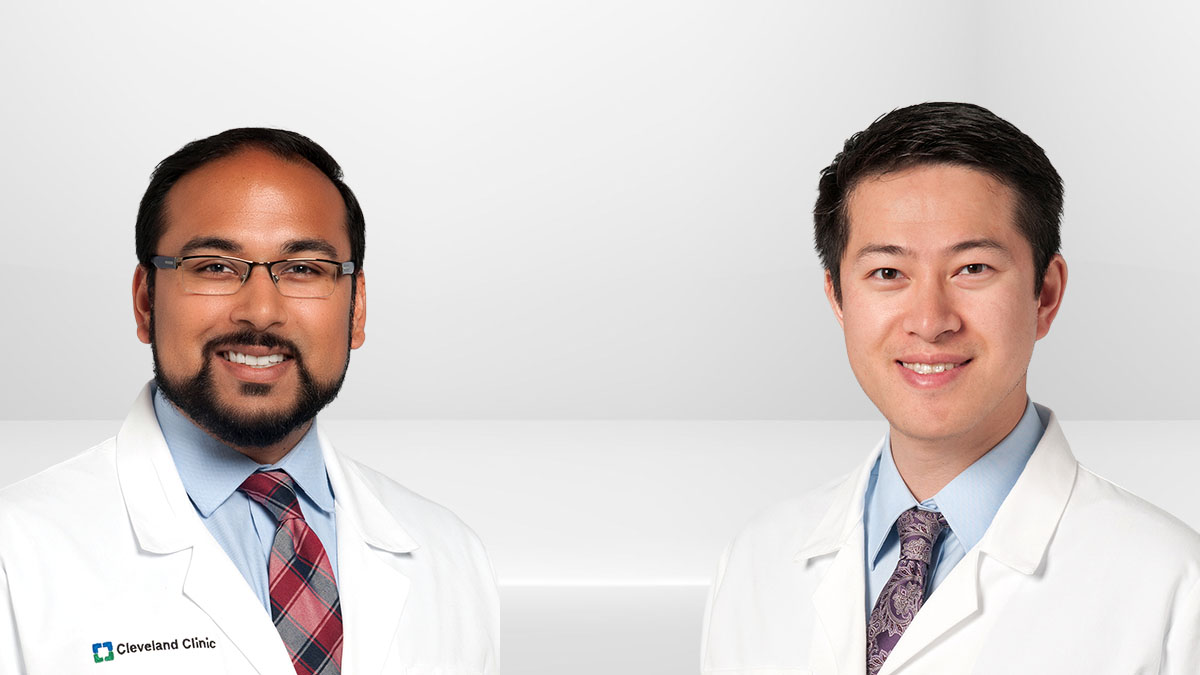
The First Year After Heart Transplant
Michael Zhen-Yu Tong, MD, and Sanjeeb Bhattacharya, MD, discuss what patients can expect during the first year after a heart transplant, including recovery, medications and monitoring for rejection. They explain how lifestyle changes, support systems and follow-up care shape long-term health and quality of life.
Schedule an appointment at Cleveland Clinic by calling 844.868.4339.
Advertisement
Cleveland Clinic is a non-profit academic medical center. Advertising on our site helps support our mission. We do not endorse non-Cleveland Clinic products or services. Policy
Recent Episodes
Robotic Lung Transplantation Explained
Kenneth McCurry, MD, and Gregory Jones, MD, discuss who may need a lung transplant, how patients are evaluated and how transplantation can i…
Recognizing the Warning Signs of Limb Loss
Courtney Hanak, MD, and Ravi Ambani, MD, discuss the most common causes of amputation, including diabetes, poor circulation and severe infec…
Quick Questions: Coronary Artery Bypass Grafting
Gianluca Torregrossa, MD, explains coronary artery bypass grafting, how it compares with stenting and the questions patients should ask when…
Video content: This video is available to watch online.
View video online (https://cdnapisec.kaltura.com/p/2207941/sp/220794100/playManifest/entryId/1_vew7sxiw/flavorId/1_5f3sgelj/format/url/protocol/https/a.mp4)
Transcript
Announcer:
Welcome to Love Your Heart, brought to you by Cleveland Clinic's Sydell and Arnold Miller Family Heart, Vascular & Thoracic Institute. This podcast will explore disease prevention, testing, medical and surgical treatments, new innovations and more. Enjoy.
Advertisement
Cleveland Clinic is a non-profit academic medical center. Advertising on our site helps support our mission. We do not endorse non-Cleveland Clinic products or services. Policy
Dr. Michael Zhen-Yu Tong, MD:
Hi, welcome to our podcast, Love Your Heart. My name is Dr. Michael Tong. I'm the surgical director of our heart transplant and our LVAD program. Today, we're joined by...
Dr. Sanjeeb Bhattacharya, MD:
Dr. Sanjeeb Bhattacharya, the associate medical director for the cardiac transplant program.
Dr. Michael Zhen-Yu Tong, MD:
Terrific. For many of our patients who come and see us with advanced heart failure, often the end goal of this journey is to get to a heart transplant. Sometimes this journey in the evaluation phase alone can take weeks or months, and then the wait time associated with getting a heart can sometimes take months to even years. So, when patients finally get to the point where they get their heart transplant, it feels like, "Finally, we've reached the end of our journey."
Well, in many ways, it's, in fact, the beginning of their journey. It's, in fact, the day of their rebirth, so to speak, and that's what we're going to be talking about today. We're going to be talking about the first year after transplant, why this time is such a critical time for these patients, and how this sets them up for the rest of their lives.
So, Dr. Bhattacharya, tell us a little bit about post-transplant. In the early management of the first year after the first transplant, what are some of the things that we're going to be looking for within the period of time before the patient goes home?
Advertisement
Dr. Sanjeeb Bhattacharya, MD:
Immediately postoperatively is a pretty, I think, stressful time. They go through this big kind of emotional process. They get transplanted, yet the recovery is just beginning. They have chest tubes in place. They have drains in place, monitors, everything like that. I think the first thing that we try to do is to make sure they are recovering from a surgical perspective, which our surgical colleagues and our CT (cardiothoracic) anesthesia colleagues do so well.
From a medical standpoint, it's up to us to start initiating all the medical therapy that we do for cardiac transplantation, including immunosuppression, i.e., antirejection medications, all the prophylaxes, meaning things to help hopefully prevent some opportunistic infections, as well as starting the process to get people educated on the importance of taking their medications, the timing of their medications, and following up. All this stuff is done. It's a lot of information for the patient, especially when they're coming out of such a big, big operation.
Dr. Michael Zhen-Yu Tong, MD:
Yeah. Also, sometimes for our patients, it's a little surprising how long this process can take after the surgery. When they come into surgery, they're often very sick. Sometimes their other organs are failing because their heart's been failing and not pumping enough blood.
When patients come for valve surgery or bypass surgery, often their length of stay is five days. Sometimes when I'm talking to these patients before surgery, I'm telling them, "Well, after surgery, we expect that you're going to be in the hospital for two, three weeks, and maybe even longer depending on how things are going." I think this is one of the things that can surprise them.
Now, you mentioned the medications. Specifically, can you talk a little bit about the dosages of the medications, the types of medications to suppress their immune system, and why not missing any doses is such a critical thing for them?
Dr. Sanjeeb Bhattacharya, MD:
I'll take the last part first, actually. When we talk about how critical it is to take all the medications, it’s because when we talk about rejection or your immune system attacking that donor organ that you just got, the highest risk is within that first year, in terms of the data that we see here at Cleveland Clinic. First six months are critical, first year is critical.
So really, it is important to make sure people really understand what medicines they're taking, why they're taking it, why it's so important, why that schedule we give them for when to take medicines are critical so they keep following it. We want them engaged in the process.
Advertisement
Some of the medicines we use have a lot of side effects, like tacrolimus or Prograf. They might get shakes. They can get hypertension. They can get diabetes, kidney disease, but we understand these side effects, and we know that the benefits of the medication outweigh the side effects.
The one thing that we use a lot, especially in that first year, is prednisone steroids, which have a lot of side effects, including weight gain, high blood pressure, diabetes, and a lot of patients don't really feel well on that until that medicine starts coming down over time. We start at really high doses, but over the year, over the next two years, we start slowly taking down the dose. You'll never be off medications forever. You'll always be on immunosuppression medications, but that regimen changes, and the levels of the medicines we give you go down over time.
Dr. Michael Zhen-Yu Tong, MD:
Yeah. I think it's also important to recognize for our patients that the dosages that we use and the type of medications that we use are specific to them. Not every patient will have the same risk of rejection. It depends on their age. It depends on how many antibodies they have going to surgery.
Also, we're trying to walk a fine balance between not over-suppressing their immune system, and then they risk having infections, because some of these patients, they're in the ICU for a long time. They have infections, sometimes even going into surgery.
Advertisement
So, we really want to strike the right balance. This is why monitoring for evidence of rejection so that we can go up on the medications if there is rejection or come down on the medications when we don't see any rejection, is so important. Let's talk a little bit about that. Tell us why biopsies are so important, and what are some of the newer ways we have today to monitor for rejection?
Dr. Sanjeeb Bhattacharya, MD:
Yeah. I think biopsies are an old, tried-and-true way of taking a look if the body is actually rejecting the heart. We see that on the specimen slides that we send to our pathology colleagues. Based on that, like Dr. Tong was saying, we can adjust up or down the medications for the rejection. Now, as time evolves, I'm glad to see that we have newer kinds of advances. Biopsies are easily done enough. We do them very regularly here with low complication rates. However, it's always good to have a noninvasive approach to taking a look at the heart to make sure it's not rejecting.
We now have an actual kind of blood tests we can do that look for specific genes that are elevated in rejection, and we also can actually understand if there's donor DNA in the bloodstream, signifying damage to the heart. So, if we can fractionate it to your own body, if it's a high percentage, we know that something is going on in the heart. It doesn't tell us what, but it gives us an idea, "Hey, we should start looking for rejection with a biopsy." What this does is it also helps us spread out the amount of biopsies you get, so it's fewer and fewer. So, less pain for the patient to go through. They don't have to go through a procedure all the time.
Advertisement
Dr. Michael Zhen-Yu Tong, MD:
Yup. Many of these rejection episodes are completely silent. Right? Just looking at the patient, just looking at the labs, sometimes we can miss it entirely, and this is why the biopsies are so important. We want to pick up early signs of rejection so we can really treat it early before it starts getting out of control.
Now, when patients do go home, and let's say, God forbid, they do develop a rejection episode, what does that look like for them, and what should they be looking for, and what are some of the signs to tell them that something is happening and they need to contact us?
Dr. Sanjeeb Bhattacharya, MD:
Yeah. I think that's an important point, and the point you made is that sometimes they just feel fine, where nothing is happening. They don't have any issues, no swelling, no shortness of breath, and they come in, and they're so surprised to see that we have a rejection that we actually have to treat with steroids, et cetera.
Some of the other signs that people can get, it can be anywhere from things like maybe a fever that's kind of unexplained. It could be that they're getting shortness of breath. Arrhythmias or abnormal heart rhythms can be another one. All of a sudden, they might feel their heart racing or see when they're taking their vital signs, that their heart rate is higher than normal.
Those can be signs that the body is rejecting. I always tell my patients, "Have a low threshold to call us." We always want to make sure that people are doing well, that they feel comfortable with what's going on, if it's normal or abnormal, and that we have a plan in place if something really is happening that we're worried about rejection.
Dr. Michael Zhen-Yu Tong, MD:
Yeah. I think that really is the key. This is a partnership. We're going to be working together for the rest of your lives, and we're here for you, for our patients. When something is going on, this is new to you. It's not new to us. You may be worried when we're not worried, and you may not be worried when we're worried.
So always err on the side of reaching out and getting some advice. Don't go to Google. Don't go to ChatGPT. Just call us. We're going to be able to give you the right advice that's tailored to you.
Now, rejection aside, let's talk about what else is expected for patients within that first year. They've been waiting a long time, living with heart failure. During that time, their physical capabilities start getting less and less. They go through a major operation. They go through a long recovery period.
What I typically tell patients is that within the first six weeks after surgery, you can't drive during this period of time. Don't lift more than 10 pounds. After six weeks, you can lift up to 25 pounds. After 12 weeks, you are free to gradually regain all your physical activities. The reason for that is really we want the bone to heal.
During surgery, we go through the breastbone. Sometimes patients have already had open-heart surgery in the past or might be opening the chest for a third or fourth time, and it takes time for that bone to heal, and we really don't want the patients to do too much that can compromise the healing. Plus, the steroids that they're on can also slow down the healing.
Now, what do you counsel patients on in terms of when they should start feeling better? When should you start feeling like you felt before you had heart failure? How long does that journey take?
Dr. Sanjeeb Bhattacharya, MD:
I think it's dependent from patient to patient, but I usually tell people to give it six months up to a year until they start saying, “Hey, I'm hitting my stride. I feel like a new person," because they're recovering from surgery. They're getting over some of the medications that are new to them in terms of side effects and things like that. It takes a little bit of time, but I think cardiac rehab has been really important for these patients. Young patients, older patients, it doesn't matter.
Having that ability to show that your exercise, aerobic capacity can build over that 12-week period also gives confidence, because you're doing exercise, and someone's watching you at the same time. I always see a change and a shift before and after cardiac rehab, where people really feel more confident to start doing low-intensity exercise at home, things like that, based on whatever they're dealing with postoperatively.
Dr. Michael Zhen-Yu Tong, MD:
Yeah. The analogy I always give to patients is, it's like you've never trained in your life, and now, all of a sudden, you want to run a marathon. You're not going to get to that step because of sheer willpower. It takes time to train. It takes time to build your body back up. The steroids that you're on slow down that building process. It's going to take even longer than what you may have initially thought about. But typically, I tell them it takes about six months to 12 months before you feel like this is really worth it, and this journey has been worth it, before they reach their full potential.
Now, this journey for patients, they can't do this alone. Even with us, we're here to provide medical care, but once they go back home, this is not something that they can do all by themselves. It's important to have a support system, and this is something that we talk to them about beforehand. Tell us a little bit about, for their caregivers, for patients' caregivers, what are some of their involvements so that they may be prepared for their journey?
Dr. Sanjeeb Bhattacharya, MD:
Yeah. I think caregivers are such an important part, and we harp on that throughout the whole process: pre, at the time of transplant, and post. I think a lot of that is because if you see the information we give patients when they go home, it's a huge binder. That's a lot to have to bear on one person's shoulder.
So, to have someone who's there who knows your medications, can help you sort medications if needed, can help you if you're physically not able to do things, and then to be a support system when you come for procedures and office visits, making sure there's an extra set of ears in the room so people are catching all the nuances in the office visit. It really is important to have that extra set of eyes, ears, hands to really help you through this so you feel like you can be the best you can be, especially in that one-year period, which is so critical.
Dr. Michael Zhen-Yu Tong, MD:
Great. What about dietary changes? What do you recommend for patients? This is something they always ask, or their caregivers always ask, "How should I be eating after transplant?" What do you tell them?
Dr. Sanjeeb Bhattacharya, MD:
Eat their sushi before transplant. We always tell them to avoid any unpasteurized food, whether it's milks or cheeses, some vegetables that are just washed. We want them to avoid all kinds of uncooked meat or seafood. The oysters or the mussels and things like that. They always have to have everything cooked as much as possible, including things like fruit that you wouldn't think are really harmful, but things like grapefruit that actually interact with some of our medications. We tell them not to eat grapefruit, which I haven't had anyone push back on yet. It is a change to go from having whatever you want beforehand to being very particular. The biggest thing we tell people about is buffets or these open lunches where they have trays of food that are out for long periods of time. Over time, that can cause bacterial growth and things that can affect them. We tell them there's a fair amount of restrictions post, but nothing that should prohibit their quality of life.
Dr. Michael Zhen-Yu Tong, MD:
And what about animals and pets? I get asked that all the time. What do you tell them?
Dr. Sanjeeb Bhattacharya, MD:
I tell them in the beginning, especially when they have wounds that are healing, try to keep them away from people. Cats and dogs can always harbor some infections in their mouth and things like that. We try to tell them not to have their pets lick them or sit on them, and especially in the beginning. Then, as they kind of get further and further out, they can get a little more intimate with their pets, as they usually do before transplant. But in the beginning, very critical to have those boundaries.
Dr. Michael Zhen-Yu Tong, MD:
Yeah. This is really just the first year. I don't want our audience to think that they have to give up their pets, but this is really the first year, as your body is healing from the surgery, as we have you on high doses of immunosuppressants. This is where you're the most vulnerable. But as time goes by, your body starts getting more tolerant to the new heart that you have, and we're able to come down on the immune suppression, because your body is just more used to having this organ inside of you. Then, we're going to start dialing down the immune suppressions to a much lower dose, and much of this risk starts to diminish at that point.
Dr. Sanjeeb Bhattacharya, MD:
Yeah. You can never tell people to get rid of pets. I have three dogs.
Dr. Michael Zhen-Yu Tong, MD:
Yeah. As we wrap up here, share with us a final take-home message for patients.
Dr. Sanjeeb Bhattacharya, MD:
I think the big thing that I tell all of my patients is that this is not an easy path, but a worthwhile path. If everything goes well, patient and physicians are aligned, this can be very rewarding in terms of extending life. Not only that, improving really their quality of life, and that's why we really get into heart transplant from a cardiology side, from a surgical side. We can really change people's lives, and that's why we push for this.
Dr. Michael Zhen-Yu Tong, MD:
Yeah. I see patients that we've taken care of five, 10, 15 years ago, and they do great, and you would never know that they had a heart transplant. It's so rewarding, because you remember how sick they were before and how well they're doing now. This is why we do it.
Now, to our audience, thank you very much for listening, and thank you for listening to this podcast. For future patients, this is a journey that we're going to be taking together. This is going to be something that you're never going to be left alone dealing with. We're going to be working together, getting you better so that you can live your best lives ahead. Thank you.
Announcer:
Thank you for listening to Love Your Heart. We hope you enjoyed the podcast. For more information or to schedule an appointment at Cleveland Clinic, please call 844.868.4339. That's 844.868.4339. We welcome your comments and feedback. Please contact us at heart@ccf.org. Like what you heard? Subscribe wherever you get your podcasts, or listen at clevelandclinic.org/loveyourheartpodcast.
Recent Episodes
Robotic Lung Transplantation Explained
Kenneth McCurry, MD, and Gregory Jones, MD, discuss who may need a lung transplant, how patients are evaluated and how transplantation can i…
Recognizing the Warning Signs of Limb Loss
Courtney Hanak, MD, and Ravi Ambani, MD, discuss the most common causes of amputation, including diabetes, poor circulation and severe infec…
Quick Questions: Coronary Artery Bypass Grafting
Gianluca Torregrossa, MD, explains coronary artery bypass grafting, how it compares with stenting and the questions patients should ask when…
Never miss a moment - subscribe now.
Listen to the Health Essentials Podcast on your favorite streaming platform.
Other Podcasts You May Love
Beyond Leadership
Hosts Jim Pae and Elizabeth Pugel escort you through a network of thought leaders, sharing world-cla…
Beyond the Pages: CCJM Podcast
Beyond the Pages: CCJM Podcast takes the listener more in-depth into Cleveland Clinic Journal of Med…
Butts & Guts
A Cleveland Clinic podcast exploring your digestive and surgical health from end to end. You’ll lear…
Cancer Advances
A Cleveland Clinic podcast for medical professionals exploring the latest innovative research and cl…